“I had to remind myself that I belonged”: A Bangladeshi engineer at Microsoft
Anamika’s journey from BRAC University to Microsoft is not a story of overnight success, but of careful decisions, repeated self-questioning and the courage to keep going even when the path felt uncertain
“I had to remind myself that I belonged”: A Bangladeshi engineer at Microsoft
Anamika’s journey from BRAC University to Microsoft is not a story of overnight success, but of careful decisions, repeated self-questioning and the courage to keep going even when the path felt uncertain
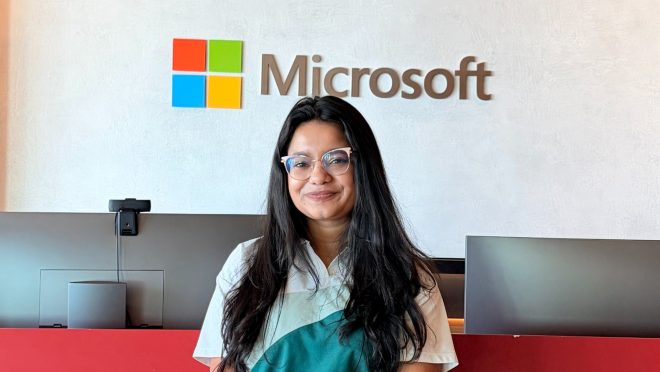
When Anamika Ahmed left Bangladesh after completing her undergraduate degree at BRAC University, there was no fixed destination in mind. What she was looking for was exposure, challenge and proof that the skills she had built in Dhaka classrooms and codebases could stand their ground on a global stage.
Today, as a Senior Software Engineer at Microsoft, Anamika’s career reflects steady ambition and quiet persistence rather than dramatic leaps. Hers is not a story of overnight success, but of careful decisions, repeated self-questioning and the courage to keep going even when the path felt uncertain. It is a journey that mirrors the aspirations of many Bangladeshi students who dream of working internationally, yet quietly wonder if they truly belong there.
Anamika chose Canada for her Master’s degree with a clear intention. “I wanted global exposure, a more industry-connected education, and the opportunity to build an international career,” she says.
After graduating from BRAC University, she felt it was time to step beyond the comfort zone and test herself in a new environment. Canada’s multicultural society and immigrant-friendly policies mattered, but the decision was ultimately about growth: seeing how far she could go when placed in an unfamiliar academic and professional system.
The shift was immediate inside the classroom, and it was impossible to ignore. One of the biggest adjustments, Anamika recalls, was the strong emphasis on self-directed learning and active participation. Lectures were no longer spaces where students quietly absorbed information and waited to be evaluated at the end of the term. Instead, they were dynamic, often uncomfortable environments where curiosity, engagement and initiative were expected.
Students were encouraged to ask questions, to probe deeper, challenge assumptions and explore alternative ways of thinking. Respectful disagreement was welcomed, even valued. Taking ownership of one’s education was not a suggestion; it was a responsibility. Anamika quickly realised that success in this system depended as much on confidence and communication as it did on technical knowledge.
“In Canada, I realised that knowing the answer is not enough,” she says. “Being able to explain your thinking clearly matters just as much.”
She credits Bangladesh with giving her a strong academic foundation and discipline. Canada, however, pushed her to apply that knowledge in practical settings.
Courses were often built around projects, presentations and real-world problems, shifting the focus away from rote learning towards practical application. Instead of simply understanding theory or reproducing it in exams, students were expected to design workable solutions, collaborate with classmates from diverse backgrounds and articulate their ideas with clarity and confidence.
This approach mirrored the realities of the industry far more closely. Teamwork, time management and communication became as important as technical correctness. For Anamika, it was a lesson in how knowledge translates into impact, and how good ideas only truly matter when you can explain them, defend them and build something tangible from them.
On how well Bangladesh prepares students for global careers, Anamika is clear-eyed but firmly optimistic.
“Bangladesh produces very talented, hardworking and resilient students,” she says without hesitation. “The potential is absolutely there.” Years of studying and working both at home and abroad have only strengthened that belief.
What is often missing, she explains, is not ability but access; access to internships, hands-on projects, mentorship and industry-facing environments that allow students to test themselves early. Just as important is confidence: the confidence that comes from seeing people like yourself represented in global spaces, and from knowing that your background does not limit your future.
After completing her Master’s degree, Anamika joined Amazon as a Software Development Engineer, marking her first major step into Canadian big tech. It was a milestone, but one that came after a demanding period of juggling priorities. She was balancing her academic workload, an internship at RBC and rigorous interview preparation all at once.
Her first Amazon interview in 2021 did not go as planned. Rather than allowing that rejection to define her, she treated it as feedback. She prepared again, refined her approach and returned stronger, eventually joining the company in 2022.
“That taught me that rejection is not the end of the story,” she says. “Sometimes it is part of the preparation.” It was a lesson that would shape how she approached challenges throughout her career.
While Amazon gave her a strong technical foundation and exposure to large-scale systems, Anamika felt a growing desire to continue evolving. Microsoft stood out for its engineering depth and the sheer reach of its products.
“Microsoft attracted me because of the scale of its products and the opportunity to work on systems that impact many users worldwide,” she explains. The decision to move was less about leaving something behind and more about stepping into the next phase of her growth as an engineer.
The recruitment process reflected that step up. For a senior role, coding skills alone were not enough. Interviews placed strong emphasis on system design, ownership, communication and judgement.
“At that level, companies want to understand not only whether you can solve a problem,” Anamika says, “but also how you think through trade-offs and handle ambiguity.” It was about mindset as much as mechanics.
Inside Microsoft, she found a work culture that felt collaborative and deeply learning-oriented. People were encouraged to ask questions, exchange ideas and engage in thoughtful, sometimes challenging discussions. For professionals coming from Bangladesh, one of the biggest adjustments, she notes, is communication style.
“In global workplaces, you are expected to speak up and share your perspective, even when you are new,” she says.
That expectation pushed Anamika to grow. She learned to communicate more openly, present her work with clarity and take ownership beyond what was explicitly assigned; skills that became just as critical as technical expertise. Over time, she realised that impact often depends not only on what you build, but on how well you can explain and advocate for it.
Another contrast emerged around work–life balance. Canadian workplaces, Anamika observes, tend to encourage clearer boundaries, flexibility and open conversations about sustainability. In Bangladesh, long hours and intense dedication are common and often worn as a badge of honour. “That dedication is admirable,” she says, “but sustainability is also important.” Longevity, she believes, matters just as much as effort.
Despite the differences, her early career in Bangladesh proved invaluable. Working in environments with limited resources taught her resilience, ownership and adaptability, qualities that continued to serve her well abroad. “When resources are limited, you learn to figure things out and keep moving,” she says. “That mindset helped me a lot in Canada.”
The most challenging period came during the transition after moving abroad. New systems, unfamiliar expectations and a competitive job market brought moments of self-doubt. Even after entering big tech, imposter syndrome lingered. “I suddenly found myself working with people from very strong academic and professional backgrounds,” she recalls, “and I had to remind myself that I belonged in the room.”
With time, that discomfort became a source of strength. Growth, Anamika reflects, often feels uneasy before it becomes rewarding, a feeling she has learned not to fear.
For Bangladeshi students and professionals aiming for global tech firms, her advice remains grounded and practical: think beyond grades. “Focus on projects, hackathons, open-source work, internships and communication skills,” she says. Most importantly, she urges students not to wait for perfect readiness. “Apply, prepare, fail, learn and try again.”
Looking ahead, Anamika hopes to grow into stronger engineering leadership roles while giving back to Bangladeshi students and early-career professionals through mentorship and honest guidance. If she could speak to her younger self today, her message would be simple: trust yourself more. Failure, she believes, is not the opposite of success but part of becoming it.