Meet Kamal Dada and his classroom built on sacrifice
A small, quiet evening school comes alive every day in Dinajpur’s Dharmapur Union village, where dirt roads get dark early. Kamal Chandra Sarkar runs this programme without big funding, a proper school building, or trained teachers. He does everything right from his home, simply wishing to protect the next generation from the hardships he faced when he was young.
Meet Kamal Dada and his classroom built on sacrifice
A small, quiet evening school comes alive every day in Dinajpur’s Dharmapur Union village, where dirt roads get dark early. Kamal Chandra Sarkar runs this programme without big funding, a proper school building, or trained teachers. He does everything right from his home, simply wishing to protect the next generation from the hardships he faced when he was young.
“To put it very simply, I am a poor man myself,” Kamal Dada shares, talking gently about a life spent struggling to make ends meet.
“I receive only 1,500 Taka a month from the government. My family cannot survive on this alone, but I still run the school. Alongside my administrative duties, I work as a day labourer in the fields. In the midst of all this, I open the school in the evening.”
His day begins with daily work in the farming fields to earn enough for daily food, followed by his duties as a Union Ansar Commander. Yet, the moment he returns home, he sets his tiredness aside. A group of thirty children, many from the neighbouring Santal community, gather at his doorstep, ready to learn.
“There are times when I return home from the fields completely exhausted, and the children arrive immediately,” Kamal Dada says softly. “In those moments, there is naturally room for irritation, but we never take it to heart. We never get angry with the children. Even if we suffer, we will not cause pain to them.”
Kamal Dada speaks with moving humility, sharing his deepest personal struggles with rare, gentle honesty. Instead of using his past to look important, he treats it as a way to understand his students with deep, gentle love. He started his pathshala in 2023 because the children’s lives reminded him of his own childhood. Kamal Dada lost his father when he was very young and found his way through education with great difficulty. Both he and his wife managed to pass their Intermediate exams through immense difficulty.
“One day, I looked around and realised that the indigenous and underprivileged children right beside me were completely neglected by society; they couldn’t even go to school,” Kamal Dada explains. “It hit me that if things stayed this way, they would never get to see the light of education. In 2023, out of personal commitment, I started this programme at our home with just five children. The core motivation was my own experience of studying through immense hardship. I thought to myself that no one else should be deprived of education due to financial scarcity like I was.”
Building trust with these families took real patience. The parents are all day labourers who leave early in the morning and do not come back until nine o’clock at night. Knowing how delicate their lives are, Kamal Dada made his home a safe space where the kids can stay, gives them small snacks out of his own pocket, and walks them home safely at night.
“The parents leave for work early in the morning and return around 9:00 PM,” Kamal Dada says. “During those hours, I keep the children safely at my home, and then I personally walk them back to their houses when the parents return. To keep them excited about coming, I arrange snacks from time to time. Knowing their kids are safe has made the parents trust me completely, and that is how I won their hearts. Today, the number of students has grown to 30.”
Because of this daily care, the usual distance between a teacher and a student completely disappeared. The children view him as a loving guardian rather than a strict authority figure. “I look after them and teach them with immense love and care,” Kamal Dada explains, reflecting on how he built that bond. “That is why they call me ‘Kamal Dada’. I have never forced them to call me ‘Sir.’ I tell them that just calling me ‘Dada’ is enough.
This relationship is incredibly important to me because my father passed away when I was very young, and our financial situation was never stable. Remembering those struggles, I felt that these neglected children should not face what I went through. Often, the children get so exhausted after studying that I personally carry them home in my arms. Even though it is physically draining, I don’t view it as a hardship. When they come to study, it makes me feel good.”
The most wonderful part of this modest work is seeing the sweet changes happening right inside his home. Children who could not read a single word at first can now read perfectly.
“In the beginning, the children couldn’t read anything at all, but now they can read very well,” Kamal Dada shares proudly.
For students who had dropped out completely, Kamal Dada stepped in to help. When a young boy without a father decided to stop going to school after Class 5, Kamal Dada became his guardian, gave him gentle encouragement, and paid his fees so he could return to his studies. “I took full responsibility for his studies and had him sit for the SSC examinations this time,” Kamal Dada recalls. “I personally paid for his fees to arrange for his exam. Initially, he told me that he wouldn’t study past Class 5 since he doesn’t have a father. As his guardian, I gave him courage, explained things to him with love, and brought him back to education.”
Kamal Dada always shares the credit with his family, pointing to his wife as the person who first thought of the school. “My family has a massive role in this journey,” he says. “Reality is honestly rather tough. It was actually my wife who first initiated this idea. My family supports me immensely. Often, when I am tied up with work, my wife sits down and teaches the children herself.”
This deep, protective love for his community naturally spills over into everything else Kamal Dada does. When he isn’t teaching or working the fields, his constant care follows the villagers down every path.
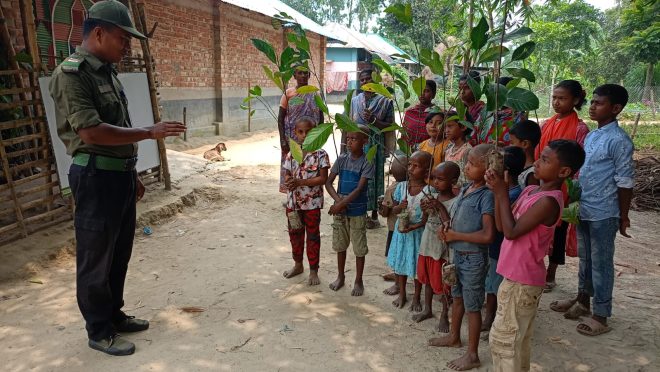
“Alongside running this school, I have undertaken a few other projects,” Kamal Dada notes. “I have planted 200 palm trees on my own initiative to protect against lightning strikes. To prevent child marriage, I go from village to village to speak with people. I also perform duties on the border and speak out against drug addiction. This World Environment Day, I gifted two tree saplings to every single child.”
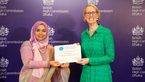
Though he never asked for anything, his hard work eventually caught national attention. On 20 May, Kamal Dada went to the Dhaka Academy, where the Prime Minister honoured him with a state award. Yet, this recognition has not changed how much he cares about his community, nor has it shifted the self-funded, grounded reality of his daily mission.
“Regarding this initiative, on 20 May, our Prime Minister Tarique Rahman honoured me with a national award at the Dhaka Academy,” Kamal Dada notes. “I never imagined that I would be honoured like this. Everyone around me is overjoyed. I have never asked anyone for help; I organise everything out of my own pocket. We are day labourers who live hand-to-mouth; there is no one out there to truly listen to our words. Until now, no one has come to stand by our side. I haven’t expected it either, nor have I asked anyone for help. I am only sharing these words with you.”
When Kamal Dada looks at the children practising their lessons on his floor, many of whom come from families that struggle to get three meals a day, he sees future doctors, teachers, and global travellers rather than the limits of poverty.
“If anyone were to stand by these children, it would be wonderful because these people are highly impoverished,” Kamal Dada says softly. “Some have mothers but no fathers, others have fathers but no mothers; they don’t even have the means to manage three square meals a day. I want to take them far ahead in life through education alone.
My ultimate dream is to take these children very high in life through this Pathshala. Perhaps many children will become doctors or teachers, and travel at home and abroad. I want them to move far ahead from here so they can spread the light of education in all directions.”
He wants nothing for himself: no money, no returns, and no praise at all. His only hope is that one day, when these children grow up and reach their goals, they will remember the small home in the village and the teacher who loved them.
“My dream is that from this very place, children will become doctors or teachers and go abroad, and, moving far ahead from here, they will say, ‘I have made it this far, and it is all thanks to Kamal Dada’s contribution,'” he says, finishing with deep conviction. “I have no other demands from life.”