One move away: Fahad Rahman's journey to becoming a Grandmaster
One move away: Fahad Rahman's journey to becoming a Grandmaster
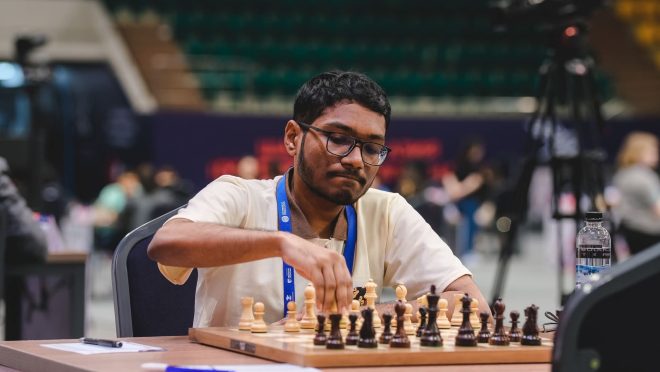
“I was born in 2003 and grew up in a rural area. As a kid, I actually loved the idea of playing football or cricket, but since my family was new to the area, the locals wouldn’t let us join their matches. That ultimately pushed me towards indoor activities and set the stage for my journey.”
What could have been an early social setback became the start of an exceptional chess career. But it was not curiosity alone that transformed him into a competitive player. His father initially played a vital role in igniting his interest. “He saw the news that Viswanathan Anand had just won the 2007 World Chess Championship. That inspired him to change his mind and bring home a physical chessboard instead of ludo.”
From there, chess began to take shape not as a pastime but as a passion.
His early competitive breakthrough came soon after. In the 2008 National Shishu Academy Chess Competition, he rose through local and regional stages to become the national champion. “It was an incredible feeling and the official start of my serious chess career.” But what makes Fahad Rahman’s journey particularly compelling is not just his early success. It is the way he interprets chess itself.
For him, the game is not confined to 64 squares but is more like a system of logic.
“In Bangladesh, a lot of people think chess is just a simple board game. But an interesting perspective is that it operates a lot like a data structure in Computer Science. It massively helps with memory, logical structuring, and overall learning in ways that are highly applicable to academics and real-world problem-solving.” That framing is central to how he understands both education and life. Fahad further adds, “Just like in my daily life, chess requires you to evaluate variables, make the best out of your available resources, and constantly adapt to complex challenges.”
Fahad has already earned the FIDE Master and International Master titles, alongside two Grandmaster norms. “Chess is incredibly draining mentally. There are times when players lose their form completely and suddenly feel like they are playing like beginners,” says Fahad.
I asked Fahad to describe his playing style and tactics for our readers. “Right now, my style is highly focused and aggressive, and it has changed over time. At the higher levels, you can’t just wait around for your opponent to make a strategic mistake; you have to actively create complex positions, attack, and force the issue.” His choice of opening reflects this tactic. “Currently, my main weapon is White e4.”
The aim is not neutrality, but control.
Fahad further shares, “I like steering the game into structures where I feel completely in control and can execute my overall game plan from start to finish.” Inspiration for this approach comes from two of chess’s most influential figures: Magnus Carlsen and Bobby Fischer. He speaks of Fischer with particular intensity. “I have profound respect for Fischer’s relentless drive and clarity on the board; in fact, I’ve studied and completed his book, My 60 Memorable Games, many times.”
This blend of discipline and adaptability has shaped his competitive identity.
One of his defining international performances came in 2024 at the Dubai Global Chess Challenge, where he secured his first Grandmaster norm. “During that event, I managed to draw games against top-tier players like Hans Niemann and Yu Yangyi. Holding my own against players of that calibre was incredibly special and proved to me that I belong at that level.” Yet, for Fahad Rahman, achievement is not measured in isolated results. It is measured in sustainability. “A truly great player manages to sustain that high level, bounce back from bad games, and avoid dropping their form over long periods.”
It is mostly hard work.
Fahad, being one of the top chess players in Bangladesh, has also shared his perspective on the structural reality of chess in Bangladesh. He is candid about the lack of support and sponsorship and the broader failure to position chess as a professional ecosystem. “There is very little sponsorship for chess in Bangladesh right now.” And he is equally clear about what needs to change. “If we can change that ‘fundraiser’ mentality into a professional sports marketing approach, the whole ecosystem will thrive.”
But his broader message to young players is the one that lingers beyond ratings and norms. He states, “Don’t view chess as just a pastime. Embrace it. It will enhance your memory, sharpen your logical thinking, much like learning complex data structures, and help you immensely in your academics and future career.”
Fahad Rahman’s story is still in progress until, soon, he becomes a Grandmaster.