Software engineer at Amazon by day, the Bangladeshi girl on your feed by night
There is a particular kind of magic in the moment when you realise you can make something appear on a screen just by typing.
Software engineer at Amazon by day, the Bangladeshi girl on your feed by night
There is a particular kind of magic in the moment when you realise you can make something appear on a screen just by typing.
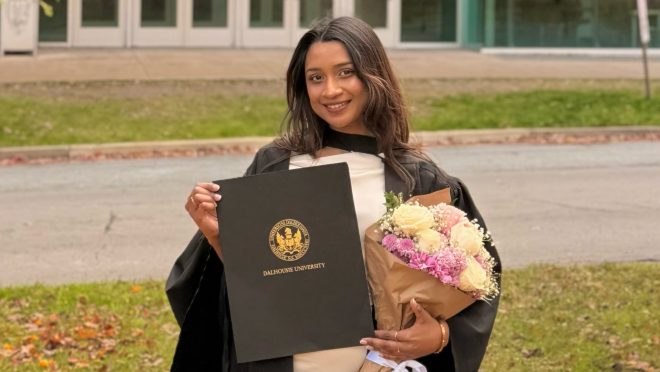
For Fariha Zerin Rabita, that moment came on her brother’s old PC, which had been passed down to her. She was just a curious girl poking around with HTML and CSS, watching words become shapes and shapes become pages.
That’s where computers had her hooked.
When Rabita left Bangladesh in 2021, she didn’t know where the path would lead. Five years into life in Canada, she has worked in fifteen on-campus roles, completed three co-op placements across three completely different industries, and now works as a Software Development Engineer at Amazon in Toronto.
Backstory
Her mother was strict about education.
“My mum always pushed me to study hard and do well in class,” she says. “At the time, it felt like a lot of pressure, but looking back, I think it built a lot of discipline in me.”
That discipline certainly helped her. She was drawn to maths and problem-solving from an early age. But computers came into her life through that inherited PC, through games, and through the small thrill of exploring how things worked. Eventually, she discovered HTML and CSS.
“I still remember how amazed I felt when I realised I could write a few lines of code and something would show up on a screen,” she recalls. “It felt like magic.”
Like most students in Bangladesh, BUET was the goal, and engineering was the path.
Then COVID happened.
She was from the HSC 2020 batch. Exams were postponed. Uncertainty stretched on for months. During that strange, suspended period, her brother, who was already living in Canada, asked her why she was only considering the usual path.
“At first, I thought it was impossible,” she says. “I came from a middle-class family, and in my mind, studying abroad meant spending a huge amount of money that we simply did not have.”
But she started researching. Her parents honestly told her what they could afford each year, and she narrowed her options around that figure. She worked on her applications, applied to universities in both Canada and the United States, and eventually received scholarships from both.
Dalhousie stood out. The scholarship amount, the co-op opportunities, and the overall fit. She received the Seymour Schulich Scholarship, valued at $44,400 over four years. It did not cover everything, but it made the difference between possible and impossible.
“Without that support, the financial pressure on my family would have been much heavier,” she says.
Her biggest fear, walking onto that plane, was not the logistics. It was not knowing whether she could survive on her own in a new country.
“I was leaving behind my family, my comfort zone, and everything familiar.”
Survival mode, and what it taught her
The early months in Canada were an education in a different sense. Rabita started working part-time at a stadium to help cover her costs. For a while, it seemed manageable. Then she understood what survival mode actually costs.
“The work took so much mental and physical energy that, by the time I came home, I barely had anything left to study, focus, or think about what was next.”
That exhaustion became a turning point. If she was going to work this hard anyway, she needed the work to give her more than a pay cheque. She started looking for roles that would build her, instead of just sustaining her.
Over four years, she held fifteen different on-campus positions: Residence Assistant, Head Teaching Assistant for Intro to Computer Systems, leading labs of more than 150 students across four consecutive semesters, Faculty Ambassador, Co-op Ambassador, BIPOC Mentoring Academy, IT Services, and many more.
“Some roles helped me become more confident with people,” she explains. “Some helped me learn how to lead. Some helped me communicate better, manage responsibility, or understand how the university worked beyond the classroom.”
She chose not to simply say yes to everything. She made sure she was being deliberate. Every role she accepted either closed a gap or opened a door.
“The strategy was to find jobs that would help me support myself, but also help me grow into someone who was more skilled, more connected, and more prepared for the future I wanted.”
Three industries, three co-ops, one clarity
Co-op is one of the most distinctive features of studying computer science in Canada. Students alternate academic terms with paid work placements, building real industry experience before graduation. For Rabita, it became the mechanism through which she tested everything.
Her first placement was at Munich Re in Toronto, one of the world’s largest reinsurance companies, as a Global IT Intern. She had no Canadian industry experience at the time. She applied to at least a hundred companies. She kept revising her CV, her cover letters, and her interview answers, treating each rejection as a small correction.
“Getting that role felt huge because it was my first real corporate experience in Canada,” she says.
Toronto itself felt enormous compared to Halifax. It was faster, louder, and full of possibility.
Her second placement took her somewhere entirely different: Ubisoft Halifax, where she worked as a Junior Programmer. For someone who had first fallen in love with computers through games, it felt as though the circle had completed itself.
She contributed to a prototype for an unreleased game and worked on Assassin’s Creed-related projects during her time there. It was creative, collaborative, and genuinely exciting. It also gave her something equally valuable: clarity.
“I realised that while game development is exciting, it was not the path I wanted long term. That clarity was valuable too.”
Her third and final co-op was at Arctic Wolf, a cybersecurity company, where she worked on backend development in a security-focused environment. The problem she inherited was an older automated report-generation system with serious latency issues. It was taking around 24 hours to produce security reports, which is a long time when the information being reported is time-sensitive.
She helped build and deploy a new microservice called the Risk Analysis Publisher. In simple terms, it pulled data from databases, transformed it into structured reports, validated them, and sent them forward through an API. The result was that report-generation time dropped from roughly 24 hours to around three hours, an improvement of more than 85%.
“I got to work on backend development in a real cybersecurity environment, and I got to make something meaningfully faster.”
Amazon and the interview she refused to wait to feel ready for
Amazon was always one of her dream companies. The opportunity arrived just two months before graduation.
During her final semester in Summer 2025, she was actively applying for new graduate roles through LinkedIn and company career websites. She knew that big tech job postings often received more than 100 to 200 applications within the first couple of hours, so she made it a habit to regularly check for new openings and apply as early as possible.
For Amazon specifically, she applied directly through the company’s website. One thing she was very intentional about was not using a generic application for every company. For Amazon, she made sure her cover letter was tailored to the company and aligned with Amazon’s Leadership Principles. She also focused on making her CV impact-oriented, not just listing what she had worked on, but clearly showing what had changed or improved because of her work.
“I do not think I ever felt completely ready,” she says. “But once I got the interview, I decided I would give it everything.”
The process began with an online application. After her CV was shortlisted, she sat a three-hour live online assessment where she had to solve two coding questions under a tight time limit, followed by a behavioural section. After that, she was invited to the Loop: three back-to-back interview rounds, each lasting an hour.
The first two rounds were technical. Coding problems, thought processes, edge cases, and time and space complexity. The questions were not just about getting the right answer. They were about how she thought, how she communicated, and how she handled the space between knowing and not knowing.
The third round focused on Amazon’s Leadership Principles. Past experiences. How she had handled challenges, ownership, ambiguity, decision-making, and impact. Two principles felt most natural to her: Bias for Action and Ownership.
“If I see an opportunity or a problem, I usually want to jump in and figure it out,” she says. “I think those have always been part of how I work.”
From the first application to the final offer, the whole process took around two months. She graduated in October 2025. She started at Amazon in September 2025, even before her graduation.
What an actual day in her life looks like
She badges in. Checks Slack and email. Sees if anything needs immediate attention. Then it is code, reviews, stand-up meetings, syncs with product managers, one-on-ones with her manager, system design discussions, testing, debugging. Sprint planning once a week. Lunch and coffee somewhere in between.
And sometimes, at 4 a.m., a page.
“When I go on call, I can get paged at any time, sometimes even at 4 a.m., when I need to acknowledge an issue within 15 minutes before it escalates to the management chain,” she says. “That is not the aesthetic part of the job, but it is part of the reality.”
She is aware that her content, the day-in-the-life reels, the Instagram posts, the carefully lit glimpses of Toronto life, shows more of the highs than the lows.
“Some people see my videos and think my job must be stress-free because the content looks nice. That is not true. There are stressful days at work. There are deadlines, pressure to deliver, competitive environments, and moments when I feel burnt out.”
But she is equally clear about something else.
“I love my job more than I hate the hard parts, and that is why I keep going.”
For the students watching from Dhaka
She started making content because she enjoyed it. Day-in-the-life videos as an international student. Then an Amazon video, made for fun, reached more people than she had expected. Then came something she had not anticipated: Bangladeshi women reaching out. Some said they felt proud. Some asked for advice. Some said her content made them believe they could dream bigger.
“That meant a lot,” she says.
The negative comments exist too. She tries not to give them too much power. She knows she is simply sharing everything she has learned with anyone who is still figuring things out.
She also shares a valuable piece of advice.
“Do not wait until your final year to start becoming employable. Start now, even if it feels small.”
Build something real, not just grades. Think globally early. Learn to tell the story of what you have built, what you have faced, and what you have learned. Go to networking events, hackathons, and career fairs. Message people on LinkedIn. Ask for feedback. Put yourself in rooms where opportunities can find you.
And when you get the interview for the company you have always dreamed of, even if you do not feel ready, go in anyway. Give it everything.
Rabita did.
The girl who left Bangladesh in 2021 just trying to survive would hardly recognise where she ended up today.
All because she tried anyway.