Tasmayati Emma Ali: Pulling the trigger without fear
In Bangladesh, athletes are often defined by their discipline and dedication to the sport. Tasmayati Emma Ali has both, along with a story that goes well beyond the range.
Tasmayati Emma Ali: Pulling the trigger without fear
In Bangladesh, athletes are often defined by their discipline and dedication to the sport. Tasmayati Emma Ali has both, along with a story that goes well beyond the range.
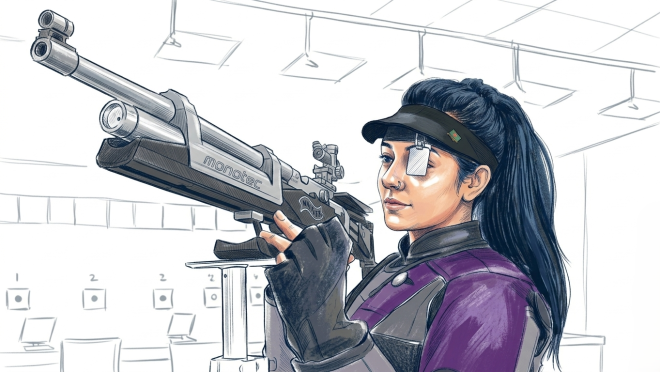
Emma is a national-level shooter whose journey combines competitive performance with a distinct personal identity. From earning medals to breaking stereotypes, her path reflects both commitment and individuality.
To learn more about what it takes to perform at the highest level in an unconventional sport, I reached out to Emma.
Finding the sport
Tasmayati Emma Ali was born and raised in Dhaka in 2000. She grew up in a joint family of eight, a childhood she describes as fun and grounded. She calls her mother her greatest source of strength. With that support, Emma explored a range of interests, including dancing and shooting.
She also shared that one of her grandparents was an international hockey player, while another was a freedom fighter, reflecting a family history of discipline and service.
Emma joined Rajdhani Shooting Club in 2017 as a general member. It was in 2021 that she fully committed to the sport, without a clear expectation of where it might lead. She earned her first medal that same year, eventually securing a place in the national camp.
When the call came for international training, she had just enrolled at Independent University of Bangladesh (IUB). She left. “I prioritised my dream,” she says, which was to compete in international shooting championships.
As of now, she is studying fashion designing and interior designing at a private institute and plans to pursue further studies abroad after the Olympics. She is unhurried about it. “I believe there is no time limit for me.”
Training and discipline
Shooting demands a particular kind of internal discipline, where everything has to align from mental state to physical movement.
In the seconds before a shot, Emma describes herself as an emotional person who has had to work hard to build that stillness. Meditation helped. So did her coach’s instruction: “Just think this is a perfect one and pull the trigger without fear.”
Emma walked into the national camp with coloured hair. The bullying from teammates started quickly. She did not change. She said, “I got bullied but I couldn’t care less. Because my lifestyle is absolutely different from others and this is what makes me, ME, and being myself doesn’t affect my performance.”
The institutional challenges ran deeper than social pressure. Emma’s first international was supposed to be at the Asian Cup Championship in China, but nepotism stood in the way. She competed in the selection trial anyway, won it in front of the federation’s then-president, and proved she was the rightful choice. She believes if favouritism did not exist, this position would have been hers. She considers that win in the trial her real victory.
Then came August 2024. After the political transition, she was removed from the national team. According to Emma, her scores were at their peak, so performance was not the reason.
She went to the interim joint secretary to speak about the safety of women athletes. His response was hostile. That same official was in the news around the same time on harassment-related matters.
She was also dropped from consideration for tournaments in two countries during this period. Her response was not to appeal or protest further. She returned to the range and started beating her own previous scores, one competition at a time.
Funding has been another ongoing obstacle. Shooting is an expensive sport, and Emma has financed her training and equipment independently throughout. Her shooting jacket has a durability of six to seven years. “It’s not possible for me to change or to get a new one with my own funds,” she says. Sponsorship would help. She is still looking.
Beyond the range
Outside the shooting range, Emma is, by her own description, a “chilled” person. She reads, listens to music, and dances. And there is Arslan, her pet horse, whom she rides, showers, and feeds carrots and apples. She is currently learning horseback archery. She believes she may be the first female athlete in Bangladesh to own a horse.
Emma is direct about what the sporting ecosystem needs. Female athletes, she says, are not heard enough. “There should be a department in every federation where female athletes will go and discuss their hardships throughout the journey, sort of counselling department, and they will also take the complaints and look after it in depth.”
On visibility, she extends the point beyond gender. “International achievers don’t get enough visibility like cricketers do. I would want that change for every discipline.”
Emma’s immediate focus is the upcoming international tournaments. The longer target is an Olympic gold medal for Bangladesh. She talks about it the way someone talks about a plan. “As an athlete I am still chasing to achieve an Olympic gold medal for Bangladesh. I wish to create history with a shot and make Bangladesh proud. Because when I will be carrying our national flag with me, I will no longer be Tasmayati Emma but I will be recognised as Bangladesh.”
There is no tidy lesson in Emma’s story. There is just a woman who kept showing up — to a sport that did not always want her, a system that actively worked against her, and a range where, in the end, only the score matters.