Can football become a way out of poverty for Mirpur’s children?
In Mirpur, 1,100 children have been given more than football training. The two-year programme is trying to teach them discipline, empathy and the game itself — but without a lasting scouting and development system, what happens to the talent they uncover?
Can football become a way out of poverty for Mirpur’s children?
In Mirpur, 1,100 children have been given more than football training. The two-year programme is trying to teach them discipline, empathy and the game itself — but without a lasting scouting and development system, what happens to the talent they uncover?
For Wahid Hasan, football has always been more than just a sport.
The 14-year-old, a tenth-grader at Pallabi Majedul Islam Model School, is happiest when he is on the field. A member of his school’s football club, he rarely turns down a chance to play.
So when sports teacher Imrul Hasan posted a notice in the club’s WhatsApp group last year about an athletic camp and tournament organised by Obhizatrik Foundation, Wahid and his teammates immediately registered.
What followed was a month of training that changed the way Wahid looked at the game.
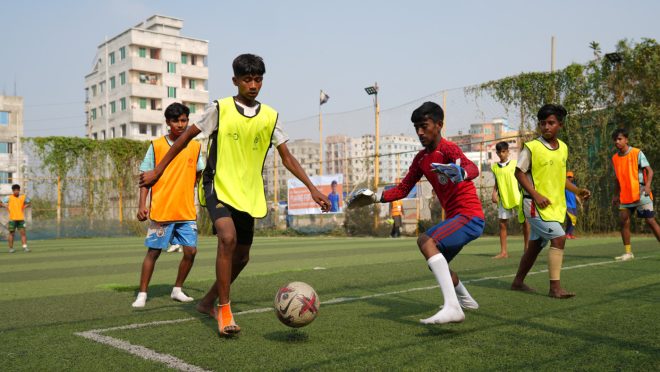
The camp combined classroom lessons with practical sessions, led by four certified coaches from the foundation. The participants began with the basics: the history of football, its rules and regulations, how to break an offside trap, defend without fouling, and maintain shape in different formations.
Then came the work on the field.
They learned how to deliver different kinds of crosses, create assists, pass effectively and finish chances. They were also taught what to do when a match stopped going their way: how to remain focused, recover after conceding and keep fighting.
Football, however, was only part of the curriculum.
The players were encouraged to improve their eating habits, choose vegetables and nutritious food over junk food and understand the connection between diet and fitness.
What they learned in the classroom was then applied on the field, where the coaches worked with them on the techniques. Toward the end of the camp, the training moved beyond physical skills and into analysis.
Matches from some of Europe’s biggest leagues — the Spanish La Liga, the English Premier League and Germany’s Bundesliga — were screened on a large projector. The young players were asked to watch closely, identify good decisions and understand the mistakes behind poor ones.
For Wahid, those sessions were the most memorable part.
He was learning to see football not simply as a game played in front of him, but as a series of decisions.
“During the tournament, we played in a 4-3-3 formation, something we had never done before,” Wahid said. “I benefited a lot from the sports camp. So when registration opened again this time, I didn’t hesitate to sign up.”
At the end of October, his team won the tournament. Wahid was named the Best Left Wing of the school club team.
“Brazil has a dozen projects running under this programme. There are many more in India, as well as in different parts of Africa. Yet Bangladesh had none — even though football is loved by the majority of people here.” Minhaj Uddin Shibli, Deputy Manager (Partnership and Grants), Obhizatrik
From defence to the goal
For another participant, the camp changed her position on the field altogether.
Ifa Akter Mim, an eighth-grade student at Obhizatrik School in Mirpur 11½, was interested when she first heard about the programme.
The eldest of four siblings, Mim was less certain about whether she would be allowed to participate. Eventually, her school’s sports teacher spoke to her father and secured his consent.
During the first few days of training, the coach encouraged Mim to play in defence. It did not take long to discover that her strengths lay elsewhere.
She began playing in goal, was eventually selected as her school team’s goalkeeper and represented the team in the senior female category of the tournament.
Her team won the title.
For children like Wahid and Mim, being given access to structured coaching, competition and a proper sporting environment can make the difference between simply enjoying football and beginning to imagine where it might take them.
That is the larger ambition behind Obhizatrik Foundation’s football programme.
More than learning the game
Meheraj Hossain Chowdhury, one of the camp’s coaches, said the programme was designed to give children a basic but meaningful foundation in football.
“We shared the basic knowledge of the game with them — things like passing, positioning and recovery runs,” he said. “In a short-term course, there is only so much knowledge we can cover.”
Most of the participants came from disadvantaged families. Many have limited free time because they also contribute to their families’ livelihoods.
Yet, according to Meheraj, the camps revealed plenty of young people who were deeply interested in football — and some who appeared to have genuine ability.
That is where the project’s larger question begins.
Talent is not particularly rare. What is rare is the system that identifies it, develops it and keeps it moving forward.
Obhizatrik Foundation, a non-profit, launched a two-year project titled “Playing for Peace: Empowering Dreams Through Soccer”, through which the FIFA Foundation’s community programme is being implemented in Bangladesh for the first time.
The premise is straightforward: football can be a means of bringing children together, building confidence and teaching values that extend beyond sport.
The FIFA Foundation’s community programme is active in 57 countries. Bangladesh’s inclusion in that network comes at a time when football remains one of the country’s most accessible forms of recreation.
“Brazil has a dozen projects running under this programme. There are many more in India, as well as in different parts of Africa. Yet Bangladesh had none—even though football is loved by the majority of people here,” said Minhaj Uddin Shibli, Deputy Manager (Partnership and Grants) at Obhizatrik.
“For a large share of the country’s children, football is their main form of recreation.”
Its simplicity is part of its appeal.
“One of the great advantages of football is that it requires just one ball,” Shibli said. “And even if you don’t have a ball, you can improvise — roll up a piece of paper into a ball and start playing.”

The camp combined classroom lessons with practical sessions, led by four certified coaches from the foundation.
1,100 children, one field at a time
The project selected Mirpur as its operational area and brought 1,100 children between the ages of 10 and 18 into its training programme.
The organisers reached students through schools across Mirpur, with sports teachers helping encourage participation. Particular attention was given to low-income communities in Duaripara and Eastern Housing, where access to organised sporting opportunities can be limited.
The registration process remained open to everyone.
“Most of the outreach happened through word of mouth, and it did not take us long to reach the required number of participants,” Shibli said.
School classrooms and playgrounds were used for the camps. For children who do not attend school, Obhizatrik School in Pallabi was also used as a venue, along with playgrounds in nearby Eastern Housing.
The organisers also sought to make the programme more inclusive. They wanted girls to account for at least 40% of participants and encouraged children with intellectual disabilities to take part.
The idea was not simply to assemble children who were already good at football.
“We wanted to create opportunities for everyone, from middle-income families to those living in poverty,” Shibli said.
When children from different backgrounds occupy the same field, the differences that usually separate them become less important.
“Sport is often said to build friendship and harmony,” he said.
The tournament selection process reflected that philosophy.
Footballing ability mattered, but it was not the only criterion. Leadership, teamwork and compassion were considered as well.
Shibli gave an example, “Suppose someone from the opposing team is lying on the field, injured and in pain. If you simply walk past without offering a helping hand, that would be inhumane.”
The camp, he said, was intended to nurture that instinct to help.
The same was true of teamwork.
“It is a quality that helps free a person from selfishness and teaches them to think beyond themselves.”
What happens beyond the field?
The training team included not only football coaches but also a strategic planner and a nutritionist.
The strategic planner worked with the participants on the idea that sportsmanship does not have to end when the match does.
Wahid put the principle simply: respect the opponent, follow the rules and accept victory and defeat with grace.
The theory is easier to understand when it is practised repeatedly.
Shibli believes that when sportsmanship becomes habitual on the field, it becomes easier to carry those values into ordinary life.
“Our aim was to have the players spend all their free time outside class at the camp,” he said. “We believe this would help them develop a positive outlook and keep negativity at bay.”
But there is an obvious limitation.
The project is designed to run for only two years.
Shibli worries that the timeframe is too short to achieve what the programme ultimately hopes to accomplish.
“It is unfortunate that the project is only for two years,” he said. “Reaching our intended goals within such a limited period will be difficult.”
The organisation is trying to extend it.
Whether that happens will matter because the project has already begun to reveal another problem: getting children into football is one thing; creating a route for them to continue is another.
The missing link
The project is now in its second year.
During the first year, six age-group tournaments were organised, with children divided according to age. Many of those who participated previously have registered again.
Some, however, are missing.
Shibli suspects that some families have moved away. In underserved communities, where many residents are migrant or transient workers, relocation is often dictated by employment and the demands of survival.
The project also faces a more basic problem: space.
Mirpur has no shortage of children who want to play football. It has a shortage of fields on which they can do so.
Even regular training sessions and matches often require rented grounds.
Expanding the programme geographically would require more funding. Sustaining it in its existing area already requires negotiating a city where open playing space is increasingly scarce.
And then there is the question of what happens to the talented children after the camp ends.
That is where Bangladesh’s lack of a systematic scouting structure becomes difficult to ignore.

Football can be a means of bringing children together, building confidence and teaching values that extend beyond sport. Photos: Courtesy
When Lamine and Nico become examples
Professional football in many countries has a system for finding young talent. Scouts watch children play, identify potential and connect promising players to clubs and academies where they can develop.
Bangladesh has no comparable system that operates consistently across the country.
Shibli believes a sustained scouting structure could uncover a significant pool of talent among children who currently have little access to organised football.
More importantly, it could give them something beyond the possibility of becoming professional footballers: a reason to believe that their circumstances do not necessarily determine their future.
Meheraj sees the same gap from the perspective of a coach.
“Football clubs in our country lack consistency. We cannot even be sure whether there will be a league next year,” he said.
In other countries, clubs invest in young players once scouts identify them.
“When they spot someone with talent, they invest in that player. That is how good footballers are being developed there. For many, football has become a way out of poverty.”
He points to Spain’s Lamine Yamal and Nico Williams as examples.
Their stories are different, but both emerged from immigrant and working-class backgrounds before reaching the highest levels of European football.
Nico’s parents left Ghana for Europe in search of a better life. Their journey included a perilous crossing of the Sahara. Nico later spoke about the risks his parents took so that he and his brother, Iñaki Williams, could have greater opportunities. Iñaki would also become a professional footballer.
For Meheraj, Nico represents more than sporting success.
“Nico values everything connected to football immensely,” he said. “And beyond that, he is a very good person.”
Yamal’s family has Moroccan roots. His father moved to Spain when Yamal was three, while his grandmother had arrived earlier. The family settled in Rocafonda, a working-class neighbourhood where immigrants make up a significant part of the community.
Yamal trained at a local sports centre alongside children and teenagers between the ages of seven and 18.
He stood out.
Scouts noticed him. A trial at Barcelona followed, then entry into La Masia, the club’s famed academy, where his accommodation, meals and education were provided.
His former coach, Iván Carrasco, remembers something that went beyond technical ability.
“I saw a boy who was generous and never chased recognition,” Carrasco said. “Yamal is not selfish at all.”
That quality matters because talent alone rarely carries a player all the way.
Someone has to recognise it. Someone has to invest in it. And someone has to create a pathway for it to survive.
A pathway, not just a tournament
That is ultimately the test facing Obhizatrik’s football project.
The camps can teach children how to position themselves, pass the ball, recover after losing possession and understand a match. They can teach them to eat better, work together and respect opponents.
They can even show them how football looks when viewed analytically, rather than simply from the perspective of the player chasing the ball.
But a two-year project cannot, by itself, create a football ecosystem.
For that, the project needs the country’s football institutions.
Meheraj believes the Bangladesh Football Federation and domestic clubs must become part of the process if the programme is to have a lasting impact.
“Talented players from disadvantaged families emerge not only in Latin America, Europe and Africa, but in many parts of Asia as well,” he said.
“This project will succeed if it can get the Bangladesh Football Federation and football clubs on board. We need to create a continuous pathway so that the boys and girls who develop here can eventually make their way into national-level leagues.”
That pathway is still missing.
For now, however, there are children in Mirpur learning to see the game differently.
Wahid is learning what a 4-3-3 can do.
Mim has discovered that she belongs between the posts.
Others are learning when to pass, when to recover, how to defend without fouling—and, perhaps just as importantly, when to stop and help an opponent back to his feet.
The field may not promise a professional career.
But for a child with talent and few opportunities, being given a place to play, a coach to teach, a team to belong to and someone willing to notice can be the beginning of something.
The harder question is whether Bangladesh can build what comes next.