Jogmaya Malo and the country that forgot her
What constitutes a hero? Is it someone wearing a cape, fighting for justice? If that is so, he or she might need superhuman strength or supernatural abilities.
Jogmaya Malo and the country that forgot her
What constitutes a hero? Is it someone wearing a cape, fighting for justice? If that is so, he or she might need superhuman strength or supernatural abilities.
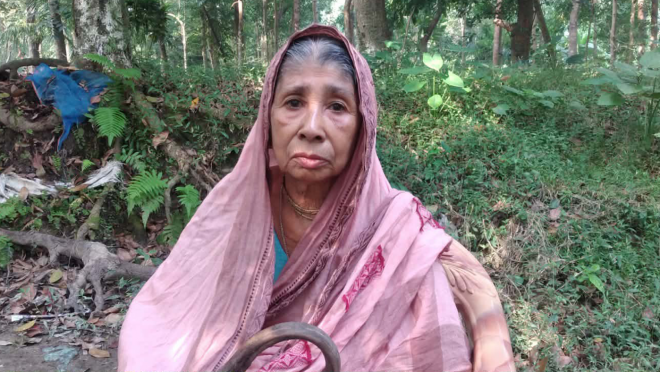
Unfortunately, as Bangladeshis, we know people who resemble such traits, but we fail to recognise their sacrifices for their nation, leading us to become apathetic and unapologetically ungrateful, only recognising their existence on the eve of their death.
On 5 January 2026, Birangana Jogmaya Malo died in Shariatpur at the age of 69. As Bangladesh mourns her passing and before we move on to the latest fad, it is important to share what she actually endured and why we, as a country, failed to honour her throughout her life, when it actually mattered the most.
Jogmaya Malo: Sacrifices during and after 1971
Jogmaya Malo was 15 years old in May 1971 when Pakistani forces and their local collaborators attacked her village. Members of her family were killed, and she was forcibly taken to a military-controlled site, where she was subjected to prolonged sexual violence and physical torture.
The hardships she went through in 1971 could be attributed to the time of war and the genocide committed by the Pak army, however, the sheer disappointment of how we, the free and sovereign nation, treated her cannot be condemned well enough in written language.
For almost 54 years, she lived without a permanent home, often moving between temporary shelters and rented tin-roofed structures. To which she quoted in an interview, “I sometimes fail to give my due rent.”
Throughout these five decades, she lived amongst us without any official assistance. In 1972, the independent government of Bangladesh had set up rehabilitation centres for Biranganas, which undertook voluntary abortion, put their children up for international adoption, arranged their marriages, trained them in vocational skills, and often ensured them government jobs.
Funny how these good faith programmes could not get through to people like Jogmaya; she, as with many of our war heroines, could not find the resources to muster up bribes and official connections in order to stand first in line.
After 1975, somehow the Bangladesh government forgot about the need to continue the programme and focused on more important issues, concentrating power and laundering money abroad.
In the late 1990s, a famous sculptor, Ferdousi Priyobhashini, publicly acknowledged that she had been raped during the war. The Bangladeshi media once again focused on the dire state of the Biranganas, and it gained much-needed attention.
Yet, the government lingered on, and Jogmaya was still without a permanent home in the free country built upon her sacrifices.
47 years after the liberation war in 2018, that in itself, as we’re writing this, is a disgrace that is beyond any description. They were told to be compensated with 12,000 taka initially. In 2021, the amount was raised by the ousted PM, Sheikh Hasina Wajed, to 20,000 a month.
Here was also a catch. Multiple reports indicate that even after recognition, payments were not always smooth or timely, a common issue faced by elderly beneficiaries due to documentation mismatches, banking barriers, and administrative delays.
The state, so boldly proclaiming to be the flagbearers of ‘muktijuddher chetona’, failed again and again to sort out the paperwork, leading us to believe that either it was riddled with incompetence, or it just simply did not care enough.
The ridiculous notion that the country respected these lionesses is purely hypocritical. As even after gazetting, the process to receive a house could take more than six years, depending on administrative follow-ups and verification.
TIB Executive Director Iftekharuzzaman said in an interview that the existing process to identify Biranganas and provide them with state recognition as freedom fighters and other benefits is “very complicated”. He also emphasised the fact that this process too is “dependent on bureaucracy”. Where these actions should have been done from a lens of accountability, administrative responsibility was conducted mostly by the constant pressure of the media.
The last days of her life
As the state covered her body with the red and green flag, it was a sight to be seen. Such a frail-bodied figure, yet comprising immense gravitational force, was being laid to rest.
The gravity of the atmosphere became heavier as her son, Ashok Chandra Malo, reportedly said, “Now, we have a tin shed where we don’t have to pay rent. My mother was able to see a place where we can finally rest. That’s our peace.”
She had been suffering from cancer for a while. Upon hearing the news, the government promised the media that the situation would be “taken care of” just days before her death.
Perhaps it is better that she left, albeit at the tender age of 69, because it would have been much more heartbreaking for us to write this article if another instance of neglect was to be reported.
The reality is, we will move on, not understanding the severity of the injustice we have done to her and to people like her, true warriors who, after going through such a painful experience, still persisted in the country she helped to liberate. Let us not repeat the same mistakes again.