Saving elephants means saving Bangladesh's forests
Asian elephants are rapidly disappearing from Bangladesh as forests shrink and traditional migration corridors are blocked. Their survival is critical to maintaining healthy forest ecosystems and preserving the country’s natural heritage
Saving elephants means saving Bangladesh's forests
Asian elephants are rapidly disappearing from Bangladesh as forests shrink and traditional migration corridors are blocked. Their survival is critical to maintaining healthy forest ecosystems and preserving the country’s natural heritage
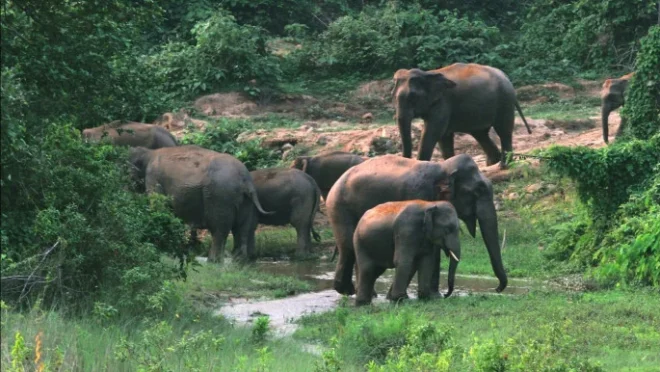
Asian elephants are among the most endangered wildlife species in Bangladesh. Yet their importance extends far beyond their survival as a species. These gentle giants are a living indicator of healthy forests and functioning ecosystems. If elephants disappear from Bangladesh’s forests, it will signal a much deeper ecological crisis.
The situation is already alarming. According to the national elephant survey, only around 250 elephants remain in Bangladesh. Of them, about 95 are migratory elephants that move across international borders, while nearly 100 are captive. The country has 52 recognised elephant routes, 12 elephant corridors and 57 transboundary crossing points. However, many of these movement pathways are increasingly under threat.
Elephants require more than food and water to survive. As highly social animals, they need large, connected forest landscapes where they can move freely in herds, interact with one another and follow traditional migratory routes. When these routes are blocked, their survival becomes increasingly difficult.
The ecological role of elephants is often overlooked. They are widely regarded as ecosystem engineers because they help shape and maintain forest environments. By dispersing seeds across long distances, enriching soil fertility and creating habitats for other species, elephants contribute significantly to forest regeneration. Research has shown that Asian elephants occupy a central position within forest mammal communities, making them crucial to ecosystem resilience.
Bangladesh’s hill forests have long supported biodiversity, protected watersheds and contributed to climate regulation. However, decades of encroachment, deforestation and unplanned development have severely degraded these ecosystems. As forests shrink, wildlife faces growing shortages of food and shelter.
The decline of elephants is closely linked to this broader environmental degradation. Habitat loss and fragmentation are widely recognised as the principal threats to Asian elephant populations. The Bangladesh Elephant Conservation Action Plan identifies habitat loss, food scarcity and direct killing as the three major threats to the species’ survival.
Elephants require large, uninterrupted landscapes to access food, water, shelter and seasonal migration routes. Yet these landscapes are rapidly disappearing. Roads, railways, tourism facilities, agricultural expansion and human settlements are fragmenting forests and disrupting elephant movement.
Cox’s Bazar illustrates the scale of the challenge. The expansion of Rohingya settlements has blocked several traditional elephant corridors, restricting the movement of elephants across the landscape. Infrastructure development, including roads and railways, has created additional barriers.
Similar pressures are evident elsewhere. In Sylhet and Sherpur, expanding agricultural activities and human settlements have increased pressure on elephant habitats. As food sources inside forests diminish, elephants increasingly venture into nearby farms and orchards in search of food. This often results in crop damage and financial losses for local communities.
The consequence is a growing human-elephant conflict. Villagers see elephants as a threat to their livelihoods, while elephants are forced into closer contact with people because of shrinking habitats. Forest officials often struggle to address these conflicts because of limited resources and inadequate community cooperation.
The costs have been severe for both humans and wildlife. Between 2003 and 2016, 62 elephants were reportedly killed by people. According to discussions at the Asian Elephant Range States Meeting in 2022, between 16 and 31 people and around five elephants die each year as a result of human-elephant conflict, including deliberate electrocution.
Recent incidents involving the deaths of elephants and calves highlight the urgency of addressing these challenges. Without effective intervention, the country’s remaining elephant population could decline further.
Fortunately, Bangladesh does not need to start from scratch. Several countries facing similar challenges have successfully reduced human-elephant conflict through community-based conservation approaches. In parts of Africa, local communities use beekeeping and the cultivation of crops such as chillies, tea and coffee to discourage elephants from entering villages and farms. Sri Lanka, India and Thailand have adopted GPS tracking systems and community-led early warning mechanisms to reduce conflict and improve coexistence.
Bangladesh has already taken important steps through the Forest Department and conservation organisations. However, much more needs to be done. Strengthening community engagement, increasing public awareness and improving cooperation between local communities and conservation authorities should be priorities.
Protecting elephant corridors must also become a central component of development planning. New roads and railways in elephant habitats should include adequate underpasses and wildlife crossings. Infrastructure projects that fragment critical habitats should be carefully reviewed and redesigned where necessary.
Addressing the Rohingya crisis and strengthening cross-border cooperation with neighbouring countries are equally important, given the transboundary nature of elephant movement.
Ultimately, saving elephants is about much more than protecting a single species. Elephants help maintain the ecological processes that keep forests healthy and resilient. Their survival is closely linked to the survival of Bangladesh’s remaining natural forests.
If the country is serious about protecting biodiversity, strengthening climate resilience and preserving its natural heritage, conserving elephants must become a national priority. Saving elephants, in the end, means saving Bangladesh’s forests.
Md Zafar Alam Bhuiyan is a Senior Research Fellow at the Centre for Climate Change and Environmental Research (C3ER), BRAC University, and a doctoral researcher in climate change at Bangladesh University of Professionals (BUP). His research focuses on biodiversity conservation, forest governance and climate resilience.
Disclaimer: The views and opinions expressed in this article are those of the author and do not necessarily reflect the opinions and views of The Business Standard.