Artemis II breaks Apollo 13's distance record
NASA’s Artemis II astronauts have ventured farther into space than any humans before, completing a lunar flyby that offered unprecedented views of the moon’s far side.
Artemis II breaks Apollo 13's distance record
NASA’s Artemis II astronauts have ventured farther into space than any humans before, completing a lunar flyby that offered unprecedented views of the moon’s far side.
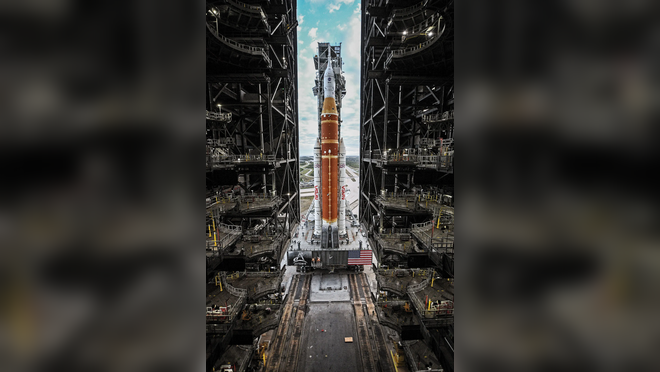
The mission, the first crewed lunar journey since the Apollo era, also included rare celestial sights and marked an important step toward returning astronauts to the moon’s south pole in two years.
During their journey, the crew of three Americans and one Canadian witnessed a total solar eclipse as the moon temporarily blocked the sun. Mercury, Venus, Mars, and Saturn were visible in the dark sky, while the Apollo 12 and 14 landing sites served as poignant reminders of NASA’s early lunar missions.
Artemis II also broke the distance record set by Apollo 13 in 1970. NASA’s Orion capsule reached a maximum of 252,756 miles (406,771 kilometers) from Earth—4,101 miles (6,600 kilometers) beyond the Apollo 13 milestone—before turning back behind the moon. Canadian astronaut Jeremy Hansen described the views as “unbelievable” and encouraged future generations to continue pushing the limits.
In a touching nod to history, Apollo 13 commander Jim Lovell, who passed away last year, recorded a message for the crew, welcoming them to “my old neighborhood” and reminding them to enjoy the view. The astronauts also carried an Apollo 8 silk patch with them, honoring NASA’s first lunar mission.
Artemis II followed a free-return lunar trajectory similar to Apollo 13, a route that uses the moon’s and Earth’s gravity to minimize fuel use and ensures a safe return home.
The seven-hour lunar flyby, the centerpiece of the nearly 10-day mission, brought the astronauts as close as 4,067 miles (6,545 kilometers) to the moon’s surface. They observed and photographed over two dozen lunar features, including impact craters, using professional cameras and smartphones. The crew requested to name two fresh craters after their capsule, Integrity, and Commander Reid Wiseman’s late wife, Carroll, which led to an emotional moment shared among them.
The Artemis II spacecraft reached its closest approach at 3,139 mph (5,052 kph) and completed the farthest distance from Earth while temporarily out of communication. Mission Control in Houston celebrated the return leg with an Earthrise view showcasing Asia, Africa, and Oceania.
President Donald Trump called the astronauts, praising them as “modern-day pioneers” and highlighting America’s continued ambitions in lunar and Martian exploration.
Science objectives included close observations of the Orientale Basin, a massive impact basin spanning nearly 600 miles (950 kilometers), while the timing of the launch ensured the solar eclipse occurred during their mission.
Artemis II is the first astronaut moon mission since Apollo 17 in 1972, paving the way for Artemis III, which will practice lunar lander docking in orbit, and Artemis IV in 2028, which will see astronauts land near the moon’s south pole.
Reflecting on the journey during Christianity’s Holy Week, astronaut Victor Glover remarked on the awe-inspiring perspective of Earth amid the vastness of space, noting the mission serves as a reminder of humanity’s shared existence and responsibilities.