Bumblebees demonstrate advanced problem-solving skills in new experiment
More than a century ago, German psychologist Wolfgang Köhler transformed scientists’ understanding of animal intelligence with a simple experiment involving chimpanzees, boxes and a banana placed just out of reach. The apes solved the challenge not through trial and error, but by grasping how objects could be rearranged to achieve a goal, a hallmark of what researchers call insight.
Bumblebees demonstrate advanced problem-solving skills in new experiment
More than a century ago, German psychologist Wolfgang Köhler transformed scientists’ understanding of animal intelligence with a simple experiment involving chimpanzees, boxes and a banana placed just out of reach. The apes solved the challenge not through trial and error, but by grasping how objects could be rearranged to achieve a goal, a hallmark of what researchers call insight.
Until now, this type of spontaneous problem-solving had been observed in only a handful of animals, including great apes, elephants and some birds. A new study suggests that bumblebees may also belong on that short list.
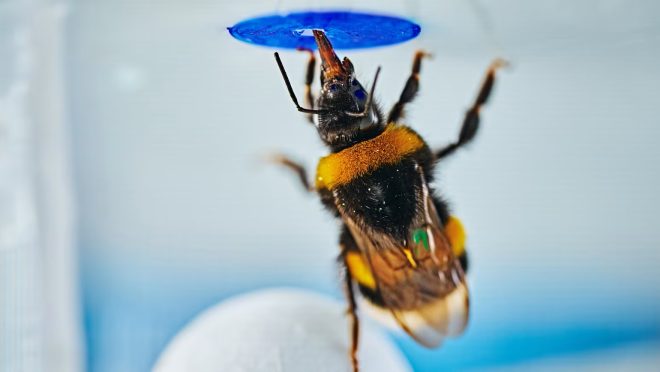
In research published in Science, scientists report that bumblebees were able to solve a completely novel task without training or gradual learning. In a laboratory experiment, the insects rolled a small foam ball beneath an artificial blue flower suspended above them, climbed onto the ball and used it as a platform to reach a sugary reward.
“We showed for the first time that bumblebees can solve a completely new object-manipulation problem spontaneously,” said lead author Akshaye Bhambore, a doctoral researcher at the University of Oulu in Finland.
Previous studies had already shown that bumblebees can learn socially and apply basic logic. What sets this experiment apart is that the bees were never taught the solution. Instead, they were only familiarised with the ball as a harmless object and with the flower as a source of reward.
According to James Nieh, a professor at the University of California San Diego, who was not involved in the study, the findings highlight the flexibility of insect cognition. “Bees do not normally move objects to make platforms,” he said, “but they can remember a goal location and manipulate an object in relation to that goal.”
The experiment took place in a small circular arena where bees could walk but not fly. After initial exposure to the flower and the ball separately, 75% of the bees successfully rolled the ball to the correct position and climbed onto it to reach the flower placed on the ceiling. Bees without this prior exposure failed to solve the task.
Researchers also ruled out random behaviour by hiding the flower from view. Even then, bees that had been familiarised with the elements were able to move the ball purposefully towards the goal.
The behaviour reflects what scientists describe as goal-directed action, said co-author Olli Loukola, a behavioural ecologist at the University of Oulu. However, he cautioned that the findings do not imply human-like reasoning or consciousness, nor do they conclusively demonstrate tool use — a concept that remains hotly debated in animal behaviour research.
Still, experts say the implications are significant. Lars Chittka, a professor at Queen Mary University of London, compared the task to a person realising they need a ladder to change a ceiling light, then fetching one from another room. “It requires keeping the goal in mind and taking the right action,” he said.
The study adds to growing evidence that even tiny brains can support complex and adaptable behaviour — a finding that may reshape how scientists think about intelligence across the animal kingdom.