Chinese researchers uncover 'ripple' structures in Milky Way
Chinese researchers uncover 'ripple' structures in Milky Way
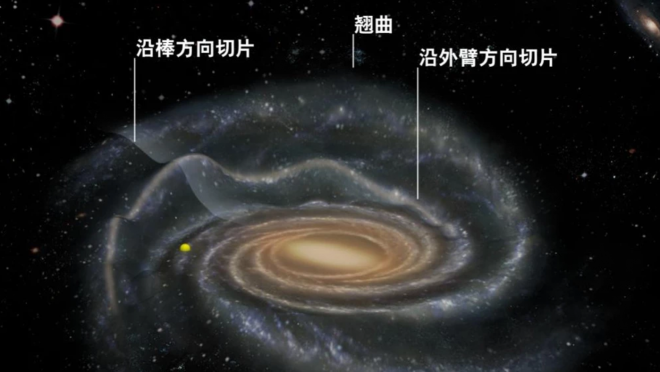
Chinese researchers have identified widespread corrugated structures in the Milky Way for the first time, offering fresh observational evidence for understanding the galaxy’s three-dimensional architecture and dynamic evolution.
The findings, from a team at the Purple Mountain Observatory (PMO) under the Chinese Academy of Sciences, were published on 7 August in the journal Nature Astronomy.
Lead author Sun Yan, an associate researcher at PMO, stated the team analyzed over 30,000 molecular clouds in 3D using carbon monoxide (CO) spectral-line survey data. The sample covered about half of the Milky Way’s outer disk, reaching up to 26 kiloparsecs from the Galactic center.
Based on these samples, the team constructed the first global “warp” model of the molecular gas outer disk. After subtracting the large-scale warp background, they detected wave-like vertical undulations, or corrugations.
“These corrugations appear as large-scale vertical deviations of the disk, likely originating from bending waves excited by external gravitational perturbations,” Sun explained.