Meet the lungfish carrying 30 times more DNA than humans
Meet the lungfish carrying 30 times more DNA than humans
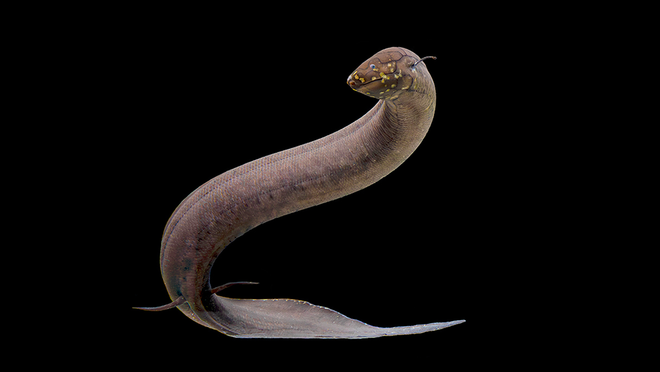
A South American lungfish has been found to possess the largest animal genome ever sequenced, with its DNA containing a staggering 91 billion chemical bases, around 30 times the size of the human genome.
Researchers report in Nature that the genome of Lepidosiren paradoxa contains roughly 20,000 genes, similar to humans, despite being vastly larger. Most of the remaining DNA consists of non-coding sequences, including repetitive stretches known as transposable elements, which can copy themselves and insert the copies elsewhere in the genome.
The discovery makes the South American lungfish the current animal record-holder for genome size. However, it is not the largest genome found in nature. The New Caledonian fork fern, Tmesipteris oblanceolata, holds that broader record, with a genome containing around 160 billion bases.
Lungfish are often described as ‘living fossils’ because their bodies retain characteristics that provide clues about the earliest vertebrate ancestors. They are also among the closest living relatives of the ancient fish that eventually gave rise to land vertebrates.
Since 2018, evolutionary biologists Axel Meyer and Manfred Schartl of Julius Maximilians University of Würzburg and their colleagues have been sequencing the genomes of lungfish from different continents to better understand vertebrate evolution.
The team first sequenced the Australian lungfish, whose fin bones bear similarities to the limb bones of land animals. They later examined African lungfish, whose limb bones are considerably reduced. Their latest work focuses on the South American species, which has similarly reduced fins but a genome roughly twice the size of those of its Australian and African relatives.
Around 90% of the South American lungfish’s genome is made up of transposable elements, sometimes described as ‘selfish’ DNA because of their ability to replicate and move around the genome. By comparison, these sequences account for about 40% of the human genome.
The researchers believe the lungfish has accumulated such vast amounts of repetitive DNA because it has lost several genes that normally help control transposable elements.
Comparisons with other vertebrate genomes suggest that the South American and African lungfishes lack some of these genetic safeguards, allowing repetitive DNA to continue accumulating largely unchecked.
The enormous genome comes at a cost. Nearly all of the lungfish’s 19 chromosomes are individually about as large as the entire human genome, meaning the animal must expend considerable energy to replicate its DNA. Its cells and nuclei must also be correspondingly larger.
The researchers estimate that L. paradoxa has added the equivalent of an entire human genome to its DNA roughly every 10 million years.
Despite these costs, an expanded genome can sometimes provide evolutionary advantages. Transposable elements can alter the activity of nearby genes and, under certain circumstances, contribute to the evolution of entirely new genes.
However, evolutionary geneticist Graciela Garcia of the University of the Republic in Uruguay, who was not involved in the study, says the uncontrolled accumulation of repetitive DNA could also pose serious risks if it interferes with genes essential for survival.
The researchers remain puzzled as to why the South American lungfish has not evolved more effective mechanisms to control the spread of these ‘jumping genes’.
“These are fish that evolution forgot,” Meyer says.
The title of largest known animal genome may not belong to L. paradoxa for long, however.
Claus-Peter Stelzer, an evolutionary biologist at the University of Innsbruck, points out that the genome of the marbled lungfish (Protopterus aethiopicus) could be up to 50% larger by weight than those of its relatives.
Until that genome is sequenced, however, the South American lungfish remains the animal with the largest genome ever decoded.