Beyond the SI Scholarship: Noore Wazid Lamin's journey back to his roots
Securing the SI Scholarship, one of the world’s most competitive, and choosing to come back, is not a choice everyone makes. But for Noore Wazid Lamin, it was never really a question.
Beyond the SI Scholarship: Noore Wazid Lamin's journey back to his roots
Securing the SI Scholarship, one of the world’s most competitive, and choosing to come back, is not a choice everyone makes. But for Noore Wazid Lamin, it was never really a question.
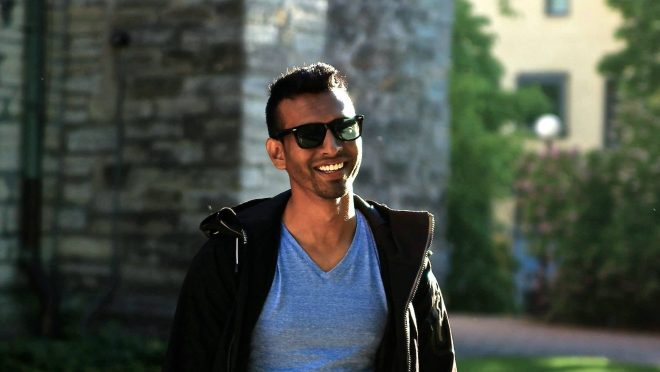
From the remote hills of Bandarban to the mangroves of the Sundarbans, Noore Wazid Lamin’s work is rooted in the remote areas of Bangladesh.
His decision to return instead of settling abroad fascinated many, which is why I reached out to him to learn more about his journey and ambition.
Roots
Lamin grew up in Manikganj, where floods were not a disaster, they were a season. Houses became islands. Boats became the only way to move. He watched the people around him absorb all of it with a quiet competence.
That early exposure made him curious about how nature works. “From watching Sir David Attenborough’s nature documentaries to spending time in the fields and waterways around me, I always had a deep urge to understand how nature works.”
As children, most of us dream of becoming doctors or engineers not because we truly want to, but because society points us there. But Lamin picked a dream from his own reality. Later in life, Lamin’s friends and family told him to consider switching careers, but he never did because he had a vision and purpose.
Application
Lamin pursued his Bachelor’s in Environmental Science at Stamford University Bangladesh, graduating with a CGPA of 3.85 out of 4.00. In his final semester, while working on his thesis, he realised that becoming a serious environmental professional would require a Master’s degree from abroad.
His aunt, Sharmin Rashid, herself a global scholarship holder at Lund University, introduced him to a fellow student who secured an SI Scholarship, and she mentored him through the process. Being guided by someone already standing in your dream place was a privilege Lamin openly acknowledges.
The application process was exhausting. He edited his Statement of Purpose more than a hundred times, asking anyone he considered academically stronger than himself to review it. The night before the results came out, his aunt told him his chances were between 10-20%. “That broke my heart a bit,” he says. “It felt like I had been giving my hundred per cent for something which is out of my reach.”
What separated his application, he believes, was not the CV, it was the clarity of the argument. He wrote about Bangladesh specifically: its climate vulnerability, the communities he had already worked with, and exactly what he planned to do when he returned.
“I made it clear that I was not going to Sweden to stay in Sweden. I was going to come back with tools that would work on our ground, for our people.”
And finally, he got into the Department of Applied Environmental Science at Halmstad University. The moment that made everything feel real came at the graduation ceremony in Stockholm’s Nobel Hall, the same room where the world’s greatest scientists receive their Nobel Prize, where he met a Dhaka University teacher who had received the same scholarship that year. The student who never got the chance to study at Dhaka University was standing in the same hall as a DU faculty member, both wearing the same award. “It made me feel like dreams truly do come true,” he says.
In Sweden
The first few weeks were cold, both weather-wise and socially. Swedes do not start conversations with strangers on trains, not out of rudeness but out of respect for privacy. In Dhaka, silence between strangers is awkward. In Sweden, it is considerate. It took Lamin a while to understand that.
What changed him most was not the culture but an exam. His first open-book exam turned out to not be open-book at all. Copying from a textbook meant failure. The only way to pass was to think independently, reason through a framework, and build your own argument from scratch.
“That exam changed how I understood what education was actually for. It was not about storing knowledge. It was about learning to think without a net, and that is exactly the skill Bangladesh demands every single day. There is no textbook for what you find in the field.”
At Halmstad University, Lamin continuously challenged himself. He did not simply blend in; rather, he became an unofficial representative of Bangladesh with practical knowledge about the environment, climate, and rivers alongside academic knowledge.
Back in Bangladesh
The heat and the noise hit him first. Then, immediately, the scale of the need.
Environmental work in Bangladesh comes with limited options and very little job security. “Bangladesh has given me everything – my roots, my reason, my understanding of what is actually at stake. The least I can do is give something back.”
He also admits that uncertainty is something he is not comfortable with, yet he stepped into it anyway. “I think that discomfort is probably important — the moment you become fully comfortable, you stop questioning whether you are doing it right.”
From Bandarban to the Sundarbans
Lamin previously worked as a Technical Specialist in Climate Change Adaptation and Mitigation with Helen Keller International under a USAID-funded project, where his work had three threads — constructing water points, installing Half Moon Bunds to capture rainwater on bare slopes, and running environmental compliance training so communities understood why protecting the land was inseparable from protecting the structures themselves.
He is now a Programme Officer with IUCN Bangladesh in the Sundarbans. “I work at the intersection of wildlife conservation and climate resilience — conducting biodiversity surveys, engaging forest-dependent communities, and contributing to the protection of one of the most extraordinary and fragile ecosystems on earth.”
But the project he is most proud of came from a failure first. Early in his career, he ran what he thought was a well-designed participatory process until he realised the women whose water access he was trying to improve had barely spoken in any of the meetings. The design was participatory, but with the wrong participants. “Now, before any meeting begins, my first question is always: are the right people in this room?”
That lesson directly shaped the project he returns to most. In 2020, a fire tore through Talukdarpara village in Bandarban. He led the disaster response and, after listening carefully to the community describing seasonal flooding, insisted on placing the main water point on higher ground despite resistance. There, they found a natural spring which was perennial, free, needing no pumping. When floods later submerged every lower water point, it kept flowing.
“A year later, I returned and saw families thriving, children healthier, women freed from hours of water-fetching. That happened because the right people were in the room — and because I listened.”
That gap between what we know and what we need to know does not discourage him. It is exactly where he wants to be, doing his honest best for the people and the ecosystems that need it most, with the blessings of his faith and the support of a family who have always been the solid ground beneath his feet.