From Aust to TU Berlin: Building a life in research
“I think I imagined a PhD as primarily an academic exercise, reading, experimenting, writing. What surprised me most is how much it’s actually a lifestyle, and how many different roles you end up playing at once,” responded Tamanna to a question asking her what life was like as a PhD aspirant.”
From Aust to TU Berlin: Building a life in research
“I think I imagined a PhD as primarily an academic exercise, reading, experimenting, writing. What surprised me most is how much it’s actually a lifestyle, and how many different roles you end up playing at once,” responded Tamanna to a question asking her what life was like as a PhD aspirant.”
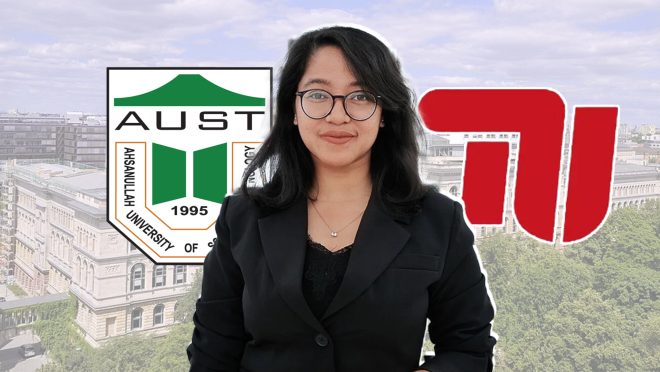
For our interviewee Tamanna Nabila Islam, higher education was something she could not ignore. Rather, one could say a life in academics, that too abroad, was to be embraced as an expected ambition as she grew up surrounded by like-minded family members.
Tamanna is now pursuing her PhD in Civil Systems Engineering at TU Berlin.
The mindset to look beyond the syllabus and dabble into further research manifested in her from the very start of her undergraduate journey.
“Once I enrolled at Aust, that curiosity found its footing. I gravitated towards conversations with professors, always looking for topics worth digging into beyond the syllabus. I also stayed closely connected with seniors who were working on research projects at BUET during their final semesters, and I was active in the research club,” shared Tamanna.
The start
Tamanna mentioned that good grades did not come to her “naturally”. And with persistent effort to maintain a good academic profile, she, from the start, made it a point to surf beyond academics and look for ways to connect and develop her intuition for academia. Moreover, as she mentioned, having like-minded friends in this pursuit didn’t hurt.
“I made a point of stepping outside the classroom whenever I could, attending conferences, going to job fairs, actively looking for ways to connect what I was learning to the wider academic and professional world. And I wasn’t doing this alone. I had a small group of like-minded friends in my class, and we pushed each other along the way. We’d talk through opportunities together, encourage one another to apply for things, and in a real sense, we worked collectively to build our entry into academic life. It wasn’t a solitary climb; having that peer support made the hustle sustainable.”
Along this journey, she had published two conference papers, and later her master’s thesis also led to a publication, giving her academic profile much-needed credibility and substance. Tamanna noted, “my supervisor was genuinely generous with guidance throughout the process, and the work itself was strong enough that publication felt like a natural next step rather than an uphill battle.”
Honing the skills before applying
Unlike many, Tamanna chose to work in the industry before pursuing a degree abroad. This was not a step outside of academics; on the contrary, her decision to pursue industry experience helped her to delve deeper into opportunities abroad.
“My time with UN-IOM, in particular, working in a refugee camp and collaborating closely with international colleagues, was pivotal. I was involved in research on sustainable construction materials, looking at how natural, locally available materials could be used in ways that were still structurally sound. That experience really crystallised what I wanted my research focus to be going forward,” mentioned Tamanna.
She specifically emphasised the value of her work experience, saying, “It’s not a detour from research.” She added, “My own time in industry, especially the work I did in the field, is what actually pointed me towards my research focus. Real-world exposure has a way of showing you which problems are genuinely worth solving.”
Tamanna’s journey
Tamanna had already completed her master’s in Civil Systems Engineering before applying for her PhD.
Along with her master’s, she also performed other roles which undoubtedly made her application much stronger.
“I worked as a student research assistant on two different EU-funded projects, which turned out to be a major boost, both for my research experience and for the technical skills that eventually got me onto my PhD project.”
At the time of her master’s thesis, a full-time position opened up, and she applied with her CV, transcripts, and certificates.
“I didn’t even have my final master’s certificate or full transcript yet, since I was still waiting on my thesis grade,” added Tamanna.
She didn’t need to look back. The interview went really well, and she was offered the position.
“I started working and the PhD took shape from there, growing out of a relationship and a body of work I’d already built rather than a cold application process.”
Upon asking what she thinks made her application stand out, she said, “I took on responsibilities well outside the scope of a typical research role, I managed the department website and handled maintenance for our internal communication server. Taking that on, and delivering reliably, showed my supervisor something a CV alone can’t: that I’m someone who can be trusted with whatever needs doing, and that I’ll get it done properly and on time, regardless of whether it falls neatly under ‘research.’”
Another important factor was the time she had already spent in Germany. A benefit of her master’s in the same university meant that she had been accustomed to Germany and its work culture for almost three years.
“When you’re being compared against candidates with similar technical skills, that kind of readiness, being able to integrate immediately, communicate in German where needed, and already understand how things work here, gives you a real edge.”
Having the PhD mindset
“A PhD isn’t just a technical qualification; it’s an environment you have to actually live and grow inside for years.” This is how Tamanna defined what a PhD actually is.
The first step is to start early. One must be determined enough to look for opportunities and do their own diligence when it comes to understanding in which field a higher degree is most probable.
She advises, “Start by talking to people, not just researching universities. Reach out to seniors, alumni, anyone who’s already walked this path, the practical knowledge you get from those conversations often matters more than anything you’ll find on a university website.”
Research should also be a part of your studies; it isn’t an extension of it. Therefore, it is a good thing to put it out in the world that you are interested in pursuing a higher degree.
“The earlier you start engaging with research, even in small ways, joining a club, assisting a professor, attending a conference, the more natural that identity becomes. You don’t need a perfect project to start; you just need to start.”
The documentation itself has to be direct and has to deliver pragmatism in its presentation as well. The biggest mistake she mentions is that people aim too high.
“A lot of applicants make the mistake of writing proposals that are too broad or too ambitious, trying to solve an entire field’s problem in three years. What actually convinces a supervisor is precision: a well-scoped question, a realistic methodology, and evidence that you’ve already thought about what could go wrong.”
Another mistake she mentions is the sin of writing the obvious cookie-cutter paragraphs in the motivation letters and SOPs. Writing with a given template will not only make your application sound generic, but it puts you at a disadvantage by not allowing you to stand out.
“The biggest mistake I see is treating it as a formality, a rehashed CV in paragraph form. A strong letter instead tells a coherent story: why this specific transition, from where you’ve been to where you want to go, and why now. It should be honest about the moments that shaped your direction, rather than just listing achievements.”
Overall, according to Tamanna, a strong research proposal does three things well: it shows you understand the gap in the field, not just the field itself; it connects that gap to a method you’re actually capable of executing, not just interested in; and it makes clear why this specific lab, supervisor, or department is the right place to do it, not just any PhD programme.
Life as a researcher
“The biggest cultural shift for me was seeing how merit-based the environment is, you’re appreciated for your work itself, without the kind of bias I was more used to encountering in Bangladesh,” Tamanna put it very bluntly.
She mentioned that she was the youngest in her team, but it never was used against her as justification or prejudice.
“I wasn’t micromanaged. From very early on, I was given the space to think like a scientist, to ask my own questions, test my own ideas, and be wrong sometimes without it being a setback. That freedom was, in itself, a huge part of my personal growth here.”
The unique take she gives is that the life of a researcher is not one-dimensional at all. The independence that comes with such a role is also its greatest challenge.
“I’m the project manager, the scientist, and the project planner, all rolled into one person. There’s no one handing me a task list or telling me what to focus on next, I have to figure that out myself, set my own priorities, and hold myself accountable to deadlines that I’m often the one setting in the first place.”
The advice she concludes by giving is to have patience.
“My own path here wasn’t a straight line, and it didn’t unfold on the timeline I expected. But every step, industry work, the master’s, the small side responsibilities, built towards something.”