The roadmap to a Norwegian PhD: A Buet graduate shares what really matters
Growing up in a power plant colony in Bangladesh, Seikh Hayatul Haque spent his childhood surrounded by turbines, generators, and the constant hum of industrial energy.
The roadmap to a Norwegian PhD: A Buet graduate shares what really matters
Growing up in a power plant colony in Bangladesh, Seikh Hayatul Haque spent his childhood surrounded by turbines, generators, and the constant hum of industrial energy.
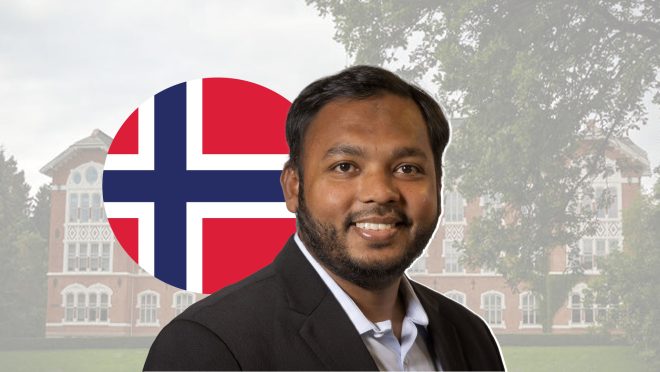
Years later, after a mechanical engineering degree from Buet and nearly a decade in Bangladesh’s national power sector, he found himself at the Norwegian University of Life Sciences on a fully funded PhD.
The journey was anything but linear.
A journey that was meant to be
Haque never had a dramatic moment of choosing energy as his field. He was born into it. Growing up in a power plant colony meant that industrial infrastructure was simply part of daily life, and when it came time to pick a discipline at Buet, mechanical engineering was a natural fit.
After graduating, he joined NWPGCL, one of Bangladesh’s major state-owned power companies, and spent over eight years working on energy audits, ERP implementation, and operational planning. Academia felt like a closed chapter.
Then came a training visit to Japan. “I was so impressed with the Japanese teaching methodology that I rediscovered my passion for learning that I had almost lost,” he recalls.
That trip changed everything.
The KTH years
With a Swedish Institute Scholarship in hand, Haque enrolled at KTH Royal Institute of Technology in Stockholm. The academic adjustment was manageable. He had always enjoyed being in a classroom. The steeper learning curve was academic writing, with its specific structure and register, something industry work never prepares you for.
But the bigger shift was in perspective. Back home, Bangladesh’s energy sector is still wrestling with the fundamentals, making sure everyone has reliable access to electricity. In Sweden, that problem was solved decades ago. The national conversation there is about flexibility, efficiency, and the low-carbon transition. “It was genuinely like comparing two different eras of energy development,” he says.
Returning to Bangladesh after his Master’s, Haque found that what he had learned at KTH was difficult to apply in his day-to-day work. The gap between where he was and where he wanted to go was widening, so he decided to pursue a PhD.
Ending up in Norway
The path to Norway was not deliberate. He had originally accepted an offer from a Swedish university, but prolonged visa processing and a change in family circumstances meant he could not join. When a position opened at NMBU, he applied.
One detail sealed it: a PhD in Norway takes three years, compared to around five in Sweden. For someone already eight years into a professional career, that was a meaningful difference.
The selection process
The NMBU interview process had two rounds. The first required candidates to present themselves and their Master’s thesis concisely, demonstrating its relevance to the PhD project. The second involved reading assigned papers and presenting their findings.
Haque believes the decisive factor in his selection was the close alignment between his Master’s thesis and the PhD project, both in methodology and research philosophy.
He is straightforward about what Norwegian supervisors are looking for. Grades matter, but only as a baseline check.
Research experience and background relevance carry more weight. And then there is personality. “Being overconfident or a show-off is a significant negative here,” he says. “They want a team player, someone who is humble, knows their subject, but doesn’t feel the need to prove it loudly.”
Advice for Bangladeshi students
Haque is direct when it comes to what actually works. The single most impactful step, he says, is getting a European Master’s first. Moving from Bangladesh straight into a European PhD is possible, but you would need either very niche expertise or a strong publication record to compete against candidates who already have European degrees and local familiarity.
He also pushes back against the fixation on CGPA. It matters, but not as much as many students think. “If your CGPA is not where you’d like it to be, focus on building your research profile and publications,” he says. “That can go a long way in compensating.”
His other practical tips: read every PhD circular thoroughly, multiple times. Fully customise each application rather than sending the same generic version everywhere. And after submitting, consider sending a short, genuine email to the potential supervisor expressing your interest. It is not expected in Europe in the same way it is in North America, but it can leave a positive impression.
What a Norwegian PhD actually means
A fully funded PhD in Norway is not a scholarship. It is a job. You receive a full salary, employee benefits, and a skilled worker visa. After three years, you are eligible to apply for permanent residency. Your family can join you, children can attend kindergarten at minimal cost, and standard Norwegian employee benefits apply.
The work culture, Haque says, is built around autonomy. Supervisors are not micromanagers. You work when you are productive, including from home. It is, in his view, one of the best environments in the world for doing a PhD.
The one thing people consistently underestimate is the weather. Long, dark Scandinavian winters are genuinely difficult, and supervisors actually raise this during interviews. It is not a footnote. “You either learn to adjust to it, or it becomes a persistent source of difficulty,” he says.
Haque is now researching resilient low-carbon energy systems in Northern Europe, a topic that feels far removed from the power plant colony where his curiosity first took shape. But looking back, he does not see the path as scattered. Industry gave him grounding. KTH gave him direction. Norway gave him the space to go deep. Each step, even the unplanned ones, turned out to matter.
This article is written in partnership with Abroadmates, the all-in-one mentorship platform for study abroad.
To know more about the PhD journey in Norway, book a session at: https://www.abroadmates.com/seikh-hayatul-haque