On this day in 1861 the world was seen in colour for the first time
Today marks a milestone in the history of photography and visual technology. On 17 May 1861, Scottish mathematical physicist James Clerk Maxwell produced what is widely recognised as the world’s first permanent colour photograph — an image of a tartan ribbon that would quietly revolutionise how humans capture and reproduce reality.
On this day in 1861 the world was seen in colour for the first time
Today marks a milestone in the history of photography and visual technology. On 17 May 1861, Scottish mathematical physicist James Clerk Maxwell produced what is widely recognised as the world’s first permanent colour photograph — an image of a tartan ribbon that would quietly revolutionise how humans capture and reproduce reality.
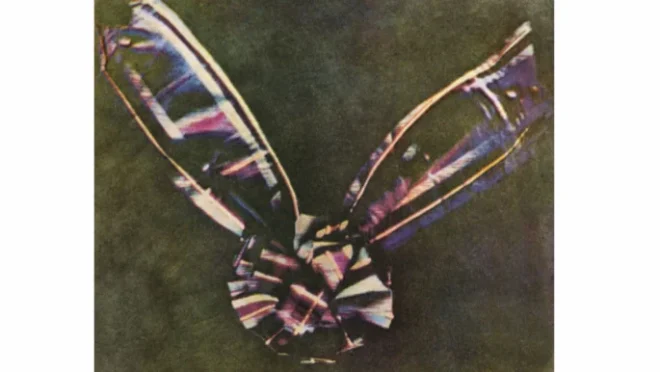
The experiment, presented during a lecture on colour theory at the Royal Institution in London, may appear modest by modern standards. Yet its impact stretches from early photography labs to today’s smartphone cameras and digital screens.
The photograph itself was created using an idea that now forms the foundation of modern colour imaging: combining red, green and blue light to recreate a full-colour image. Maxwell had the ribbon photographed three separate times through different coloured filters before projecting and recombining the images into one composite.
The actual photographs were taken by Thomas Sutton, inventor of the single-lens reflex camera. Although the final image looked faint and imperfect, it demonstrated for the first time that colour photography was scientifically possible.
Ironically, the technology of the time almost sabotaged the experiment. Photographic plates in 1861 were barely sensitive to red and green light, meaning much of the image should not have worked at all. Later researchers discovered that ultraviolet light — reflected by some red dyes in the tartan ribbon — unintentionally helped expose the image.
Still, the experiment was enough to change the future.
Before photography emerged in the 19th century, artists had long relied on the camera obscura, a dark chamber that projected upside-down images through a small opening, mimicking the way the human eye sees the world. But once photography arrived, cameras rapidly evolved from crude recording devices into sophisticated mechanical “eyes” with lenses, shutters, focus systems and eventually colour vision.
By the time Maxwell unveiled his tartan ribbon photograph, photography itself was still young. The first known photograph, captured by Joseph Nicéphore Niépce in 1826, had been taken only 35 years earlier.
Maxwell’s colour theory, however, laid the groundwork for nearly every colour imaging system that followed.
“It’s easy to forget that not long ago news agencies were transmitting their wire photographs as colour separations,” BBC picture editor Phil Coomes once wrote, referring to the same red-green-blue principle Maxwell demonstrated in 1861.
From newspaper printing presses to cinema projectors, television broadcasts and digital photography, Maxwell’s experiment became the basis for how machines reproduce colour.
Yet colour photography did not immediately flourish after the breakthrough. For decades, photographers continued experimenting with unstable and often impractical techniques. Hand-tinted photographs remained more vivid and lifelike than early colour images well into the late 19th century.
It was only in the early 20th century, through innovations by figures such as Gabriel Lippmann and companies like the Sanger Shepherd process developers, that colour photography became commercially viable and visually striking.
Today, every selfie, film frame and social media upload owes something to that ribbon photographed in 1861.
More than 160 years later, Maxwell’s experiment remains a reminder that some of the biggest revolutions begin quietly — with curiosity, light, and a strip of coloured fabric.