39 years of Messi, and a lifetime of lessons
39 years of Messi, and a lifetime of lessons
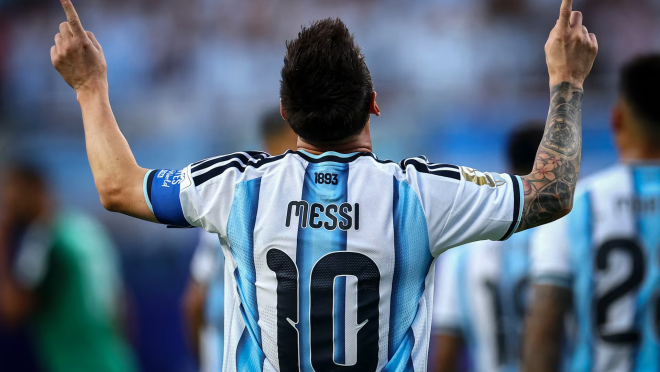
24 June 1987. In a little town in Argentina, a boy named Lionel Andrés Messi was born in Rosario, Santa Fe. A working-class city. His father Jorge worked in a steel factory. His mother Celia worked in a magnet manufacturing workshop.
Nobody in that neighbourhood had any reason to believe that the quiet little boy with the ball at his feet would one day become the most decorated footballer in the history of the sport.
But then again, the greatest stories never announce themselves at the beginning. Today, 24 June 2026, that boy turns 39. Happy Birthday, Lionel Messi. Thirty-nine years ago, Rosario gave the world a gift, and the world is still unwrapping it. Still watching. Still in awe.
This Time, we watched
We all know the story of Robert Bruce. The Scottish king who lost his throne, fled into hiding, and watched a spider fail to spin its web six times before succeeding on the seventh attempt. The story goes that Bruce took it as a sign and tried again, tried one more time, and eventually reclaimed his kingdom. It is one of the most famous stories of perseverance in human history.
But no one saw it happen. No one watched Bruce fall. No one watched him rise. It is a story passed down through centuries, told in classrooms, written in books, and accepted on faith. We believe it because we were told to believe it. Lionel Messi gave an entire generation something Robert Bruce never could. We watched it happen. In real time. With our own eyes.
The boy who had everything – except one thing
By the time Messi was 24, the football world had already run out of superlatives. Four Ballon d’Or awards before his 25th birthday. La Liga titles. Champions League trophies. Records that had stood for generations, broken before he was old enough to fully understand what he was doing. At club level, he had conquered everything. Pep Guardiola called him the best he had ever seen. Arsène Wenger called him the best who had ever lived.
But there was one thing missing. And the world would not let him forget: international football, the World Cup, the Copa América. The stage where Maradona had become immortal in 1986. The one place where Messi, despite everything, had nothing to show for it. And so the debate started, quietly at first, then louder, then deafening. The greatest at club level, they said. But can he do it for his country?
What followed was not just a football story. It was a masterclass in what it means to refuse to stop.
The falling
In 2014, Messi carried Argentina to the World Cup final in Brazil on his back. Four goals. The Golden Ball as the tournament’s best player. And then Mario Götze’s extra-time winner for Germany, and Messi standing on the pitch at the Maracanã with a runners-up medal around his neck, staring at the floor. The world watched and said: close, but not enough.
He came back. Copa América 2015. Argentina reached the final against Chile. They lost on penalties. Messi stayed on his feet.
He came back again. Copa América 2016, the centenary edition. Another final. Another penalty shoot-out. Another loss to Chile. That night, Messi walked to a microphone and announced his international retirement. He was 29 years old and had given Argentina everything he had, three consecutive finals, and received nothing back.
The story should have ended there. For many, it would have. But Messi is different.
The moment that changed everything
He came back in 2017. And the first test was immediate and brutal. Argentina were struggling to qualify for the 2018 World Cup, a footballing nation of that stature on the brink of missing the tournament entirely. The pressure was suffocating. The criticism was savage. Some called for Messi to be dropped. Some called for the entire system to be torn down.
Then came Ecuador, away, in Quito, one of the most difficult venues in world football due to altitude. Argentina needed to win. Messi scored a hat-trick. Argentina qualified.
He went to Russia 2018 anyway. They were eliminated in the Round of 16 by France. Mbappé, then 19, tore them apart. Messi scored one goal. Argentina flew home. The criticism returned louder than ever.
In 2019, Argentina lost the Copa América semi-final to Brazil on home soil. Messi was furious. He called out corruption in South American football. He accepted the third-place bronze medal with barely concealed frustration.
By any rational measure, a man who had already won five Ballon d’Ors, multiple Champions Leagues, and broken every club record imaginable had no obligation to keep suffering through this. He could have walked away and still been considered among the greatest who ever played.
He did not walk away.
The turning
2021: The Copa América, played in Brazil, Argentina’s fiercest rival’s home soil. Messi was 34 years old. His body carried the weight of the previous decade of near misses. And yet, tournament after tournament, he kept showing up.
Argentina won. Messi lifted a major international trophy for the first time in his career. He dropped to his knees on the pitch in the Maracanã, the same stadium where the 2014 World Cup final had broken him, and wept.
The generation that had watched him fall, watched him stand back up every single time, finally saw him rise.
And then he went further.
2022: Qatar. The World Cup. Messi was 35. Critics said he was too old. Said the window had passed. Said 2014 was his best chance and it was gone. He scored seven goals. He provided three assists. He won the Golden Ball. He lifted the trophy. In the final against France, a match that will be discussed for as long as football exists, Argentina led 2-0 in the second half, but Mbappé scored twice in quick succession to make it 2-2 and force extra time. In extra time, Messi scored to put Argentina 3-2 ahead, before Mbappé completed his hat-trick with another penalty to make it 3-3. Argentina then won the match on penalties.
He held the World Cup above his head and screamed into the night in Lusail.
Robert Bruce took back his kingdom. But no one saw his face when he did it. We saw Messi’s.
The man at 39
He did not stop. In 2024, he won the Copa América again, becoming the most decorated player in the tournament’s history. And now in 2026, at 39 years old today, at his sixth World Cup, he is the all-time leading scorer in FIFA World Cup history with 18 goals. He is one assist away from becoming the all-time leading assist provider in World Cup history as well. He is still here. Still competing. Still breaking records that no one thought were breakable.
The generation that grew up watching Messi did not just watch a footballer. They watched a man lose, repeatedly and publicly, in front of hundreds of millions of people, and come back every single time. They watched him retire from international football and return. They watched him be written off at 35 and win the World Cup. They watched him be told the story was over, and write a new chapter anyway.
Robert Bruce and his spider is a beautiful story. But it is a story. We cannot verify the look on his face when he failed for the sixth time. We cannot know what was running through his mind in that cave before he decided to try again. We accept it on faith.
We do not need to have faith in Messi. We have the footage. We have seen the tears in 2014. We have the retirement speech in 2016. We have the hat-trick in Quito in 2017. We have the photograph of him on his knees in the Maracanã in 2021. We have the image of him screaming with the World Cup above his head in 2022. And we have him today, at 39, still the best player in the tournament.
No motivational speech, no ancient parable, and no classroom story about a spider and a king will ever hit the way Messi’s story hits because we were there. We watched every fall. We watched every return. We watched a man prove, across two decades and in front of the entire world, that the only way to guarantee failure is to stop trying.
That is the gift he gave a generation.
Happy 39th Birthday, Lionel Messi.
The greatest who ever played. The most human who ever played. And the living, breathing, documented proof that impossible is nothing.