An evening in Jatiya Sangsad: A visitor's view of power
If you ask me what is the one item I would cross off my bucket list, I would, without a second’s hesitation, tell you that it is witnessing a session in Parliament.
An evening in Jatiya Sangsad: A visitor's view of power
If you ask me what is the one item I would cross off my bucket list, I would, without a second’s hesitation, tell you that it is witnessing a session in Parliament.
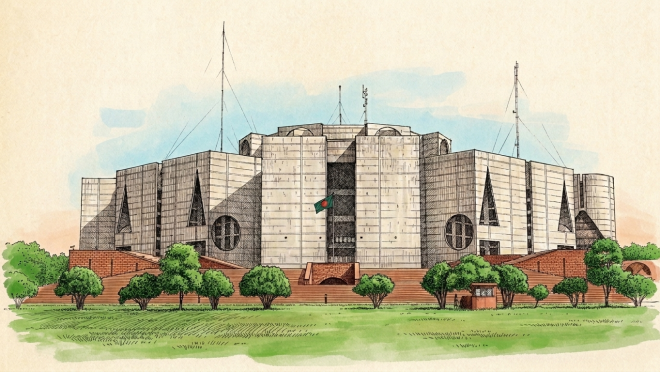
On a pleasant evening on 15 June 2026, I had the unique opportunity to experience a remarkable session on the Appropriation Budget Pass 2026, observing the proceedings and atmosphere of Parliament from both the government and opposition sides through the Birshrestha Lance Nayak Nur Mohammad Sheikh VIP Gallery-04.
I arrived at approximately 5:40 pm. Entering the Parliament premises through the MAJ Osmani Gate, I was immediately greeted by the imposing presence of the monumental structure. Before entering Parliament, I was checked by parliamentary security and had to show my entry pass. The vast open surroundings, carefully planned landscapes and the majestic concrete geometry of the Parliament building created a sense of awe and anticipation. Even before entering the main building, the significance of the location was evident. This was not simply a visit to an architectural landmark; it was a journey into the very centre of Bangladesh’s democratic process.
Following the designated route, I proceeded straight ahead after entering the premises and then turned left towards the main access point. The atmosphere was calm yet purposeful, reflecting the disciplined environment expected within the country’s highest legislative institution. Security personnel were stationed throughout the area, ensuring that all visitors complied with the necessary protocols.
The journey continued upwards to the fifth floor of the Parliament building. As I ascended, there was a growing sense of excitement about what awaited beyond the corridors. The fifth floor houses several galleries from which visitors can observe parliamentary activities, each named in honour of a Birshrestha.
Upon reaching the fifth floor, I turned right and made my way towards VIP Gallery Number 4, officially known as the Birshrestha Lance Nayak Nur Mohammad Sheikh Gallery. The gallery serves as a reminder of the sacrifices made for the nation’s independence. The very name of the gallery adds a profound sense of patriotism and historical significance to the visitor experience.
Before entering the gallery, security procedures were conducted with professionalism and efficiency through metal detector doors. Officials carefully checked visitors and ensured compliance with all regulations. As part of the security protocol, my mobile phone was secured and temporarily locked, preventing its use while inside the gallery. Such measures are essential to maintaining the integrity, confidentiality and decorum of parliamentary proceedings. Although strict, these procedures reinforced the seriousness of the institution and the importance of preserving a respectful environment within Parliament.
After completing the security formalities, I proceeded through the entrance and into the viewing area. It was at this moment that the experience truly became extraordinary. Just a short distance ahead, the entire Parliament chamber came into view, simply mesmerising.
The sight was both impressive and inspiring. From the elevated position of the gallery, I could observe the parliamentary floor in its entirety. The carefully arranged seating, the Speaker’s chair, the architectural symmetry of the chamber, the umbrella-shaped theme under which the ministers were sitting, the full brightness, and the dignified atmosphere combined to create a powerful impression. What had previously been seen only through television broadcasts, newspaper photographs and online media now stood directly before my eyes.
The chamber reflected the principles upon which democratic governance is built. Every seat represented the voice of a constituency, while every discussion carried implications for the future of millions of citizens. Watching the proceedings from above offered a unique perspective on how national decisions are debated, discussed and ultimately shaped.
Even within a highly functional legislative chamber, there exists an unmistakable artistic beauty that distinguishes Jatiya Sangsad Bhaban from parliamentary buildings around the world. I had the opportunity to see the oath room, ministers’ cafeteria, the opposition team’s room, the main entrance used by ministers, and the surrounding areas.
I remained inside the gallery for nearly an hour, observing every detail. During this time, I observed the orderly conduct of parliamentary activities and appreciated the disciplined environment maintained within the chamber. There were a total of five galleries for visitors and three galleries for journalists. The whole system was sloped and elevated, converging towards the centre.
The gallery offered an opportunity not only to witness governance in action but also to reflect on the democratic institutions that underpin the nation.
As the minutes passed, the experience became increasingly meaningful. During my time there, a total of three bills were passed, including those related to garbage disposal, the Science Ministry and canal excavation.
Rebuttals were given by opposition members, with a notable one coming from a representative of Rajshahi-8.
While strict procedures were in place, they enabled visitors to safely observe and understand the workings of their Parliament. This openness strengthens the connection between the people and the legislative body that represents them.
As the hour drew to a close, I prepared to leave the gallery. Yet the impressions formed during that time would remain long after the visit ended. The commanding architecture, the disciplined atmosphere, the symbolic significance of the Lance Nayak Nur Mohammad Sheikh Gallery, and the rare opportunity to observe parliamentary proceedings combined to create an unforgettable experience.
Standing high above the parliamentary floor and witnessing the heart of Bangladesh’s governance in action, I left with a renewed appreciation for the institutions that serve the nation and the principles that guide its future.