Are expensive foreign trips widening inequality in Dhaka’s elite schools?
Dhaka’s English-medium schools often arrange foreign study tours to give students valuable learning experiences. But when only some students can afford the fee, it risks increasing inequality and making others feel inferior
Are expensive foreign trips widening inequality in Dhaka’s elite schools?
Dhaka’s English-medium schools often arrange foreign study tours to give students valuable learning experiences. But when only some students can afford the fee, it risks increasing inequality and making others feel inferior
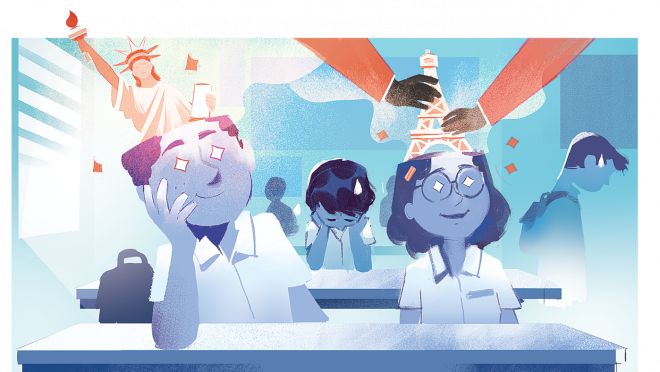
When a foreign study tour is announced at an English-medium school, it is never presented as a luxury. It is framed as exposure, global learning, cultural exchange, confidence-building, or education beyond the classroom. A global tour can indeed open a student’s mind in ways a textbook cannot.
But for many middle-class families in Bangladesh, the announcement also brings fear. The regular tuition fee is already burdensome. Books, uniforms, transport, coaching, events, gadgets, and other co-curricular expenses already stretch the household budget. Then comes the foreign trip: a large additional payment that many parents simply cannot afford.
International School Dhaka, commonly known as ISD, is one of the pioneering institutions in Bangladesh to regularly take students beyond the country as part of its academic and experiential learning programme. Its “Week Without Walls” initiative is a compulsory part of the school experience, ensuring that all eligible students participate rather than only those who can afford or choose to join separately.
But since the programme is built into the school’s official fee structure, parents do not usually face the uncertainty of sudden additional charges for these trips.
This model prevents discrimination among students, as participation is arranged collectively. However, inspired by such initiatives, many English-medium schools that cater to the middle class have also started introducing foreign tours, often as optional programmes requiring separate payments.
For middle-class parents, this creates a financial burden and turns what should be an inclusive educational opportunity into a source of pressure and inequality.
Humayra Begum (not her real name) is the mother of a student who studied at Manarat. She and her husband both work in corporate jobs. Like many parents, they enrolled their child into an English-medium school with high hopes, even though the cost was high.
“I work at a commercial bank. My husband works at another corporate office. We had high hopes and admitted our child into Manarat, though it was beyond our capacity. But we still admitted him there and were doing our best to accommodate the fees. But when the foreign tour came, we could not afford it,” she said.
“It is a very unbearable moment to see when my child is sad and mentions that others are going, and we cannot afford it.”
Her words capture the hidden emotional cost of class differences within schools. It is not only that some children cannot go abroad. It is that they sit in the same classroom as those who can, hear the excitement, see the photographs afterwards, and quietly absorb the lesson that opportunity is not equally distributed.
Several English-medium schools in Bangladesh promote their international study tours glamorously. DPS STS School Dhaka’s Europe Summer Exchange Programme 2023, arranged with Dusemond Study Programme, reportedly included 66 students, 12 teachers, and 45 parents, with visits to Rome, Paris, Scotland, and the United Kingdom.
Glenrich International School, Uttara, promoted its Japan Educational Tour in 2024. Manarat Dhaka International School and College states that students have visited the US, China, and Japan. Mastermind English Medium School had 130 students depart for a 10-day cultural exchange programme in the United Kingdom in 2025, organised with Oxbridge Education.
These initiatives may be valuable. The problem is not that schools take students abroad. The problem lies in the question of access.
Public descriptions often celebrate learning outcomes, but they do not always mention whether the school bore the cost or parents paid, or whether all students were invited or there was a selection process.
That silence matters.
Rehan (not his real name) is a former student of DPS STS School Dhaka. When he studied there, his classmates went on the Europe Summer Exchange Programme 2023. He could not join.
“Only 45 parents, 12 teachers, and 66 students could go. When I still see my friends posting photos of that tour, I feel left out.”
His words show the afterlife of exclusion. A trip may end in ten days. The photographs remain for years. Social media keeps the discrimination alive.
The pattern is not limited to English-medium schools.
Notre Dame College, Dhaka, also organised an educational tour to the United States in 2025, including visits to NASA’s Kennedy Space Center, MIT, Harvard, and the United Nations Headquarters.
A teacher from the prestigious institution defended the purpose of such programmes, saying, “These programmes we arrange are for the students to gain real-life experience and increase motivation for future growth.”
But when asked about charges and fees, he added, “It is true and unfortunate that we cannot accommodate all our 3,000 students at once, but at least we have begun, and we believe eventually we will be able to get sponsored trips and accommodate all our students someday.”
That acknowledgement actually tells both sides of the story. But if only a small group can participate, schools must also think about what the rest experience while being left behind.
Notre Dame College, Mymensingh, had a similar tour to NASA in the United States. Only a few selected students were able to go, and they paid their own way. That left students like Zubair (not his real name) behind.
“It is like a dream, but when you see only two of your friends can afford it and all of your classmates are left out, you can do nothing but accept your fate,” he said.
Kazi Rumana Haque, a psychosocial counsellor at Moner Bondhu, says the issue should be understood in two ways. Such tours, she believes, can be meaningful for students when they are designed carefully.
“School years are a crucial period for learning and development, so such initiatives can actually be very good for students’ mental health. When students go somewhere with their teachers and classmates, they learn through experience. If this is given as a result of achieving something, it can work as a reward or positive reinforcement,” she said.
But the experience is very different for those who cannot participate.
“They definitely feel left out. At the same time, it can create tension within their families. A child may start thinking, ‘Why couldn’t my family support me in this?’ As a result, frustration, resentment, or even mistrust can develop in the family. From a mental health perspective, this can have a negative impact,” she added.
She suggests schools should take greater responsibility for access.
“If the school organises such activities, it should try to bear the full financial responsibility. It should not become something where some students can participate and others cannot simply because of money. Schools can also think about whether this kind of reward—taking students outside—can be given in some other form, so that no child feels excluded,” she said.
Students do not experience class differences only through money. They experience it through who participates, who has stories to tell, who appears in group photographs, and who must pretend not to care.
The American Academy of Pediatrics says a child needs belonging through family, friends, schoolmates, and other groups. “Without this acceptance or group identity, children may feel rejected, lonely, and adrift,” it says.
That is what can happen when expensive participation becomes normalised as part of school life. The child left behind may feel inferior. When classmates go on foreign trips, join paid clubs, bring costly devices, wear expensive outfits, or talk casually about holidays abroad, the child may begin comparing family status.
Jinho Kim, an Associate Professor of Health Policy and Management at Korea University studied adolescent depression and found that students with higher relative deprivation within schools showed more depressive symptoms, with lower self-esteem and lower future expectations explaining a significant part of the association.
The Organisation for Economic Co-operation and Development (OECD) has found that engagement in extracurricular activities is positively related to social and emotional skills in students aged 10 and 15. But it also notes that disadvantaged students participate less.
This matters because trips and co-curricular activities can build confidence, curiosity, and peer connection. When access is unequal, the loss is not only a missed flight; it can be a missed developmental opportunity.
Students are not always vocal about it, rather they are uncomfortable speaking up.
Some say, “I didn’t want to go.” Some say, “My parents didn’t allow it.” Some say, “I was busy.” These are not always honest explanations. At times, they function as shields—to protect dignity, avoid sympathy, or keep classmates from knowing that the family could not afford the fee.
Others become quiet, defensive, jealous, or withdrawn. Some work harder, hoping to prove that money does not define them. Others lose confidence, avoid group work, stop participating, or feel that school rewards wealth more than merit. The classroom then becomes a daily reminder of one’s position in the social hierarchy.
However, this does not necessarily mean every child who misses a trip suffers clinical trauma. Nor does it mean every foreign tour is harmful. But repeated exclusion from highly visible, status-linked activities can create emotional distress, low self-worth, and a damaged sense of belonging.
Bangladesh’s middle-class parents often choose English-medium education as an investment in the future. They may cut personal expenses, use savings, or reorganise family life around school bills. English-medium education and private schooling costs can burden middle-income households, especially when fees are joined by transport, uniforms, session charges, activities, and other expenses.
A good school should recognise this. It should never force every child to pay for expensive optional activities. It should avoid public comparison, provide sponsored or subsidised options, create low-cost alternatives, offer transparent information on who pays and who qualifies, and ensure that non-participating students are not made to feel invisible.