Argentina without Messi is Portugal with Ronaldo
If I show you a piece of statistics where Messi and Ronaldo are compared, the first thing that will come to your mind is to, taunt this comparison, bring in your own memorised experience of both players, and declare your idol the greatest. And this same debate has been going on around the world for decades.
Argentina without Messi is Portugal with Ronaldo
If I show you a piece of statistics where Messi and Ronaldo are compared, the first thing that will come to your mind is to, taunt this comparison, bring in your own memorised experience of both players, and declare your idol the greatest. And this same debate has been going on around the world for decades.
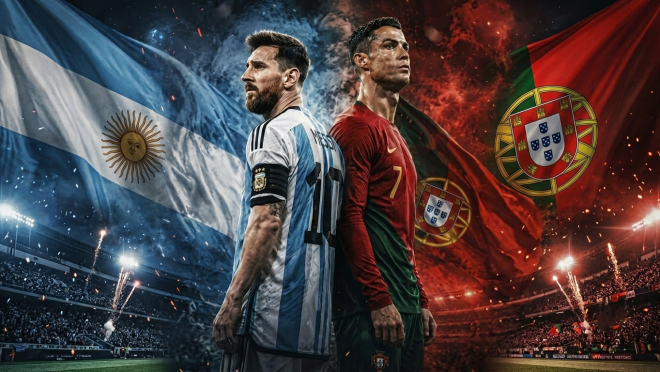
In reality, it is not a debate for fans who actually understand football. You can’t debate math.
For years, football fans have argued over systems, coaches, tactics, generations, and golden eras. Yet some truths are so obvious that people spend more time avoiding them rather than discussing them. One of those truths is this: Argentina without Lionel Messi is remarkably similar to Portugal with Cristiano Ronaldo.
The statement will create two poles now, which will trigger people on both sides. It will annoy those who have spent years trying to prove that Argentina is a machine that naturally produces success while Portugal is merely Ronaldo’s vehicle. It will upset those who desperately want football to be a story about systems instead of superstars.
But history is stubborn. Statistics are stubborn. Reality is stubborn. And reality says that both nations have spent decades searching for players capable of carrying the weight that Messi and Ronaldo carried almost alone. It is a double standard nobody wants to talk about.
Football discussions often suffer from selective memory. When Portugal struggles without Ronaldo, the headlines appear immediately: “Portugal depends on Ronaldo” or “Portugal cannot replace Ronaldo” and even “The team loses its identity without Ronaldo.”
Yet when Argentina struggles without Messi, people suddenly become philosophers. They start talking about tactical structures, mention youth development, discuss chemistry and collective effort. The excuses arrive faster than counterattacks.
The reality is simpler than this complex network of debate. Take Messi away from Argentina and the team instantly loses its most important source of creativity, leadership, decision-making, and psychological superiority, alongside internal confidence and strong mentality.
Take Ronaldo away from Portugal and exactly the same thing happens. Different players, same effect. Messi’s shadow is bigger than Argentina wants to admit. One of the most fascinating aspects of Messi’s career is how many people spent years trying to separate Argentina’s success from Messi himself. The argument usually sounds like this:
“Argentina has always had world-class players.”
Sure. No one is denying the fact, even when players like Gabriel Batistuta are mentioned, Argentina still had world-class talent. But so has Portugal. Having talented players and having a transformational player are two completely different things.
Argentina before Messi’s emergence spent years drifting between disappointment and frustration. The nation produced talent after talent, yet major trophies remained elusive. Scoring with a golden hand and securing the World Cup is a different issue. Then came Messi in 2006.
Suddenly every attack had purpose. Every counterattack had direction. Every opponent had fear. The long tragedy of the handball debate was somehow buried under the emergence of this young boy from Rosario back then. The difference was not merely technical quality. It was about gravitational pull.
Messi does not just play football. He elevates it. He bends entire matches around himself. Defenders shift, midfields collapse, game plans change, coaches panic. The entire football ecosystem reacts to his presence. Take that away and Argentina becomes a very good team, not an unstoppable one.
For two decades, Ronaldo has been the emotional heartbeat of their national team. People often reduce Ronaldo’s influence to goals. That is where the misunderstanding lies. His greatest contribution may have been belief. Before Ronaldo, Portugal often approached tournaments with hope only. With Ronaldo, Portugal entered tournaments with expectations. That psychological transformation changed everything.
The myth of the perfect supporting cast
Another popular myth claims Argentina’s supporting cast has always been significantly stronger than Portugal’s. This argument sounds convincing until you examine it closely. Portugal has produced elite defenders, elite midfielders, elite playmakers, and elite managers throughout Ronaldo’s career.
Argentina has done the same for Messi. The difference is that football history remembers the superstar more than the supporting cast. Nobody talks about the orchestra when the soloist steals the show. Yet the orchestra alone rarely sells out the stadium.
That is precisely why replacing Messi has become Argentina’s greatest challenge. Not because Argentina lacks talent, but because replacing a football phenomenon is impossible.
Portugal faces the exact same reality with Ronaldo.
Many people believe Argentina’s World Cup triumph ended this debate forever. In reality, it strengthened it. Why? Because the tournament highlighted exactly how decisive Messi remained.
Even at an age when most players are declining, he continued producing moments that altered the course of games: goals, assists, leadership, control, pressure handling, and ultimately decisive moments.
Football at the highest level is often decided not by systems but by moments. And few players in history have produced more decisive moments than Messi. The same argument has followed Ronaldo throughout his international career.
Great teams create opportunities, but great players decide destinies. Football is approaching a fascinating period. Messi and Ronaldo are almost at the end of their careers.
For the first time in decades, Argentina and Portugal will face life after their icons. That is when reality will become impossible to hide. The next generation may be talented. They are exciting. They may even win matches.
But replacing what Messi and Ronaldo represented is a different challenge entirely. A superstar can be replaced statistically, goals can be redistributed, assists can be shared. What cannot be replaced is aura. Messi’s aura transformed Argentina, whereas Ronaldo’s aura transformed Portugal.
Those are not tactical concepts but historical realities.
Why fans refuse to accept it
The resistance to this comparison comes from emotion. Football fans want their heroes to be unique. They want Messi’s story to be different. They want Ronaldo’s story to be different.
Yet greatness often creates similar consequences. When a player reaches a certain level, the nation begins revolving around him. The system becomes his stage. The teammates become his supporting cast. The expectations become tied to his presence. That happened in Portugal. That happened in Argentina.
The only difference is that some fans are comfortable admitting one while refusing to admit the other. The uncomfortable truth is that Argentina without Messi and Portugal without Ronaldo are reflections of the same football reality.
Both nations possess talent. Both nations possess history. Both nations possess passionate supporters. But both were elevated by once-in-a-generation figures whose influence extended far beyond goals and assists.
Football loves romantic stories about collective success. Yet history repeatedly reminds us that extraordinary individuals change the destiny of nations. Messi did it for Argentina, whether by scoring a hat-trick or missing a penalty. Ronaldo did it for Portugal, whether through a simple missed cross or a bicycle kick.