At 100, David Attenborough still speaks for a dying planet
On 8 May, a nostalgia resurfaced. Sitting in the dining room in front of the television and watching National Geographic broadcasting Life on Earth, with grandparents sitting beside us.
At 100, David Attenborough still speaks for a dying planet
On 8 May, a nostalgia resurfaced. Sitting in the dining room in front of the television and watching National Geographic broadcasting Life on Earth, with grandparents sitting beside us.
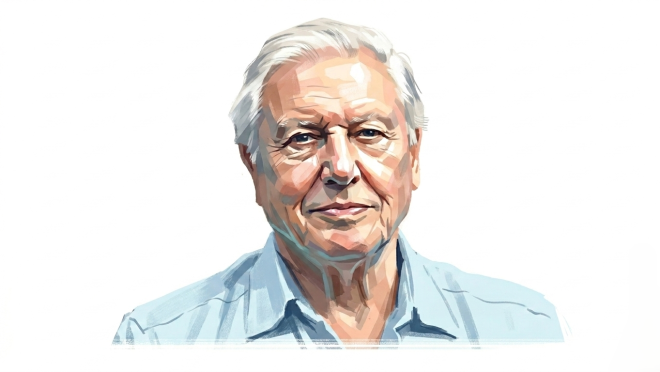
From exclaiming with wonder to sharing opinions and positive comments, we lived those moments through the wonders of the world. The question is, what was so special about it?
Rapid urbanisation and industrialisation have made us forget a true friend of nature and have diminished the childhood memories for which there are no longer any family gatherings around the television anymore.
The world pauses to celebrate a remarkable milestone today, the 100th birthday of Sir David Attenborough, a man whose voice has become synonymous with the story of life in the universe.
For decades, Attenborough has not merely documented nature, but translated its language for humanity. In doing so, he has shaped how generations understand the fragile, intricate web that sustains our planet.
It would understate his legacy to call him merely a broadcaster. Moreover, we can describe Attenborough as a storyteller, a scientist at heart, and perhaps most significantly, a bridge between human civilisation and the natural world. From the black-and-white days of television to the modern era of ultra-high-definition documentaries, his work has evolved with technology, but its purpose has remained constant, to reveal the beauty and urgency of life on Earth.
Attenborough’s journey began long before streaming platforms and global audiences. Born in 1926, he grew up with immense curiosity for fossils, rocks, and creatures. Who knew that an early fascination would later define him?
When he joined the BBC, he could not have anticipated how deeply he would shape the medium. What began as experimental programming grew into landmark series like The Blue Planet and Planet Earth, each of them expanding not just our knowledge, but our sense of responsibility.
What makes Attenborough extraordinary is how he presents his work. His narrations carry a rare combination of authority and wonder. He does not speak down to his audience, nor does he dramatise for effect. Instead, he invites viewers into nature’s rhythms. Whether describing the silent hunt of a snow leopard or the synchronised dance of marine life, his words turn observation into a lifetime experience.
Despite all this, while the first half of Attenborough’s career was about discovery, the later half has been defined by warning. As the evidence of environmental degradation became undeniable, his tone too shifted. Climate change, biodiversity loss, and deforestation were no longer distant concerns, but immediate crises. And Attenborough, even in his later years, refused to remain neutral.
This transition is perhaps his most powerful contribution. He did not remain a passive observer of nature’s decline, but became one of its most influential advocates. His documentaries began to include not only breathtaking visuals but also stark truths. Coral reefs bleaching into ghostly remains. Forests reduced to fragments. Species disappearing before they could even be named. Through his work, these abstract issues became deeply personal, from phone wallpapers to research and thesis work.
There is also something deeply humane about Attenborough’s enduring appeal. In an age of noise, speed, and constant distraction, his presence is calm and deliberate, like a sleeping bird at night. He allowed silence to speak. He trusted the intelligence of his audience. In doing so, he offered something increasingly rare, attention. And through that attention, he taught us to truly see the ecology of the world around us, from one corner to another.
For younger generations, Attenborough is more than a familiar voice. He is often the first introduction to environmental consciousness. Many people can trace their awareness of nature back to a documentary watched in childhood, narrated by him. That influence is immeasurable. It has inspired scientists, conservationists, filmmakers, and everyday individuals to think differently about their place in the world.
As we celebrate his 100th birthday, the question is not just what Attenborough has achieved, but what we choose to do with his legacy. His work has given us knowledge, perspective, and a sense of urgency. The responsibility now lies with us. Will we continue to treat nature as a resource to be exploited, or as a system to be protected?
8 May, then, is not just a celebration of his birthday, but a call to see the world as Attenborough has shown it to us: beautiful and fragile.