Bangladesh's children are growing up with lead in their blood
Decades after Bangladesh phased out leaded petrol, informal lead-acid battery recycling has become one of the country’s largest sources of lead exposure, affecting children across urban neighbourhoods through contaminated soil, dust and industrial emissions. Researchers warn the health and economic consequences are already measurable
Bangladesh's children are growing up with lead in their blood
Decades after Bangladesh phased out leaded petrol, informal lead-acid battery recycling has become one of the country’s largest sources of lead exposure, affecting children across urban neighbourhoods through contaminated soil, dust and industrial emissions. Researchers warn the health and economic consequences are already measurable
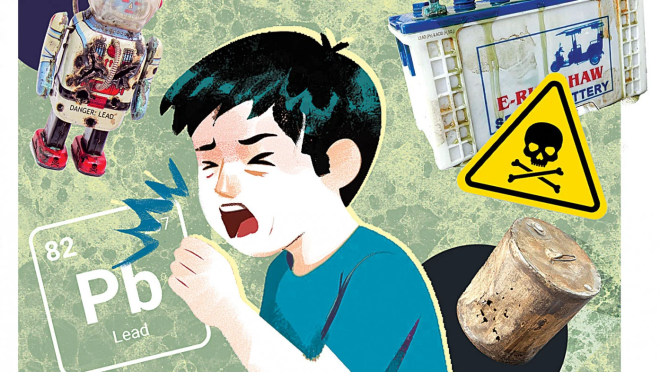
In 2020, UNICEF identified Bangladesh as the fourth most seriously affected country in the world by the number of children impacted by lead poisoning. That ranking did not trigger a national screening programme. It did not prompt a major regulatory response to the industries driving the contamination. Public and institutional responses remained limited.
That silence has a cost. A 2024 study by economist Bjorn Larsen, commissioned through Pure Earth, estimated the combined health burden of lead exposure in Bangladesh at $28.6 billion in 2019 alone, equivalent to 6 to 9% of GDP. IQ losses from childhood lead exposure cost an estimated $16 billion per year in lost lifetime productivity.
The crisis in numbers
The clinical data on blood lead levels in Bangladeshi children constitutes, by any international standard, a public health emergency.
Studies conducted across Dhaka and surrounding districts since 2012 found elevated blood lead levels in 54 to 78% of children tested. At the time, the US Centers for Disease Control and Prevention (CDC) defined elevated exposure as blood lead levels above 5 micrograms per decilitre.
In the industrial belt of Tongi, Gazipur, a 2009 study published in the International Journal of Environmental Research and Public Health found that 104 out of 105 children tested carried blood lead levels at or above 10 µg/dL, a threshold associated with measurable cognitive and behavioural damage.
A separate cross-sectional study of 779 schoolchildren across Dhaka found nearly 90% had blood lead levels above 10 µg/dL, with half above 15 µg/dL.
The most recent data sharpens the picture further.
A study conducted by icddr,b between 2022 and 2024 involving 500 children aged two to four across Dhaka found detectable lead in every child tested.
Dr Jesmin Sultana, Assistant Scientist at icddr,b and lead researcher on the study, found that 98% of the children exceeded the CDC reference value, with a median blood lead level of 67 µg/L.
Crucially, children living within one kilometre of identified lead-related industrial sites had blood lead levels 43% higher than those living more than five kilometres away — a spatial pattern that points directly to the source.
For comparison, the United States, which itself continues to face lead exposure problems in older cities, records elevated blood lead levels in less than 3% of children. The scale of exposure in Bangladesh is substantially greater.
Leaded petrol is gone, but the problem is not
The standard response to any mention of lead poisoning in Bangladesh is to note that the country banned leaded petrol in 1999, becoming the first nation in South Asia to do so.
But the sources of lead exposure have changed significantly since then, while regulatory attention has not kept pace.
The main source of urban lead exposure in Bangladesh today is the informal recycling of used lead-acid batteries, known as ULABs. In many cases, the batteries are broken apart and melted in workshops located inside densely populated residential areas, often without emission controls or protective equipment. Children living nearby are exposed through contaminated soil and dust. Areas such as Islambagh and Kamrangirchar in Dhaka are documented hotspots.
Dr Md Mahbubur Rahman, Project Coordinator at icddr,b’s Environmental Health and WASH unit, who has tracked lead sources in Bangladesh for over a decade, says lead-related industries are now the country’s most urgent source of exposure.
“Our recent Dhaka study found that lead-related industries are the main source of exposure among children. These include lead-acid battery recycling, smelting and processing operations across small, medium and large industries.” He said.
“We consider lead-related industries the most urgent sources that need to be addressed,” he added.
According to Rahman, the response should include a complete halt to informal lead-acid battery recycling, relocation of these industries away from residential areas, the development of dedicated safe recycling zones, a transition to lead-free alternatives, and stronger evidence-based policy implementation.
Other documented exposure pathways include lead-soldered food cans, particularly canned fish and condensed milk, as well as legacy soil contamination along major road corridors from pre-1999 leaded petrol that has never been remediated.

Researchers have also identified emissions from ceramic factories, pharmaceutical plants and cement producers concentrated around Tongi, Gazipur and Narayanganj as significant sources of exposure.
Lead paint, despite existing regulations, also remains in widespread household and commercial use. A 2020 study by Stamford University Bangladesh found excessive lead concentrations in soil samples from Dhanmondi.
Dr Fahmida Khanam, Additional Secretary of the Ministry of Environment, Forest and Climate Change, acknowledges the breadth of the problem.
“A substantial amount of waste is being generated from lead-acid batteries, and that volume is continuing to increase,” she said. “Another major concern is the presence of lead in food products, toys, and paints.”
She also pointed to a regulatory gap that has persisted for years: while the acceptable lead content limit for architectural paint is set at 90 ppm, no equivalent standard has yet been established for industrial paint.
What lead does to the brain
The effects of lead on the brain are well established.
Lead damages the brain because it chemically resembles calcium, allowing it to interfere with biological processes that guide early neurodevelopment.
It disrupts normal brain signalling, affecting attention, impulse control and emotional regulation.
The prefrontal cortex is among the regions most severely affected. This part of the brain governs impulse control, planning, emotional regulation and the ability to inhibit reactive behaviour.
Damage during the critical developmental window — from gestation through early childhood — is largely irreversible. There is no established safe level of lead in a child’s blood.
The CDC has repeatedly lowered its reference value as evidence has accumulated of harm at progressively lower concentrations.
Studies have linked higher blood lead levels to measurable declines in children’s IQ. Documented effects also include ADHD-like symptoms, reduced attention span, elevated aggression, and higher rates of antisocial behaviour persisting into adolescence and adulthood.
When asked whether Bangladeshi children are already experiencing these effects, the icddr,b researchers were unequivocal.
“Yes, it is affecting,” said Dr Rahman and Dr Sultana in their joint response. “All the published literature confirms these effects.”
How Bangladesh eliminated leaded turmeric
The rural exposure source that most surprised researchers was adulterated turmeric.
A 2019 study published in Environmental Science and Technology, conducted jointly by Stanford University and icddr,b, used lead isotope ratio analysis to trace the source of blood lead in rural Bangladeshi pregnant women.
The researchers identified turmeric as the predominant source. Lead chromate was being added during processing to intensify the spice’s yellow colour and increase its weight before sale.
Lead chromate is a bright, stable pigment. It is also acutely toxic.
Following publication of the research, Bangladesh introduced policy measures that reduced contamination rates from 47% in 2019 to 0% within two years, making it the only country to successfully eliminate a widespread lead-adulteration crisis of this scale.
The limits of enforcement
Bangladesh’s regulatory response to lead poisoning has remained largely static since 1999.
There is no national blood lead screening programme. The informal ULAB recycling sector continues to operate with limited oversight. There is no soil remediation programme for high-exposure areas, and blood lead testing is not integrated into routine paediatric care at public health facilities.
The icddr,b researchers point to several reasons why the informal battery recycling sector has proven resistant to the kind of coordinated intervention that eliminated lead from petrol and turmeric.
“Political commitment to restrict informal recycling, poor implementation of existing safe recycling policies, high profit margin with minimal investment for lead industries, high demand for lead-acid batteries due to the booming of millions of battery-driven three-wheelers, and finally lack of investment in safe alternatives,” said Dr Rahman.
India banned leaded petrol one year after Bangladesh, in 2000, but has since adopted a more active regulatory approach toward post-petrol lead exposure sources.
The economic case for intervention is clear. The US experience suggests a cost-benefit ratio on lead reduction of approximately 17:1. Bangladesh is currently absorbing losses conservatively estimated at 6 to 9% of GDP annually while investing comparatively little in the interventions required to reduce exposure.
There are, however, early signs of institutional movement.
Dr Fahmida Khanam said a multi-stakeholder steering committee chaired by the Environment Secretary has been formed to coordinate action across ministries, assigning responsibilities to the Ministry of Health, DGHS, BSTI, food certification authorities and the Ministry of Industries.
She said a comprehensive national strategy with an implementation plan extending to 2035 is being finalised, while funding support is being sought from the Asian Development Bank.
“In reality, work has already started, and significant progress has been made in several areas, particularly concerning lead-acid batteries and certain medicinal products,” she said.
Whether those commitments translate into sustained and enforceable regulatory action remains to be seen.