Beneath the metro, a bamboo bookstore is keeping Dhaka's literary soul alive
One day, while mindlessly scrolling through my phone, a video came up on my feed, a short review by Moiyen Zalal Chowdhury, a faculty member at BRAC University, showcasing a library situated at the bustling edge of the Uttara Center Metro Station, where the hurried rhythm of Dhaka rarely pauses for reflection.
Beneath the metro, a bamboo bookstore is keeping Dhaka's literary soul alive
One day, while mindlessly scrolling through my phone, a video came up on my feed, a short review by Moiyen Zalal Chowdhury, a faculty member at BRAC University, showcasing a library situated at the bustling edge of the Uttara Center Metro Station, where the hurried rhythm of Dhaka rarely pauses for reflection.
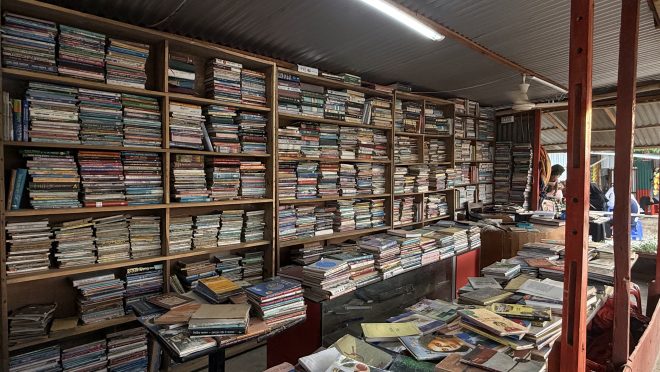
There stands an unlikely refuge built from bamboo poles, corrugated tin, weathered wood, and dreams. Then I thought of visiting this shop and having a look at all the open treasuries it has.
It is termed a gold mine. The warm vocal tune, the key-string echo of a harmonium, a simple light, and all the national and international books, available at a very cheap rate, kept on the shelves in the most organised way possible. The structure itself appears almost cinematic, as though lifted from the pages of a Bengali novel, hardly seen in today’s era. Once, while walking through, he saw that place empty, with serene greenery and a silent vacuum of peace alongside it. There, he thought of starting his journey of selling books, and it has now been four months since the establishment of his shop.
‘Shikder Bhai’, the founder of Shikder Boi Bitan, has had immense love and passion for books and music over time. During his early childhood, he used to see people in his village setting up a jute mat, sitting and reading a large number of books, with all their talks and opinions centred on them. From this, his attraction to books started.
Once, he visited Bakulia in Chattogram, where he saw that all the villages in that area had several libraries, which are diminishing nowadays. Then he used to sit in Nilkhet with other booksellers and readers and gossip. All these experiences inspired his love for books and moulded him to set up libraries everywhere.
From opening branches in Barishal, Patuakhali, Joydebpur, and Dhaka, he has experienced it all. Previously, he had a shop in Dhaka’s Shiddeshwari for 17 years. He opened these shops in places to meet people and connect with them. But selling books in Dhaka was not as easy for him, in terms of finding a place, collecting books, and everything else. He used to walk in search of a place to set up his shop. He didn’t think about buyers because he believed that if there were books, buyers and readers would definitely come.
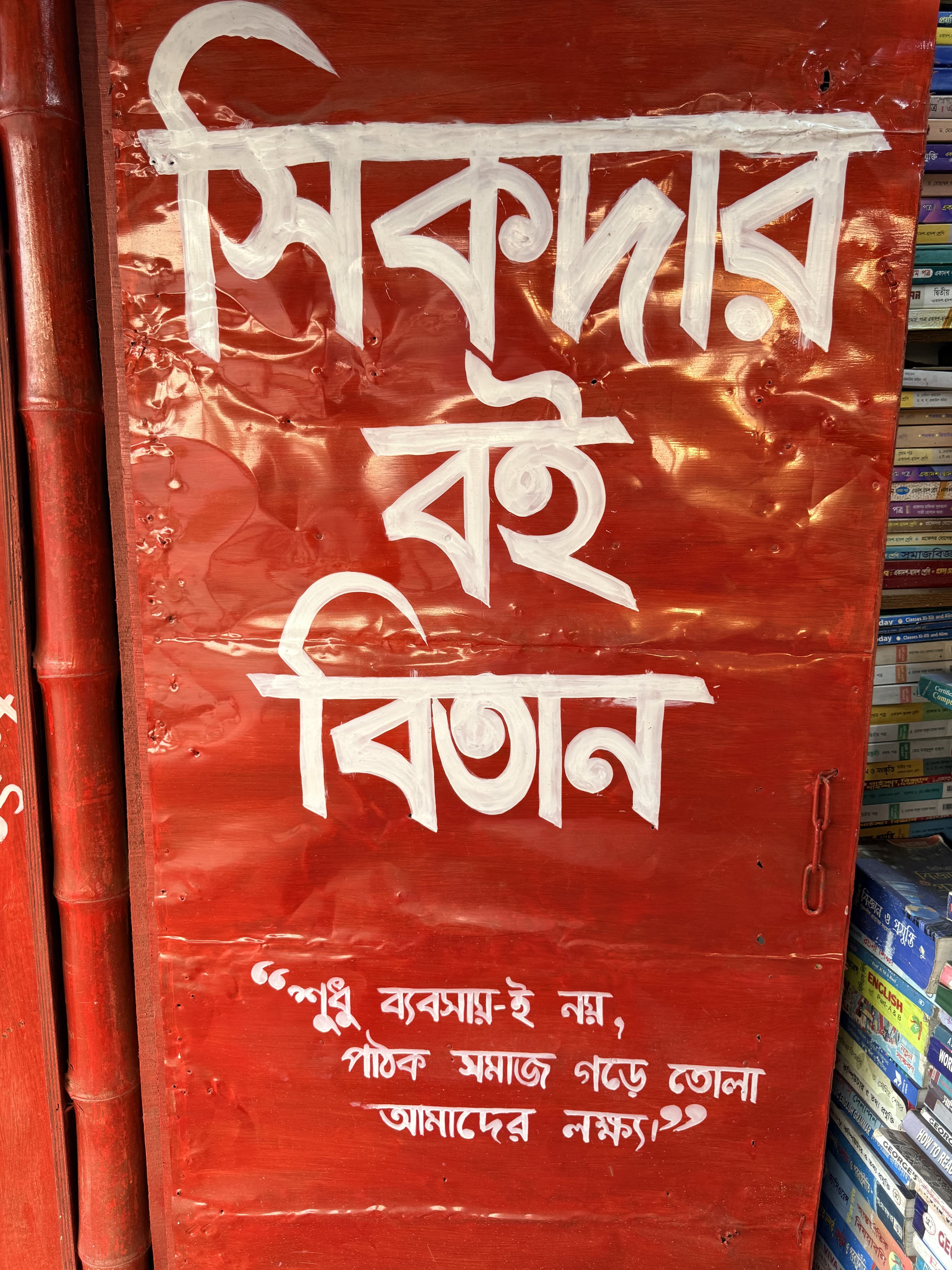
A clear cut slogan, Photo: Tahmid Zarif
The roof is made of tin sheets patched together over time. Bamboo frames support rows of wooden shelves overflowing with books. Some are new, some worn with age, their pages carrying the fingerprints of countless readers. There are novels, poetry collections, political essays, translated classics, religious texts, biographies, magazines, children’s stories, academic books, and rare second-hand editions. Yet, what makes the place extraordinary is not merely the books. It is the atmosphere and the pricing.
Throughout the day, students stop by after classes, and office workers pause during evening commutes. Rickshaw pullers, university aspirants, poets, street photographers, faculty members, readers, sophisticated personalities, and curious passers-by gather there without invitation. Some purchase books at affordable prices. Others stand quietly in corners reading for hours without pressure to buy anything. No one is turned away from his shop. Everyone is invited.
While customers browse through stacks of literature, Shikder Bhai often plays a harmonium placed near the entrance of the library. His songs drift through the metro station air, blending with the sounds of trains and footsteps. He sings Rabindra Sangeet, Nazrul Geeti, folk songs, and many more with heart.
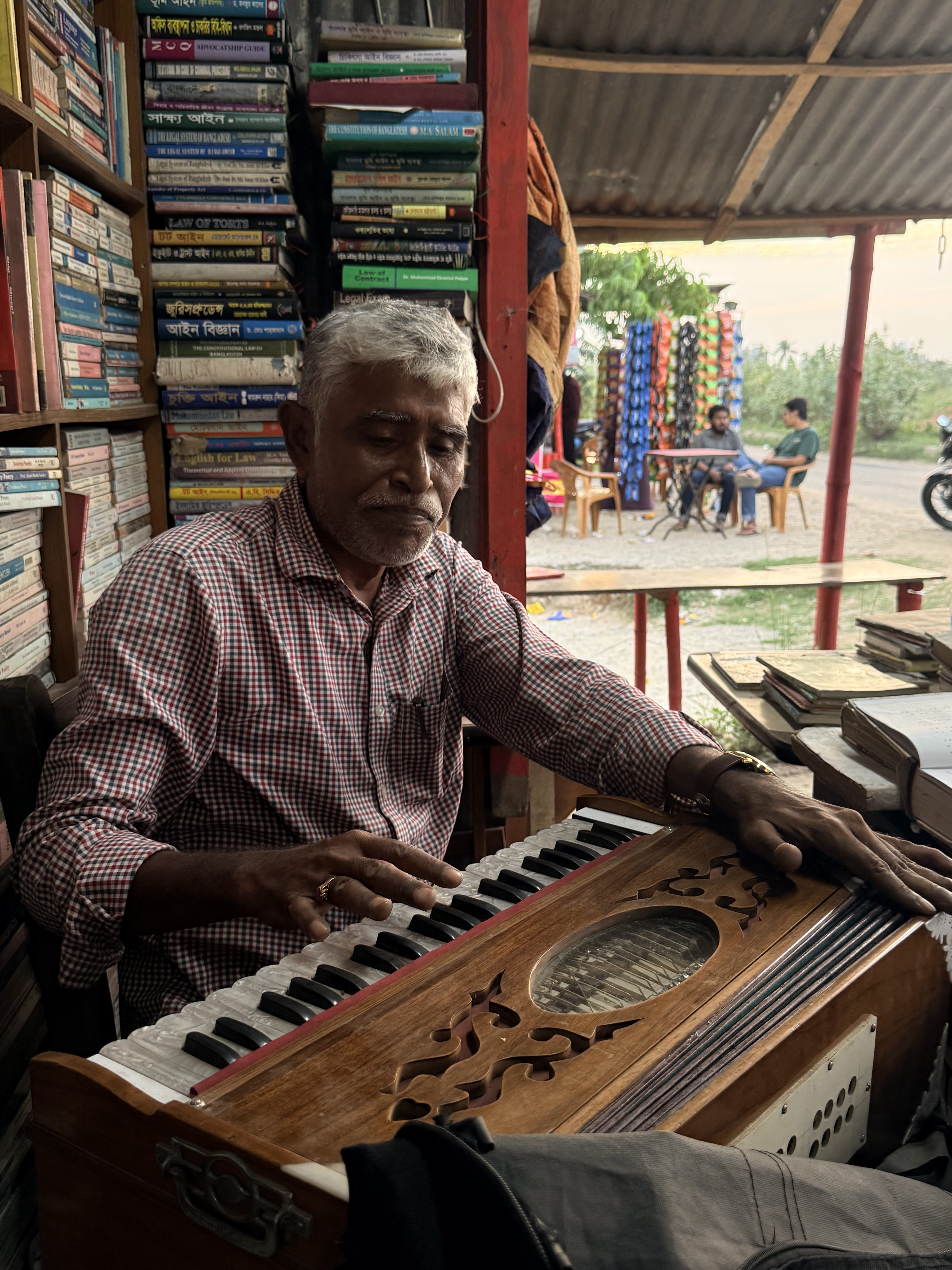
Photo: Tahmid Zarif
His voice is not polished in the commercial sense, but it carries sincerity, the kind that belongs to people who have spent their lives among stories.
The result is something increasingly rare in modern urban life: a space where literature, music, conversation, and humanity coexist naturally.
A different kind of public space
Dhaka is a city constantly expanding upward through flyovers, high-rises, and elevated transport systems. The metro rail has transformed commuting patterns and accelerated the pace of daily life. Yet beneath this infrastructure, spaces for reflection and community are often disappearing.
That is why Shikder Bhai’s library feels so significant. People do not simply come here to buy books. They come to breathe.
It exists outside the polished commercial logic of modern retail culture. There are no fluorescent lights, digital displays, or corporate branding. Instead, there is bamboo, old paper, tea stains, handwritten notes, and conversation. In an era dominated by scrolling screens and algorithm-driven entertainment, the library offers something deeply analogous and profoundly human.
Regular visitors say the environment feels therapeutic. A university student who visits the library several evenings a week described it as a place where the city becomes softer. Another visitor said he initially stopped there out of curiosity but eventually began spending hours reading after work because the atmosphere reminded him of village tea stalls where people once gathered to exchange ideas and stories.
Many commuters who pass through Uttara Center Metro Station every day now recognise the harmonium melodies before they notice the shop itself. The music has become part of the identity of the area.
Books without barriers
Perhaps the most remarkable aspect of the library is its openness.
Unlike many bookstores where customers are expected to make quick purchases, Shikder Bhai encourages people to spend time with books freely. Young readers often stand between shelves reading entire chapters. Some sit on improvised stools or on the edge of the wooden platform beneath the tin roof. Others stand and read or browse books for hours. In a society where access to books can still be limited by affordability, this informal reading culture carries social importance.
Bangladesh has a rich literary tradition rooted in public engagement with poetry, storytelling, and political writing. However, the rapid commercialisation of urban life has reduced the number of accessible community reading spaces. Public libraries often struggle with maintenance and modernisation, while independent bookstores face increasing economic pressure.
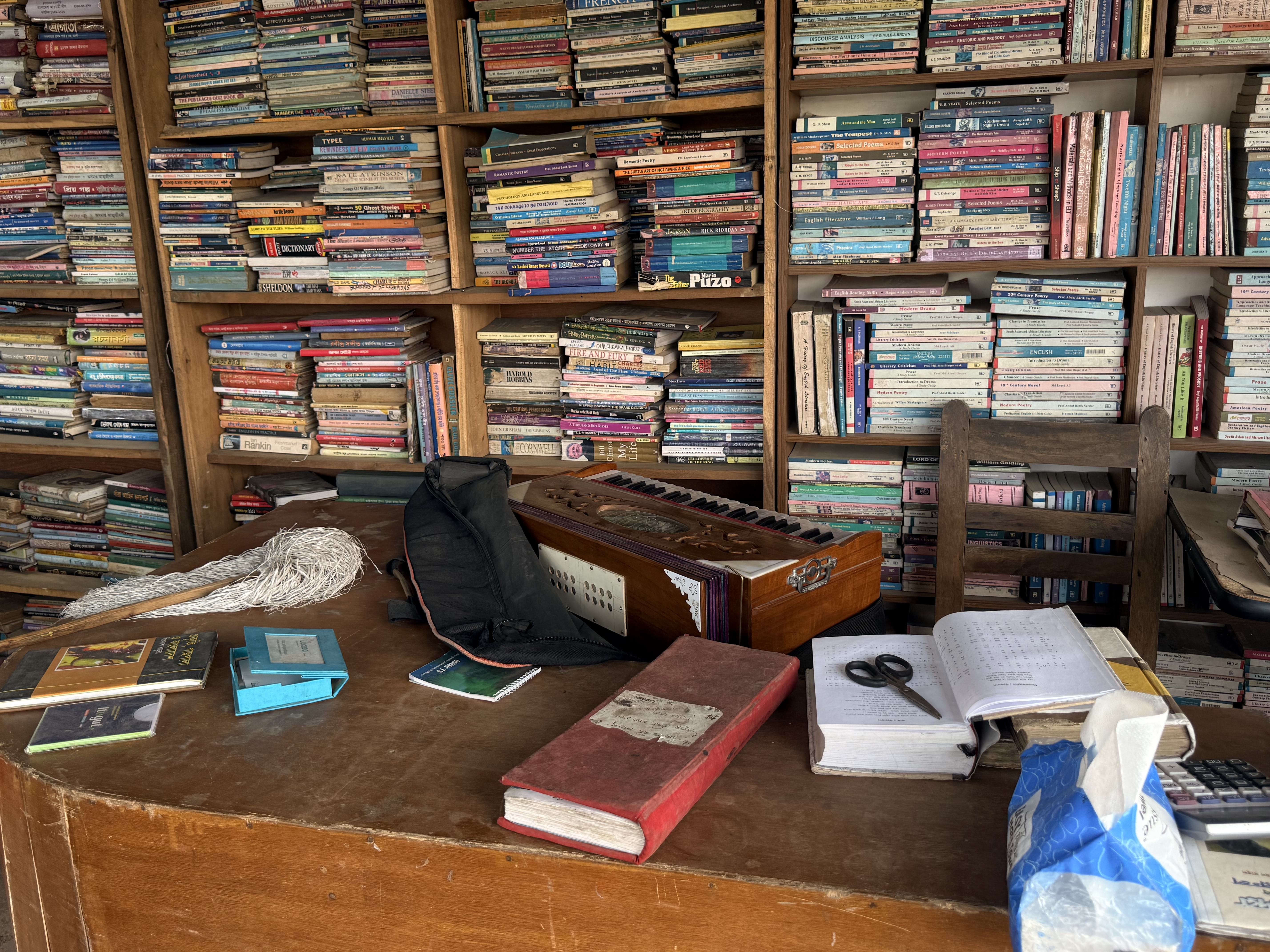
Photo: Tahmid Zarif
Against that backdrop, Shikder Bhai’s humble initiative represents more than nostalgia, it represents resistance. Resistance against cultural isolation, resistance against the idea that meaningful spaces must be expensive or exclusive, and resistance against the disappearance of public intellectual life from everyday streets.
During quieter evenings, the library transforms into something between a roadside cultural adda and a miniature folk gathering. Strangers listen while metro trains continue arriving overhead, creating a surreal contrast between modern infrastructure and timeless artistic expression.
There is something symbolic about this coexistence.
The metro rail represents speed, efficiency, and urban modernisation. Shikder Bhai’s library represents slowness, contemplation, and emotional connection. Side by side, they reveal two different dimensions of contemporary Dhaka.
One moves people physically. The other moves them inward.
Preserving the soul of the city
As Dhaka modernises at remarkable speed, questions increasingly emerge about what kind of city it is becoming. Development projects continue to reshape the urban landscape, but many residents worry about the gradual erosion of intimate, community-centred environments that once defined everyday life.
Places like Shikder Bhai’s library remind people that culture is not built solely through grand institutions or formal events. Sometimes culture survives through small acts of persistence: a man selling books under a tin roof, a harmonium played beside a metro station, or a reader turning pages while trains thunder overhead.
These details matter because they preserve the emotional texture of a city.
In many ways, the bookstore reflects the enduring spirit of Bangladesh’s literary heritage. This is a country where poetry has fuelled protest movements, where songs have inspired liberation, and where books continue to shape personal and political imagination. Even in an age of digital distraction, the sight of people gathering around shelves of printed books remains deeply powerful.
And for a brief moment, the noise of the city fades. In that small corner beneath the metro line, Shikder Bhai has built more than a bookstore. He has built a sanctuary with the quote: “শুধু ব্যবসায়-ই নয়, পাঠক সমাজ গড়ে তোলা আমাদের লক্ষ্য”.