Between the canvas and the crest: The shifting economics of Dhaka’s framing houses
In the crowded markets of Katabon and Gausul Azam, Dhaka’s framemakers have spent decades perfecting an invisible craft. Now, squeezed by cheap imports, dwindling exhibitions and corporate crests, they are fighting to survive
Between the canvas and the crest: The shifting economics of Dhaka’s framing houses
In the crowded markets of Katabon and Gausul Azam, Dhaka’s framemakers have spent decades perfecting an invisible craft. Now, squeezed by cheap imports, dwindling exhibitions and corporate crests, they are fighting to survive
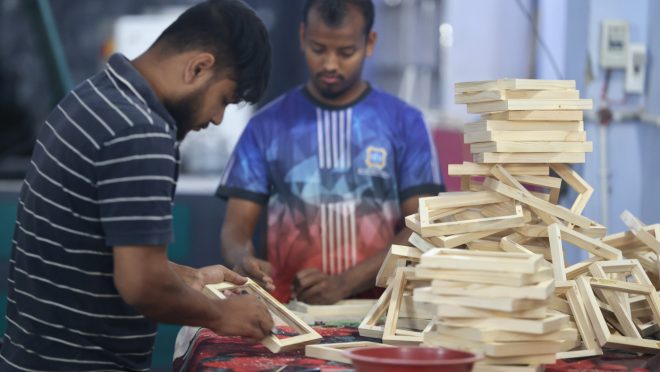
When you are tasked with framing a piece of art that spans 24 feet by 16 feet, the project ceases to be about aesthetics and becomes a feat of structural engineering. However, for Yunus, the owner of Hawladar Frame Crest and Laser House, it falls under the purview of something much more primal: survival.
Historically, frames were as much a part of the art as the paint itself. Born in churches long before museums existed, they were designed to protect and glorify sacred images. In the Renaissance, a frame was a status symbol, sometimes more expensive than the work it held.
Today, that history is visible in the sheer variety of styles found in Dhaka’s framing shops, from the heavy gold filigree that feels like a relic of a more indulgent age to the stark, minimalist black frames of modern galleries. Every gallery visit is, in reality, two exhibitions: one of art, and one of the structures that hold it up.
In the cramped, sawdust-choked atmosphere of the Gausul Azam and Katabon markets in Dhaka, most framing shops deal in the small-scale portraits of grandchildren, certificates for mid-level managers. Yunus has carved out a different niche. His business thrives on the bulk and the behemoth: redecorating luxury hotels, outfitting government offices, and handling massive commemorative souvenirs.
Among his most memorable commissions is work for Hotel Le Méridien. The frames required for the hotel’s lobby and rooms were so large that transporting them through Dhaka’s traffic would have been a disaster. Instead, Yunus’s craftsmen moved into the hotel for the duration of the project, building the frames inside the very rooms they were designed for.
For men accustomed to the sawdust and noise of Gausul Azam market, spending weeks inside a five-star establishment was a surreal departure from reality. They worked long hours, and in the quiet moments between shifts, these workers who would normally never have a reason to pass the front gates found themselves lounging on luxury sofas or napping on five-star beds.

Photo: Mehedi Hasan
“My employees would tell me that without this job, they’d never even get past the front gate, let alone enter the rooms,” Yunus says. “They’d finish a gruelling session with the heavy timber and then take their breaks by lounging on the luxury sofas or lying down on the five-star beds just to see what it felt like. There is a different kind of satisfaction in seeing our work, the work done by hands usually covered in adhesive and wood dust, hanging in the most expensive rooms in the country.”
Yunus has built his business on this kind of scale. Walk-in trade for single photo frames has dwindled, and bulk orders from government offices, large organisations and hotels have become his primary source of income. These clients do not want one piece; they want hundreds of souvenirs or an entire wing redecorated. Recently, he handled a project for the July Foundation worth nearly one crore taka, involving the mass production of two specific wooden souvenirs: a customised calendar and a memorial plaque etched with the names of the July martyrs. Both required intricate, painstaking handwork that could not be rushed. He handled comparable demands during the previous government’s era for Mujib’s 100th birth anniversary, a project of equal workload and profit.
“My peers say that I am lucky in business,” Yunus says. “Maybe I really am lucky, but it also requires dedication and honesty to the work. These projects demand you work day and night.”
But Yunus did not start at the top. He spent his formative years under the wing of Jahangir, a man who, for decades, was the undisputed master of exhibition framing in Dhaka.
Ask around in Dhaka’s creative circles for a framing recommendation, and almost everyone will eventually point you towards Jahangir. For the better part of three decades, Jahangir Frame Ghar was not just a shop; it was the default destination. Whether it was a high-stakes gallery exhibition or a delicate piece of personal history, Jahangir’s name carried a guarantee of quality stretching from the showrooms of Dhaka to the halls of Chattogram.
That reality has now undergone a jarring shift. Nobody knows quite where he has gone. Some say he has retreated to his village, hiding from the ghost of his debts. Others reckon he has moved to Qatar, trading his craftsman’s hands for manual labour.

Photo: Mehedi Hasan
A framemaker is, in many ways, the unsung hero of the art world. A good frame acts as a silent mediator, creating the boundary between the artwork and the environment it inhabits. Done well, it adds depth to the viewing experience. Done poorly, it can choke the life out of a painting, undoing months of an artist’s effort with a single badly-angled cut. Jahangir understood this better than most.
He began his journey in 1989 as an apprentice to his uncle, eventually striking out on his own in 1993. Over the years, his shop in Gausul Azam market became a hub for Dhaka’s artist community. He was not simply selling wood and glass; he was building connections.
“We used to frame everything for our exhibitions with Jahangir because he understood exactly what we wanted,” says Tirtho Saha from the Brihatta Foundation. “There was a level of trust there. The way he handled the art pieces, his dedication it was something the entire artist community appreciated. He’d even work at lower rates for regular customers like us. Since he went missing about a year ago, we’ve been a bit lost. We go to other shops in Katabon now, and they do the work well if we explain it carefully, but they lack his years of experience. And honestly, they’re a bit more expensive.”
The collapse, when it came, was total. In 2025, a fire tore through Jahangir’s warehouse in Hazaribagh. It was not a small blaze; the machinery and equipment lost were reportedly worth nearly Tk1.5 crore. Twenty-three years of professional momentum were reduced to ash in a matter of hours.
The catastrophe came on the heels of the pandemic, which had already left him drowning in nearly Tk65 lakh of debt. For a man whose livelihood relied on the steady, rhythmic output of his craftsmen, the fire was the final, unrecoverable blow. He tried to turn it around. The weight was too much. He simply disappeared.
The story of Jahangir is a painful entry point into the wider world of Dhaka’s framing trade, one that is changing in ways that go beyond the fate of a single man. There are at least 15 shops clustered in the Katabon and Gausul Azam area, each a small universe of sawdust and glass.
But for most of them, the assured craftsmanship with which Jahangir once operated is becoming a luxury they can no longer afford. The business of framing art is increasingly a business of survival, the craft of the mitre joint pushed aside by the more reliable, if less poetic, trade of making corporate crests.

Photo: Mehedi Hasan
At Ruma Frame Corner, which has been a fixture in Katabon since 1992, the shift is unmistakable. Al Mamun, who has worked there for 15 years, recalls a time when his brother-in-law, Idris Ali, helped establish the framing scene in the area. “Back then, there were only three or four of us,” he says. “Now, you have shops in Katabon, Gausul Azam, even Elephant Road. The competition is everywhere.”
It is not merely that there are more shops; the barrier to entry has dropped. In the old days, a framer worked with seasoned wood, ceramic, and high-quality lacquer. Today, the market is dominated by Chinese board, a synthetic MDF that is cheap, widely available, and requires little actual skill to handle. It has turned a craft into a commodity. “People don’t frame family photos like they used to,” Mamun observes. Digital screens have replaced the mantlepiece. “Exhibitions became fewer after the pandemic, and the profit margins on a single frame barely cover the rent and salaries.”
This is why the crest business has become the industry’s life raft. Almost every shop in Katabon that once did only framing now relies on making trophies and awards to keep the lights on. While a custom art frame demands time, precision, and an eye for aesthetics, a crest is a high-volume, low-effort transaction. The parts arrive pre-made from China at low prices. You buy a crest for Tk400, print a nameplate on it, and sell it for Tk800 or Tk1,000. The labour cost is minimal. It provides the steady, regular income that sustains a shop through the months when the galleries are quiet.
Even for Yunus, the economics are relentless. His monthly overheads, rent and salaries for his team come to around Tk4 lakh. The art world cannot always absorb that pressure. Some months, orders for exhibition frames are non-existent.
The cost of a frame itself depends on size and material. Wood still commands a higher price than China board, though even within timber, there is a hierarchy: kerosene wood is the standard workhorse for most everyday frames, while more prestigious options, such as segun, are reserved for those who specifically request them. A 12×16-inch wooden frame costs Tk500; the China board equivalent is Tk450. As the dimensions grow, so does the price gap. A 24×36-inch wooden frame will set you back Tk2,100, while the synthetic board version comes in at Tk1,800.
This is the micro-reality of the Katabon framing scene: a world of extraordinary skill and quiet tragedy, of high-end hotel lobbies and cheap plastic trophies. It is a place where a 30-year legacy like Jahangir’s can be erased by a single warehouse fire, and where the next generation of framemakers is learning that survival depends less on the soul of the craftsmanship than on luck and corporate connections.