Coffee naps: The productivity hack we've been overlooking
What if I told you one of the best ways to get more out of your coffee is to fall asleep right after drinking it?
Coffee naps: The productivity hack we've been overlooking
What if I told you one of the best ways to get more out of your coffee is to fall asleep right after drinking it?
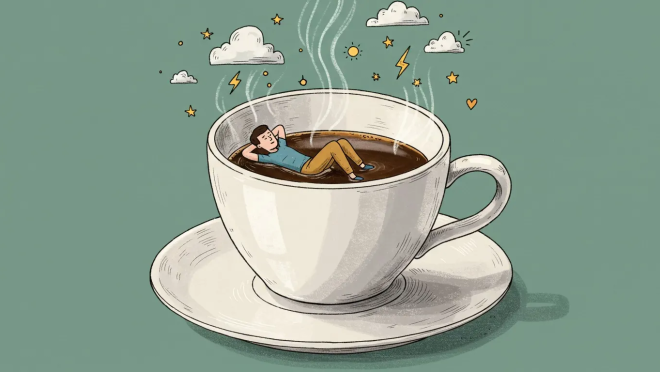
It sounds like the kind of advice that belongs in social media myth rather than a science journal. In general, coffee is supposed to keep us awake, not lull us to sleep.
Yet researchers have spent years studying this unfamiliar combination, and they found that a simple 20-minute “coffee nap” can make people feel more alert than a nap or just a cup of coffee alone.
As someone who depends on coffee to survive long university days, 9 hours of office and the occasional late-night productivity session, you probably had one question: How can sleeping after caffeine possibly work?
“You are telling me to have a cup of coffee and then immediately go to sleep?”
That was exactly how I reacted the first time I heard about a coffee nap.
For years, I believed coffee and sleep were antagonists. One keeps you awake, the other is what coffee is supposed to replace. Blending the two sounded like one of those internet productivity hacks that people swear by but no one can actually explain.
Looking into the internet and science sites
Surprisingly, it turned out that coffee naps aren’t any myth or just another social media trend. They are verified by research in sleep science and neuroscience, and they might be one of the simplest ways to fight that exhausting afternoon slowdown.
For me, another cup of coffee always works when I am just delaying taking a rest while juggling so much work.
That’s why the concept of combining coffee and a short nap just caught my attention.
Wait… what exactly is a coffee nap?
A coffee nap is amazingly simple.
You drink a cup of coffee quickly and then immediately take a 15-20-minute nap.
Not an hour. Not two hours. Just enough time to rest before you dive into deep sleep. The trick lies in timing.
According to scientists, caffeine doesn’t enter your bloodstream and reach your brain instantly. It usually takes around 20 minutes before your alertness starts to increase.
That small delay creates an opportunity.
While you are sleeping, your brain starts clearing away a chemical called adenosine, the substance that accumulates throughout the day and makes you feel tired and sleepy.
At the time you wake up, two things happen simultaneously: your short nap has already reduced some of the adenosine, and the caffeine finally starts reaching your brain.
Instead of competing with each other, the nap and the coffee work together.
The science behind it
Throughout the day, your brain builds up adenosine.
Think of adenosine as your brain’s sleep pressure meter. The more time you are awake, the more it accumulates, making you feel tired.
Caffeine doesn’t remove adenosine.
Instead, it blocks adenosine receptors, stopping your brain from receiving those “you’re tired” signals.
But here’s the catch. If your brain is already overloaded with adenosine, caffeine has to compete with it.
A short nap naturally lowers some of that accumulation.
When you wake up, caffeine has an easier job to block the remaining receptors, making you feel more refreshed.
This explanation is based on the two-process model of sleep regulation, which suggests that awareness depends on both your body’s internal biological rhythm and the buildup of sleep pressure (adenosine) throughout the day.
Does research actually support it?
Yes.
Multiple studies have found that combining caffeine with a short nap can improve alertness, reaction time, attention, driving performance, and also mental performance during monotonous tasks.
In several studies, participants who took part in a coffee nap performed better than those who only drank coffee or only took a nap.
That’s why some shift workers, drivers, medical professionals, and students use the technique during demanding schedules.
When coffee naps don’t work
Like every productivity trick, coffee naps aren’t magic. They might not help if
you nap for more than 30 minutes and wake up drowsy because of sleep inertia, or you drink coffee late in the evening, making it harder at night to sleep, or you’re severely sleep deprived.
A coffee nap cannot replace consistent, quality sleep.
Think about it as a temporary boost, not as a substitute for healthy sleep habits.
Though the real lesson of a coffee nap isn’t about caffeine at all.
It is about disclosing that our brains are not machines built to run limitless on dedication and another cup of coffee. I think sometimes, the smartest way to be more proactive and productive isn’t to stay awake longer, it’s to allow ourselves to pause.
So the next time I find myself reaching for coffee during that familiar afternoon setback, I might not head straight back to my laptop.
I might close my eyes instead.
Maybe the brain also has been trying to tell us something all along: working smarter doesn’t always mean staying awake longer. Sometimes, it begins with closing your eyes for just twenty minutes.