USDC, CSD showcase solar irrigation and agrovoltaics project at ULAB’s 23rd Foundation Day
USDC, CSD showcase solar irrigation and agrovoltaics project at ULAB’s 23rd Foundation Day
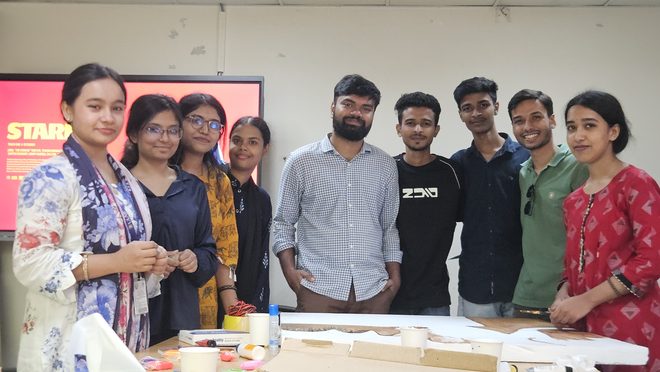
The ULAB Sustainable Development Club (USDC), in collaboration with the university’s Center for Sustainable Development (CSD) and Department of Environmental Studies and Sustainability (ESS), showcased a student-led solar irrigation and agrovoltaics project during the University of Liberal Arts Bangladesh’s (ULAB) 23rd Foundation Day celebrations on October 4.
The demonstration explored how renewable energy can be integrated into agricultural systems to support sustainable farming and reduce dependence on fossil fuels.
The initiative was inspired by CSD’s Strengthening Households with Integrated Farming Through Energy Transformation (SHIFT) project, which focuses on improving climate resilience among smallholder farming communities in Tetulia, Panchagarh.
The SHIFT project promotes solar-powered irrigation as an alternative to conventional fossil-fuel-based systems. It also encourages sustainable farming practices, including biofertiliser production from organic waste and greater participation of women and young people in local decision-making.
Building on this approach, USDC students developed the demonstration as a hands-on learning project. Students participated in its conceptualisation, design, construction and testing to explore the practical applications of renewable energy in agriculture.
The project was displayed alongside CSD’s research and development initiatives addressing locally led climate action, governance, the blue economy, sustainability education, agriculture and energy.
Students, faculty members and ULAB Vice-Chancellor Professor Shamsad Mortuza visited the showcase and observed the demonstration, which offered an opportunity to explore practical responses to environmental and agricultural challenges.
The project was led by A.H.M. Munaimul Azam, president of USDC, under the guidance of Nayma Akther Jahan, lecturer-cum-research associate at the Department of Environmental Studies and Sustainability.
The initiative sought to connect academic learning with real-world challenges by encouraging students to develop and test practical sustainability solutions.
Through the project, USDC and its collaborators highlighted the role of student-led initiatives in promoting renewable energy, sustainable agriculture and climate-conscious innovation.