IUB holds GSG Global Day 2026 focusing on climate change and urban development
IUB holds GSG Global Day 2026 focusing on climate change and urban development
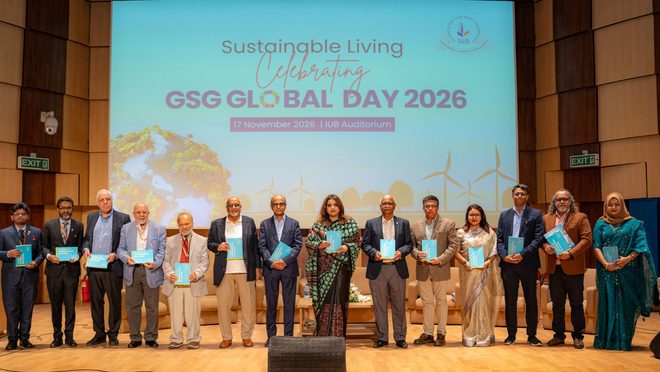
Independent University, Bangladesh (IUB) held GSG Global Day 2026 on 17 November, bringing together policymakers, diplomats, academics, researchers and development professionals to discuss sustainable development, climate change and the challenges of making Dhaka more liveable by 2030.
IUB’s Department of Global Studies and Governance (GSG) holds the event annually in keeping with the priorities of United Nations Day. This year’s programme focused on the UN Sustainable Development Goals (SDGs) and the environmental and social challenges facing Bangladesh and the wider world. It featured an inaugural session, the launch of a journal supplement, a roundtable policy dialogue and a cultural programme, according to the press release.
Bangladesh’s progress on the SDGs
State Minister for Foreign Affairs Shama Obaed Islam MP attended the inaugural session at the IUB Auditorium as chief guest. Dr Debapriya Bhattacharya, distinguished fellow at the Centre for Policy Dialogue (CPD), delivered the keynote address on Bangladesh’s progress towards the SDGs.
“We are translating our commitment into concrete national actions. The government’s 31-point program manifesto is closely aligned with the 2030 agenda, with 73 percent of its activities directly and 27 percent indirectly corresponding to SDGs. This alignment is reinforced by our Five-Year Strategic Framework for Reform and Development 2026-2031, which seeks to turn SDGs into national priorities, accelerate inclusive development and ensure that no one is left behind,” Shama Obaed Islam said.
She also highlighted canal excavation, tree planting, waste-to-energy projects, waste management, rooftop solar panels and renewable energy as priorities for the government’s environmental efforts.
IUB Board of Trustees Chairman Didar A Husain, Vice-Chancellor Professor M Tamim and School of Environment and Life Sciences Dean Dr K Ayaz Rabbani also spoke at the inaugural session. Dr Md Shanawez Hossain, associate professor and head of the GSG department, delivered the welcome remarks.
The session marked the launch of a special SDG supplement of the Journal of International Relations, with articles by faculty members from IUB and the University of Dhaka’s Department of International Relations. Professor Rashed Uz Zaman, chair of the journal’s committee at the University of Dhaka, and Professor Imtiaz A Hussain, the journal’s guest editor, spoke at the launch. Hussain was the founding head of GSG and directs IUB’s Center for Social Science Research. IUB Pro-Vice-Chancellor Professor Daniel W Lund delivered the closing remarks.
Policy dialogue on Dhaka’s future
In the afternoon, Professor M Tamim opened a roundtable titled “Dhaka 2030: Governing a Livable, Inclusive and Climate-Resilient City” at the IUB Multipurpose Hall. State Minister for Land and Chittagong Hill Tracts Affairs Mir Mohammed Helal Uddin MP attended as chief guest.
Helal Uddin called for land zoning and integrated urban planning, saying much of Dhaka was made up of mixed-use areas with little distinction between residential and commercial spaces. He said plans to keep footpaths clear should include alternative spaces for street vendors, given their role in the informal economy.
Citing the government’s initiative to relocate ministries to Agargaon, he said planners should account for traffic flow, green spaces, renewable energy use and the wider urban environment. He said such planning was needed to make Dhaka and other major Bangladeshi cities more liveable.
The roundtable focused on SDG 11 (Sustainable Cities and Communities). Participants discussed housing, urban mobility, air pollution, waterlogging, waste management, water and sanitation, public health, road safety and the inclusion of women and persons with disabilities. They also discussed how public agencies could coordinate their work and use evidence to guide policy reforms. The GSG department plans to prepare a policy paper based on the discussion and share it with the relevant authorities.
Participants included representatives and experts from the Dhaka Transport Coordination Authority, Rajdhani Unnayan Kartripakkha (Rajuk), Dhaka North City Corporation, the Department of Narcotics Control, BRAC James P Grant School of Public Health, WaterAid Bangladesh, Ekmatra Society and Prothom Alo. Academics and researchers from Jahangirnagar University and IUB also took part.
Md Ohidujjaman, a faculty member in the GSG department, moderated the roundtable, and Shanawez Hossain delivered the closing remarks.
Discussions throughout the day also covered the effects of climate change on highly vulnerable countries, pollution in rivers and growing pressures on urban environments. UN representatives, government officials, think tank experts and representatives of local and national institutions were among those who attended.
Global Gatekeepers, an IUB student club, presented the cultural programme that closed the event at the IUB Auditorium.