Education in your pocket, yet still taxed as a luxury
Education in your pocket, yet still taxed as a luxury
Our tax policy still treats smartphones and mobile internet as if they are luxury products rather than basic necessities of modern life.
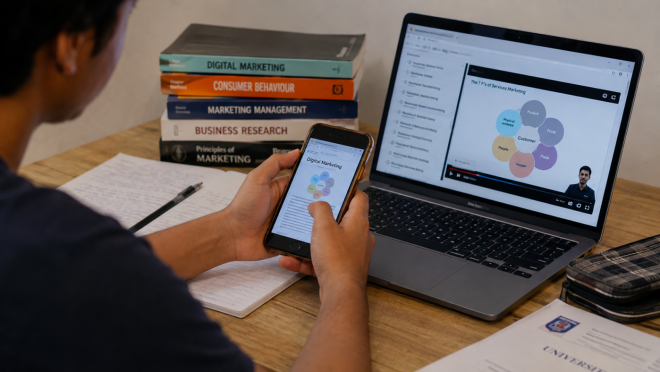
Let us think about the daily life of a university student. The student checks class notices, reads PDFs, searches for assignment materials, consults online journals, watches video classes and completes forms through the phone. Scholarship applications, mobile banking and communication are also managed through the same device.
However, our tax policy still treats smartphones and mobile internet as if they are luxury products rather than basic necessities of modern life.
There was a time when a mobile phone was a symbol of wealth and social status. But that reality has changed. Today, a smartphone serves as a classroom, library, newspaper, bank, camera and job application centre. For students who cannot afford a laptop or computer, it is the main gateway to the digital world.
A survey conducted by the Bangladesh Bureau of Statistics during the first three months of 2026 shows that 73.4% of households have at least one smartphone, while only 9% have a computer. During the same period, 58.6% of people aged five years and above used the internet. These figures show that digital life in Bangladesh is far more dependent on mobile phones than on computers.
However, one smartphone in a household does not mean that every family member’s digital needs are being fulfilled. Nearly 90% of people use mobile phones, but personal ownership is much lower. Many still borrow or share a phone with family members. This gap is particularly important for students because online classes, assignments and job applications often have fixed deadlines.
Digital inequality is therefore not only about phone ownership. The quality of the device, the reliability of the connection and the ability to purchase data regularly are equally important.
At present, mobile services are subject to 15% value-added tax, 20% supplementary duty and an additional 1% charge. Mobile operators describe the combined tax rate as 39%. However, these taxes are not calculated on the same base. Therefore, when a customer buys mobile services worth Tk100, the entire Tk39 is not directly taken as tax. Around Tk28 may go towards different taxes.
For a student who receives limited financial support from the family or earns money through private tuition, the price of every data package matters. Small amounts of tax can gradually become a significant monthly expense.
Mobile data pricing creates another unfair burden. People who can afford large packages usually pay less for each gigabyte, while those with limited income are forced to buy smaller packages at a higher rate. Therefore, people with less money often pay more for the same service.
Buying a device creates a similar financial burden. In Bangladesh’s formal market, a basic smartphone from a recognised brand costs around Tk15,000. A mid-range phone usually costs between Tk20,000 and Tk30,000 or even more. For a student from a low-income or lower-middle-income family, this is not a small expense.
The total tax burden on a fully built smartphone imported from abroad is currently around 61.8%. If the import value of a phone is Tk10,000, different duties and taxes may add nearly Tk6,000 to its cost. Transport, marketing and the profit margin of sellers make the retail price even higher.
The national budget for the 2026–27 fiscal year has introduced benefits for local mobile phone production. Advance income tax on 22 types of raw materials has been reduced to 1%, while conditional VAT benefits for local production and assembly have been extended until 2030. Some telecommunications taxes have also been reduced and the fixed tax of Tk300 on a new SIM card has been withdrawn.
These are positive steps. However, the main question remains unanswered. Will these benefits reduce the retail price of phones? Will lower costs for telecommunications companies make data packages cheaper for students? or will the benefits remain within the financial accounts of the companies?
The government needs to collect revenue. This is normal and necessary. However, an expensive flagship phone and a basic smartphone used for online classes, job applications and communication should not be treated in the same way. A luxury device may be taxed heavily, but a basic device needed for education and employment should be made more affordable.
It may not be practical to remove all taxes on smartphones immediately. A more realistic option would be to introduce a lower tax rate for basic smartphones within a particular price range. The present rate could remain on expensive phones, while affordable devices used by students and low-income groups could receive special tax benefits.
In the case of internet services, there is a need for a transparent, affordable and 30-day data package that can be purchased with a university or college identity card. Students should also be allowed to carry forward at least part of their unused data to the next month. Reliable Wi-Fi should also be ensured in public universities, colleges and public libraries.
Technology has changed our education system, but public policy has not fully kept pace. Young people are encouraged to take part in online education, freelancing, digital entrepreneurship and the global job market. Yet smartphones and internet services, which are the main gateways to these opportunities, remain expensive.
A smartphone is no longer only a device for taking photographs or using social media. In the hands of a student, it is a tool for building the future. Taxes may remain on such devices, but tax policy must recognise the difference between necessity and luxury. When the classroom is increasingly moving into a small screen, access to that screen can no longer be treated as a luxury.