Empires collide again, this time on the football pitch
Long before they became footballing superpowers, Spain and France were among the world’s greatest colonial empires. They sailed across oceans not to win trophies, but to conquer lands.
Empires collide again, this time on the football pitch
Long before they became footballing superpowers, Spain and France were among the world’s greatest colonial empires. They sailed across oceans not to win trophies, but to conquer lands.
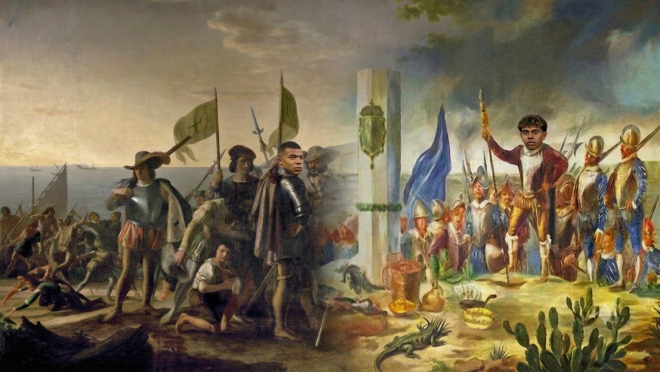
Spain’s conquistadors overthrew the Aztec and Inca empires, extracting unimaginable wealth from the Americas. France built a vast empire stretching from Algeria and Senegal to Vietnam and parts of the Caribbean, leaving behind borders, languages, and political scars that remain visible today. Their flags once flew over territories spanning four continents, and for centuries they competed for power, prestige, and influence across the globe.
Tonight, that rivalry takes on a very different form. No colonies are at stake, no empires to expand. Instead, France and Spain meet in the semi-finals of the 2026 FIFA World Cup, where the reward is simply a place in football’s biggest final.
The timing could hardly be better. France are chasing a third consecutive World Cup final, a feat achieved only by Brazil (1994–2002) and West Germany/Germany (1982–1990). Spain, meanwhile, arrive unbeaten in 36 matches, their possession-based football once again making them one of the hardest sides to break down.
The midfield will remain the key battleground. Spain thrive on controlling possession, patiently moving opponents around before striking through the smallest opening. Their relentless pressing after losing the ball often prevents teams from launching meaningful attacks.
France are unlikely to challenge Spain by trying to dominate possession themselves. Instead, they will probably allow Spain more of the ball while remaining compact and disciplined.
Didier Deschamps’ side are happier defending compactly before exploding forward through Kylian Mbappé, Michael Olise, and Ousmane Dembélé the moment Spain lose the ball.
Spain’s biggest strength can also become their greatest weakness. Their full-backs push high up the pitch to support attacks, while the defensive line often holds an aggressive position near the halfway line. France are one of the few teams capable of exploiting those spaces consistently. One accurate pass into open ground could completely change the game.
The Kylian Mbappé, Michael Olise, and Ousmane Dembélé trio are here to run the show again. Their pace against Spain’s high defensive line could prove decisive if France win possession in dangerous areas.
Beyond tactics, both sides possess extraordinary depth. Whether it is fresh legs from the bench or world-class replacements in almost every position, neither manager is short of match-winners.
Like at the last Euros, if Spain can hold their nerve, they can be on the winning side. This must be Lamine Yamal’s day for that to happen.
And for France, they can adapt to any type of play, as they have all sorts of players in every position. You need to break a low block, you need to be quick in transition, you need individual brilliance. And, of course, the attacking players.
Also, their two centre-backs have been rock solid and underrated in this World Cup.
As far as my prediction goes, I think it won’t be that high-scoring game. Both coaches could play for the win in conservative ways. Mbappé could be the difference-maker once again.
France 2–1 Spain
As the players walk out in Dallas, the empires of old will remain history. This time, Spain and France are not fighting for territory or influence, but for a place in the World Cup final. Once they conquered continents; tonight, only one can conquer the world’s biggest stage.