Hazel Rinds (Part 1)
Hazel Rinds (Part 1)
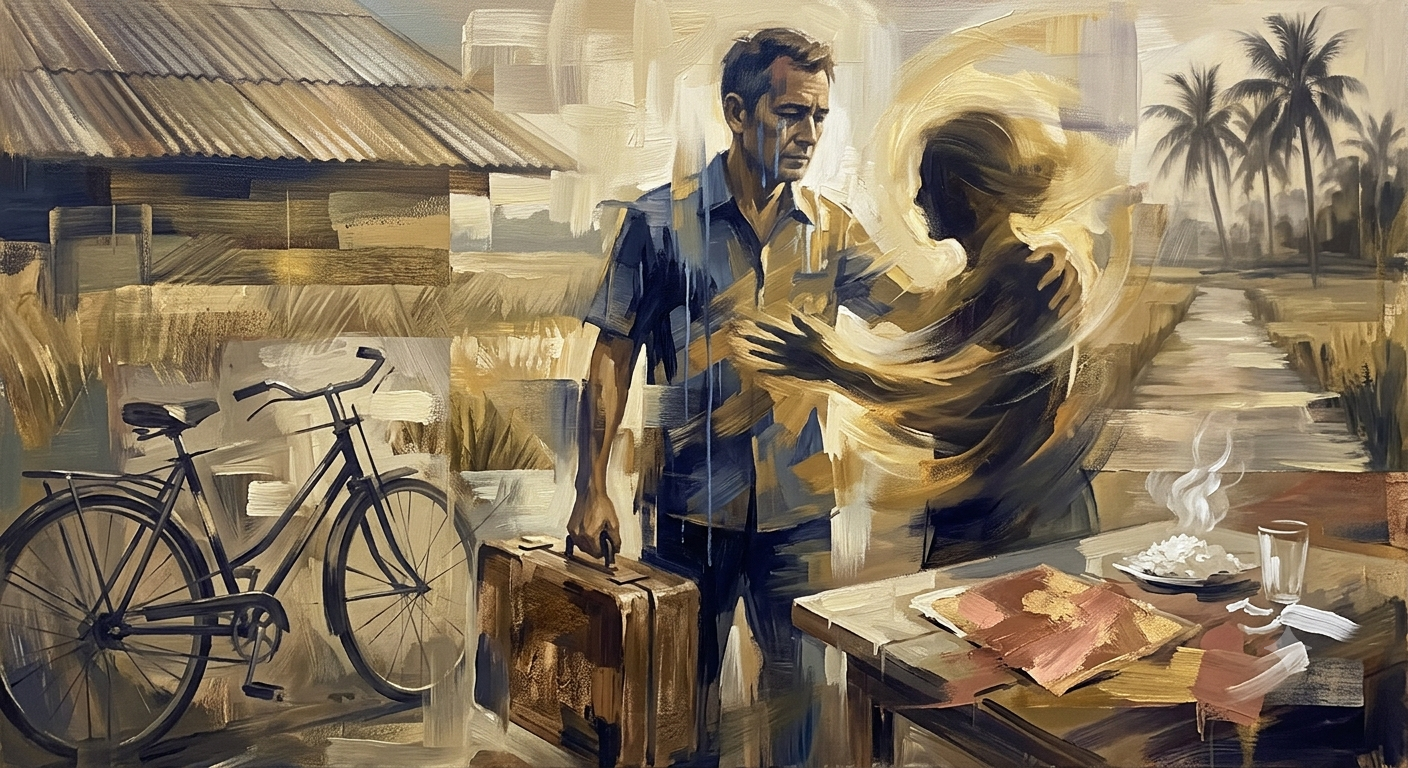
Shorif scribbles on a piece of paper and stares across the fields he had lived his entire life around. The red-blue haze of the setting sun and the fleeting feeling of time. He gets up, only to sit back down again. Flashbacks of his childhood are quick to surface, and they take him back to the time he had spent here.
One memory leads to another, and the voices barge through his chain of thought, going from the chaos of school to the tragedies of life. As he stands up again, he sees a cycle in the distance. He greets the old man on the cycle, someone he has known for years. Every strand of grey hair on that man tells a story, a few stories that branch back to Shorif himself.
One of life’s greatest tragedies, something that I think of quite often personally, is the immense gap between how little we actually know about people and our falsified perception of how close they are. It fuels a never-ending distrust, paranoia even, and an endless search for something that might not even exist. Think of Icarus, for example: indulge too heavily in the emotion and risk falling off entirely, or never bother flying and die a death not worth living. Floating in the middle is ideal, especially when it comes to people. The irony really lies in Shorif understanding all of that but falling for it every, single, time.
The man gets off his cycle before greeting Shorif back. A gentle pat on the shoulder, and a smirk that hides. A few moments earlier, while the entire “I’m sad and I wish the world would end” fiasco unfolded, a certain memory brought a bittersweet smile to Shorif’s face. The time when someone had snitched on him and told his dad about his newly acquired smoking habits. One can guess what might have happened next. But the snitch was never caught, and no one really knew who it was anymore because his father himself was dead too. The man, an old friend of his father, often jokes about the time with an odd smirk. Regardless, Shorif offers a bright smile and tells the man how he is leaving for Dhaka tomorrow. “It’s a remote job as a night guard,” but before he can finish, the man laughs at Shorif. The man grabs his arm, and a visibly shaken Shorif barges into him. He goes on for half a minute about how lean his arms are, and then ends with, “They might need a night guard for you as well.” Irritated, Shorif goes back home, replaying the conversation over and over again in his head.
He grabs a glass of water once he’s back home and lets out a loud sigh. Almost hesitant, but unsure of why, Shorif starts a rant to his wife. The rant does not end well when he realises why he was so hesitant in the first place. His wife, a woman of superstition (and temper), had particularly told him that morning to keep his journey a secret. But Icarus simply cannot float well when he sees people.
Staring at the ceiling, he hopes things go well. Tossing and turning, he stares at the yellow halogen hanging by the window. He’s eager yet shy, and anxiety is quite often like that. It’s a feeling of jolts on your skin, a tingling sensation perhaps, one that makes you second-guess every single motion your body makes. You want to walk towards it, but then something pulls you, once to the left, then to the right, holding onto you but letting you go towards the inevitable. While his wife could try keeping him quiet around the villagers, nothing really stopped the voices in his head. Suddenly, out of the blue, Shorif got off the bed and rushed to a wooden box across the room. He forces his hand through the pockets of an old pair of trousers hanging nearby, careful not to tear through them. The sharp notches prick his hand, but not enough to bother him.
With shaky hands, he opens the box and grabs the makeshift bag inside. It’s less of a bag and more a wrapping of red cloth with a knot on top of it. He unties it, and his breathing is finally back. He counts the money and reassures himself that this really is a healthy bribe for a remote job. His wife, awakened by the crackling of keys, did not care to look at the scene for longer than a moment because why would anyone ever want to see the same scene so many times?
His eyes slightly heavy with a dry burning sensation, he wakes up somewhat reluctantly. His wife is up before him, and the day has a sense of normalcy but with an odd transience. She’s cooking his favourite meal. He too, as always, joins in and prepares the food. I have never grasped the idea of why people would want to have their favourite food before they’re leaving. Maybe to take a taste of their home along with them, but does the sadness not lace enough poison into the meal that you never really enjoy it anywhere else other than here?
As the table is set, the steam from the rice fogs up the place. A victim of the fog is the glasses his wife uses. He takes his seat but is struck by the sight of the sunshine beaming straight through the window. A brown rind of hazel grows ever so visible around a pitch-black centre, and he remembers how they share almost the same eyes. It’s a poignant remembrance of the softness that crawls through her squinted eyes when she smiles. An oddly loud silence surrounds them as he rushes to finish the meal.
Seven years after they had met, his wife was never particularly great at cooking. Shorif wished the dishes would get their taste from her more than from him, but he never shied away from helping. Even today, the food seemingly got its taste only when he joined in. With a string attached to his back, the longing for home had already started to pull him back. Each step is an inch towards the life he had wished for, all while leaving the one he wished to spend the supposed life with.
As he reluctantly drags himself towards the door, he looks back one more time. Shorif calls for his wife, waiting for her to arrive. Waiting and hoping for one final hug. Ever so eager, he walks back in to look for his wife and rushes in to hug her. Only to grab nothing but air.
The moment freezes. A burst of emotions hits Shorif, pushing him back onto the breakfast table. His reaction is almost subdued, one that is deep yet not an outcry. He grabs the photo frame on the table and puts it into his suitcase. A picture of the time when they visited Dhaka for a wedding a few years ago. The lights had illuminated her hazel rinds, and they did so every single time from then on. The frame was a piece of his home that he needed to take along. The same home that felt just like another house since his wife had died.