I walked through Baishakhi Shobhajatra and saw Dhaka come alive
Baishakhi Shobhajatra stands as one of the most vibrant and culturally significant celebrations in Bangladesh, symbolising unity, resilience against evil, and the rich heritage of the Bengali people.
I walked through Baishakhi Shobhajatra and saw Dhaka come alive
Baishakhi Shobhajatra stands as one of the most vibrant and culturally significant celebrations in Bangladesh, symbolising unity, resilience against evil, and the rich heritage of the Bengali people.
Although I had been familiar with these words since childhood, witnessing it in person for the first time yesterday transformed that long-held awareness into a profound experience.
I started from home early in the morning, having the fear of missing a moment to attend the procession from the beginning. Reaching at around 8:20 am, I started to walk from Palashi Road, gradually passing BUET 3rd Gate to reach DU BNCC headquarters.
On that road, I clicked several pictures to capture moments of thousands of people attending the procession. There was a smile on everyone’s face. The chirping of birds, the cool morning breeze, the laughter, the jokes, the attire, the icons, the masks, the running of children to and fro, everything was as if TSC had come alive in a new dimension.
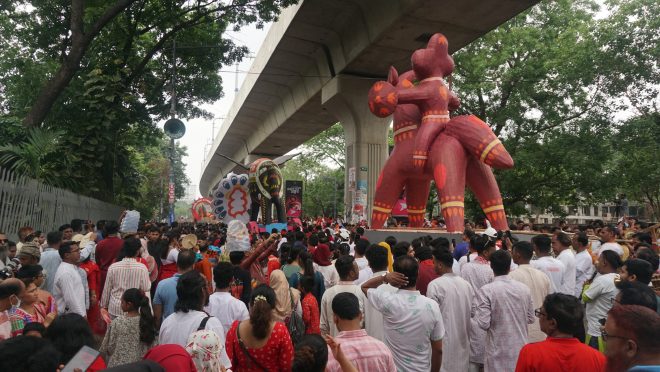
Proceeding forward, there were different groups representing their traditional narratives, roots and culture, especially groups from ethnic minorities. Many were performing with sticks in hand, excitement in their eyes and expertise in their moves. In front of Charukola of the University of Dhaka, the motifs were kept sequentially, starting with the replica of a hen followed by Ishteraj, pigeon, elephant with wings, and a replica of a warrior on horseback, which symbolised the ending of all odds and evils from the world at the start of this new year. On the back of the hen, it was written in the spirit of this 1433 Pahela Baishakh: “নববর্ষের ঐকতান, গণতন্ত্রের পুনরুত্থান”.
There were about five Nakshi Kantha designs placed one by one on the road. The designs included every cultural aspect and traditional craftsmanship of Bangladesh, which not only drew visitors’ attention but also created an inner cultural belief of love for the nation’s proclamation. Kids were enjoying it and people were taking photos in a manner that attracted the attention of visitors coming from other countries.
The procession was not only confined to the motifs and Nakshi Kantha, but was also characterised by colourful masks, large handcrafted sculptures, artistic displays representing animals, folklore and rural traditions, including icons, handmade fans, replica owls, birds, balloons, bubble wands, insignias with different designs and so on.
The procession was designed in such a way that, firstly, there were 12 attractive horses dressed in royal form on which personnel from the Bangladesh Police were seated carrying the red-green flag of our country. Then, for security purposes, there were multiple groups of SWAT. Then there were representatives from the University of Dhaka with the Bangladesh flag.
Lastly, the motifs were placed sequentially. Throughout the session, there was tight security supervised by the Bangladesh Police and Detective Branch. Volunteers from Scouts, BNCC, DU Red Crescent Society, Girls’ Guide, etc. were also present. The chief guest of the procession was the Cultural Minister of Bangladesh, MP Nitai Roy Chowdhury. There was extra security imposed for him.
Foreigners from across the globe had come to the procession and enjoyed it, expressing heartfelt appreciation for the warmth and hospitality of everyone present. They expressed this sentiment when they were requested to give interviews in different media outlets, including TV channels.
As the government had already announced the closure of DU Metro Station and Shahbagh Metro Station beforehand, there was no excessive gathering. The Metro Station at DU remained closed throughout the day, while after 12 pm, Shahbagh Metro Station was opened and people resumed travelling from that station after walking from DU to Shahbagh. This was because entry of any form of vehicle was strictly prohibited at points such as TSC, Charukola and Doyel Chattar. Although rickshaws were available for smoother movement and to avoid any difficult transportation situations.
The procession began at sharp 9:00 am with the National Anthem. As soon as it started, there were about 10–12 drones flying overhead to capture the entire scene, alongside people carrying cameras, some even carrying two to three cameras each. From Charukola, it moved in front of Shahbagh Police Station, proceeding forward and passing through Dhaka University Metro Station. As it moved forward, the enthusiasm of people continued to rise, and the procession took a turn again from Doyel Chattar and returned to where it all started.
There were several Baishakhi melas held in different places, such as Suhrawardy Udyan, DU-FBS and the premises of Shaheed Minar. Throughout the day, folk songs and Bangla cultural songs and dance adorned the entire event, making it an unforgettable one.
People from all walks of life, especially students and elderly people, enjoyed the procession at their own pace. I always wondered what there is in a procession that the entire world witnesses every year; attending this procession answered that question in the best way possible.