Infinity: Different meaning to different people
Infinity: Different meaning to different people
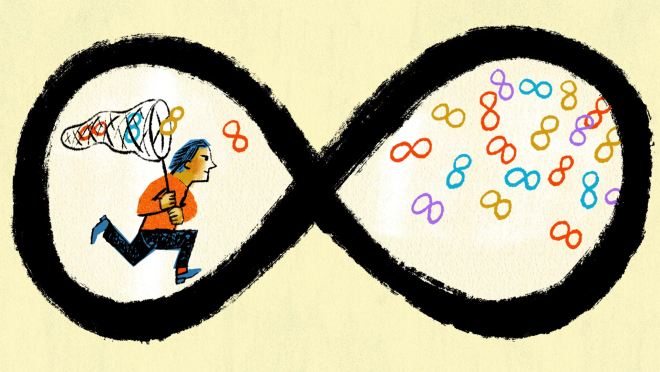
Infinity is a funny idea. We all recognise its symbol (∞), but what it actually means depends on who you ask. For a mathematician, infinity is about numbers that never end. For astronomers, it is about the endless night sky. A philosopher might give you a question instead of an answer. And if you ask someone in love, they might simply say, “Forever.”
Every year on 8 August, World Infinity Day is observed. The date, 8/8, when turned sideways, symbolises the infinity symbol (∞). It is a day to celebrate the idea of something, anything without any limits.
In 1987, the day was created by New York philosopher Jean-Pierre Ady Fenyo, and since then it has been promoting deep thinking, philosophy, science, art and the freedom of expression.
That is perhaps the nicest thing about infinity. It does not belong to just one subject or one way of thinking.
This Infinity Day, let us look at different ways of understanding this wonderfully strange idea.
Infinity in Mathematics
For mathematicians, infinity is where things get wonderfully confusing.
We imagine infinity as a really, really big number, but it is not quite that simple. Infinity is not an ordinary number that you can reach by counting high enough. Instead, it describes something without a limit or end. Mathematicians use the idea of infinity to talk about endless sequences, infinite sets, limits and many other things.
Think about counting. 1, 2, 3, 4, 5…
You can keep going, but you will never arrive at infinity. There is always another number waiting, and that is what makes infinity so strange. Mathematics also gives us some wonderfully strange examples of infinity. For example, Isaac Newton used infinitesimal quantities. Gottfried Leibniz, one of the co-inventors of infinitesimal calculus, speculated widely about infinite numbers and their use in mathematics. There’s infinity in calculus, logic, geometry and so many more.
Infinity in the universe – Now look up at the sky.
That tiny bright dot you see might be a star thousands of light years away, and that star is only one among hundreds of billions in our Milky Way. The Milky Way itself is just one of billions of galaxies in the observable universe.
The word big does not seem quite big enough.
Our universe contains stars, planets, galaxies, black holes and so many other things that we are still trying to understand. Some galaxies could contain hundreds of millions of stars, while others could be large enough to contain trillions. We do not even know whether the entire universe is infinite, as we can only observe a tiny part of it. But beyond what we can see, there may be so much more.
Infinity in philosophy
Philosophers have been thinking about infinity for thousands of years.
And unlike mathematicians, they do not always need a calculator to make things complicated. Infinity, for them, raises some very big questions. Does time have a beginning and an end? Is space endless? Can something truly have no limit? What does it mean for something to exist forever?
In the 6th century BC, Anaximander described the apeiron, something as boundless and indefinite as the source of the universe. Aristotle had also made a famous distinction between potential and actual infinity. He accepted processes that could continue forever, such as counting, but rejected the idea of a completed infinite collection. Centuries later, Leibniz explored infinity in mathematics, nature and the idea of the divine. In the 20th century, Emmanuel Levinas gave infinity a more human meaning by using it to describe the endless depth and mystery of other people.
Infinity in love
Infinity becomes much softer when we use it as an adjective of love. We use the word when we talk about the amount of love we might have for someone.
“I will love you forever.” “Friends forever.” “Together for eternity.”
You cannot put love into a measuring cup. You cannot say that one person loves another by exactly 37 kilograms or 400 kilometres. Love does not work like that.
So, we borrow infinity.
As Shakespeare famously said in Romeo and Juliet, “My bounty is as boundless as the sea, My love as deep; the more I give to thee, The more I have, for both are infinite.” Aside from Shakespeare, so many other poets and writers have used infinity to beautifully express their emotions, love and thoughts.
Infinity means different things to different people, and the most interesting thing about it is that there is always another way to look at it.