Let elephants be elephants
Let elephants be elephants
As the primary source of entertainment in our household, my sister never fails to deliver. She has an uncanny knack for coming up with complete nonsense that no sensible person has ever thought of doing. So, naturally, on a fine Saturday morning, right after her private tutor packed up her books and left, my sister decided to make an urgent call to our dad.
Saturdays are our “bazaar day”. While the rest of us were still half-asleep, our dad was already on his way to the local market. That was where he stood when his phone rang.
My sister: Hello, babai?
Abbu: Hello, abbu. Bolo, ki lagbe?
My sister, completely nonchalant: Abbu, bazaar theke ekta hatir khacha niye ashba, please?
My dad paused, the market chaos fading as he tried to process whether he’d forgotten Bangla or whether the phone connection was playing tricks on him: Kisher khacha anbo?
My sister, enunciating every syllable as if she was explaining something very obvious: Ha-tir kha-cha.
Abbu, utterly astonished and trying to hold back a laugh: Hatir khacha e lagbe tomar?
My sister, after a mindful calculation of our modest balcony, nodded firmly into the receiver: Hae. Ektu boro dekhe e ano.
Her tutor had spent the morning talking about pets and showing pictures of her house cats. My sister took that basic lesson and pushed it past any logical limit. A cat was too ordinary; she wanted an elephant. She expected my father to strap an iron cage the size of a minibus onto the back of our car and bring it home next to the vegetables.
She was just a kid who assumed affection was enough to make a home for anything. What stands out about that memory now is how adults, who actually understand the biology and the logistics, do something far worse with that same impulse. We spend our lives building cages, motivated by profit and control rather than childhood confusion.
For centuries, people have turned the world’s largest land animals into products. We lock them in circus tents and use pain to force them into tricks. We drive them onto paved city roads so that passengers in buses and cars will toss coins into a bucket to clear the street.
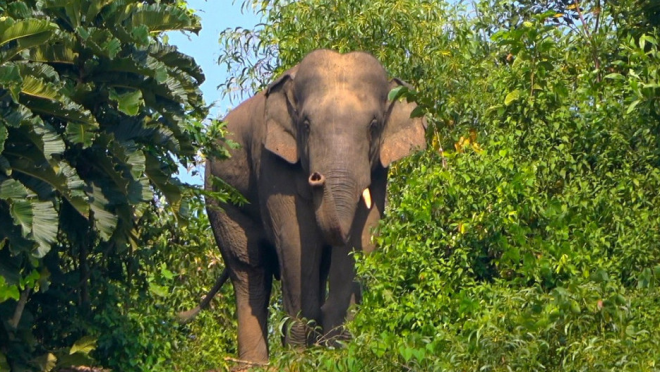
In the wild, elephants live in family groups that last across generations. They mourn their dead and navigate vast distances using memory built over decades. Yet, as our roads and farms cut through their old migration paths, we crowd them into shrinking spots of land, then act surprised when they step across human borders to survive.
Canadian filmmakers Patricia Sims and Michael Clark started World Elephant Day with Thailand’s Elephant Reintroduction Foundation back in 2012 to stop that pattern. August 12 is a hard deadline, not a day for posting pictures or warm sentiments online. If we keep clearing land and hunting at this rate, whole regions will be empty of wildlife before we grow old.
When elephants die off, the forests they live in don’t survive either. They do the basic physical labour that keeps an environment going. They break down thick bushes so smaller animals can move around. During dry spells, they dig into empty riverbeds to reach underground water, keeping every other species alive. As they walk across long distances, their waste scatters seeds that grow the next canopy. Remove them from the scene, and the whole system breaks.
Money is the main driver behind their decline. Poachers shoot the older females for tusks, leaving young calves behind to starve. The tourist industry takes wild calves from their families, training them until they stop resisting human riders.
Fixing this requires actual discipline rather than broad ideas. We have to stop buying tickets to animal shows. We need to send support to sanctuaries that keep visitors at a strict distance. And we need to push governments to enforce laws against the wildlife trade with actual jail time.
My sister’s phone call still brings back laughter to our dinner table, but the meaning inside it has changed ever since. A child asks for a cage because she thinks keeping something close is the same as caring for it. Adults build real cages because they value greed and control over letting them exist.
World Elephant Day exists to push back on that drive to own. Elephants don’t belong on city streets, in living rooms, or in tourist camps. They belong in places where human control stops and the wild stays intact, and we are running out of time to protect those places.