Mrinal Sen: A life and art that refused to be contained
Mrinal Sen: A life and art that refused to be contained
Near the end of Interview, Mrinal Sen’s 1971 film, Ranjit Mallick walks past a shop window. Inside it, a mannequin stands dressed in a Western suit, the exact kind he spent the whole film trying to borrow, failing to find, and losing a job over. He looks at it for a moment. Then he breaks the window, puts his fist through the glass and tears the clothes off it, this stiff, well-dressed stand-in for everything that was asked of him and never explained why.
The mannequin, colonial in its very posture, paid the price. This scene was not subtle, rather precise. And this precision was always Mrinal Sen’s instrument.
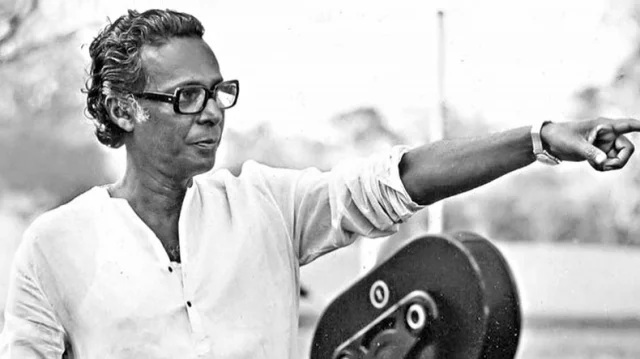
Born on 14 May, 1923, in Faridpur, Mrinal Sen came of age in a Bengal that was still metabolising the shock of Partition, the Bengal famine of 1943, and the end of British Raj. He studied physics, wrote for academic journals, worked as a medical representative in Uttar Pradesh for want of anything better, and eventually found his way into a film studio as an audio technician.
None of this sounds like the biography of a future cinema giant. But Mrinal Sen was always reading, and somewhere in those years of displacement and debt, he encountered Rudolf Arnheim’s Film as Art and understood that cinema could make one think.
His first film, Raat Bhor (1955), starring the newly minted matinee idol Uttam Kumar, was a compromise he spent the rest of his career quietly disowning. The star system pulled one way; his convictions pulled another. He lost that round. But the defeat clarified something for him. By the time Bhuvan Shome was released in 1969, a sharp, funny film in Hindi about a pompous bureaucrat undone by a village girl’s straightforward humanity, he had found his style.
Low budget, National Film Development Corporation money, Utpal Dutt in the lead, and Amitabh Bachchan doing his first-ever voice-over. The film launched what came to be called the New Cinema or Indian Parallel Cinema movement.
What followed next was perhaps the most sustained creative surge in the movement. The Kolkata Trilogy, Interview (1971), Calcutta 71 (1972), Padatik (1973), was the director at his most deliberately abrasive. He wanted to disturb people, not impress them. Through his film, he showed the things which we ignore in our daily life, the things we pretend not to see around us or within us.
Mrinal Sen’s characters are just like us. They are educated, desperately looking for work, anxious about the future in that low, constant way that never quite leaves you. And, they spend a considerable amount of energy hiding the failures that life or circumstance handed them, and often fail at that, too.
Calcutta 71 stretched four stories across four decades of social deprivation, Padatik took on the Naxalbari movement with directness, a topic that Satyajit Ray, in Pratidwandi, had only gestured toward. It is worth pausing here on the comparison with Satyajit, because it was, for decades, inescapable. The two men occupied the same Bengali cinematic landscape and disagreed about nearly everything in it. Their arguments played out in the pages of The Statesman, each refusing the other an inch.
Satyajit Ray’s humanism was European, classical, and measured. Mrinal Sen’s Marxism was local, combative, and restless. He liked jump cuts, direct address, Godardian ruptures in narrative time; he was called “the Bengali Godard” for a reason, though the label pleased neither man. Where Satyajit Ray built temples, Mrinal Sen threw bricks. Both approaches, of course, produced masterworks.
Mirinal Sen was always trying something. He shot crowd scenes with a nervous, compressed energy that influenced a generation of Bengali filmmakers, including Goutam Ghose. He occasionally stepped in front of his own camera, collapsing the distance between filmmaker and film, disorienting audiences who had settled into the comfortable third-person of conventional cinema.
He made films in Bengali, Hindi, Odia, and Telugu, more languages than either Satyajit Ray or Ritwik Ghatak, both of whom worked primarily in Bengali. His Genesis was trilingual. He was, in the most literal sense, a pan-Indian filmmaker.
He also made careers. Mithun Chakraborty, Mamata Shankar, Ranjit Mullick, Shabana Azmi, and several of Bengali and Hindi cinema’s most significant actors found their first or formative roles in Mrinal Sen’s films.
He cast his wife, Gita Shome, as a performer who brought her years of theatre training to his spare, demanding scripts. He renamed an actress called Madhuri as “Madhabi” for Baishey Shrabon (1960); the Madhabi Mukherjee who would go on to Charulata, to Subarnarekha, to permanent residence in the Bengali cinematic imagination.
He died in 2018 at ninety-five, having outlived both his great contemporaries and most of the arguments about them. He received the Padma Bhushan, the Dadasaheb Phalke Award, France’s Commander of the Order of Arts and Letters, Russia’s Order of Friendship. The honors accumulated. On his 103rd birthday, the city he spent a lifetime filming has changed beyond recognition. The questions he asked of it have not.