Nobel Prize 2026 and the ghost particles helping us decode the universe
Who are we? What are we made of? And is there more of “us”, meaning life, out there? Questions such as these drive the frontier for innovation, and this year’s Nobel Prize in Physics went to a man who not only contemplated said questions, but rather institutionalised and materialised the possibility of answering them.
Nobel Prize 2026 and the ghost particles helping us decode the universe
Who are we? What are we made of? And is there more of “us”, meaning life, out there? Questions such as these drive the frontier for innovation, and this year’s Nobel Prize in Physics went to a man who not only contemplated said questions, but rather institutionalised and materialised the possibility of answering them.
There are these things called neutrinos. Particles that very recently (before the 50s) we didn’t know existed. Termed as the ghost particle, these neutrinos move through the universe without interacting with any atoms or by changing their energy or mass.
Yet, on exceptionally rare occasions, one of these subatomic phantoms collides with an atomic nucleus, offering a chance of detection to anyone equipped with the proper instruments.
So, why is detecting one so important?
As neutrinos rarely interact with any matter, whenever scientists are able to detect them, it may allow them to decode the particle’s identity and its cosmic origin.
It is here that our Nobel Laureate made a significant contribution.
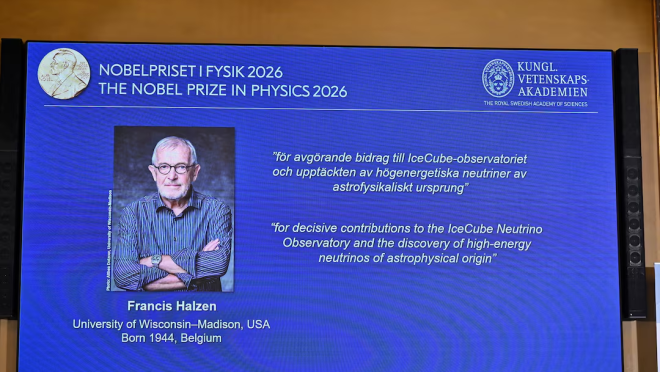
“Francis Halzen has led an international team of researchers and engineers who have provided us with a fantastic instrument. His tenacity and scientific vision has paved the way for a new kind of astronomy,” says Mark Pearce, Chair of the Nobel Committee for Physics.
The instrument in question is known as the IceCube Neutrino Observatory. Using IceCube, researchers can capture neutrinos from extremely energy-rich processes in the distant universe.
Capturing their existence through the observatory means capturing the intricacies of the universe.
The core of Halzen’s vision relied on utilising the massive frozen ice of Antarctica. Thus, a bold undertaking was launched to construct a detector right at the South Pole, embedding thousands of optical sensors deep within the polar ice.
His IceCube has already contributed significantly to helping scientists answer the intricate questions of the universe.
In a groundbreaking paper published in August 2026, researchers analysing IceCube data showed that neutrinos can carry a measurable trace of the Earth’s core. Out of 1.13 million detected atmospheric neutrino events, particles that crossed the planetary core showed a phase-coherence shift over 200,000 times larger than those taking atmosphere-only paths, opening a path toward using neutrinos to map the planet’s interior.
Last month, his Observatory recorded a high-significance, track-like event with a very high probability of being an astrophysical muon neutrino. The discovery is significant because it could allow scientists to trace the particle’s flight path precisely back to extreme cosmic accelerators like supermassive black holes or gamma-ray bursts.
Having made all of these new discoveries possible, and for showing the “tenacity and scientific vision”, according to the Chair of the Nobel Committee for Physics, to steer the ship that will eventually lead to more astronomical discoveries, Francis Halzen’s IceCube is now the proud recipient of the Nobel Prize in Physics.