Of memes, movements and ministries
There’s a specific kind of laughing that isn’t happiness. You do it when something has already broken, and there’s nothing left to do about it except make it absurd enough to survive. That’s what a meme usually is in the middle of a protest.
Of memes, movements and ministries
There’s a specific kind of laughing that isn’t happiness. You do it when something has already broken, and there’s nothing left to do about it except make it absurd enough to survive. That’s what a meme usually is in the middle of a protest.
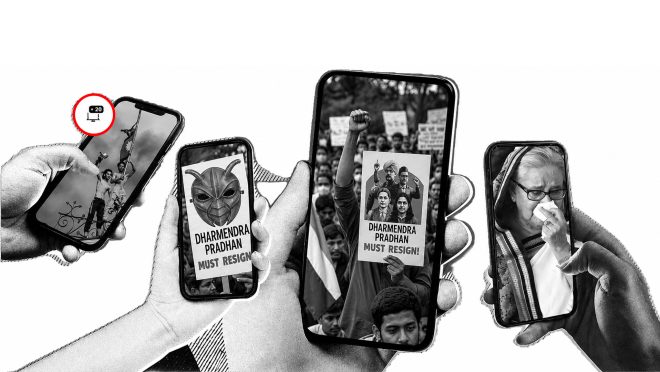
Not information. Not a slogan dressed up. It’s a scream that decided to wear a costume so it could travel further than a scream is normally allowed to.
I keep thinking about this because the last two years gave us three versions of the same story. Dhaka in July 2024. Kathmandu in September 2025. Delhi this year at Jantar Mantar. In every one of them, the funniest thing on people’s phones was never really about being funny. It was grief and rage that had figured out the only way past the checkpoint was to make people laugh first and feel the weight of it second.
Take that clip from July. The then Prime Minister crying on camera, asking for sympathy on national television. What came back within the hour was not outrage. It was mockery. Memes took that same footage and turned it into a punchline, and the punchline travelled further than any official response ever could.
The chants did the same work without needing a screen at all. “Tumi Ke Ami Ke, Razakar Razakar.” On its face, it sounded almost childish, a call and response you might hear in a school playground. Underneath it sat a wound that had existed for decades. A slur used against freedom fighters’ families was turned back on a government that had used the same word to dismiss its own students.
Nepal’s version carried its own dark comedy. Young people mocked politicians’ children for posting luxury holidays and expensive watches while an entire generation struggled to find work. On the surface, it looked like ordinary internet trolling. It only worked because it rested on something painfully real. Years of watching the system reward the wrong people. When the government banned the platforms where those jokes lived, the humour did not disappear. It hardened. Soon there was a government on the floor and thousands of anonymous young Nepalis gathered in a Discord server, trying to imagine what came next.
Delhi may be the best example because the movement started out as an insult and has always sounded like one. A Justice on the Supreme Court likened young people without jobs to vermin. People quickly adopted the label, referring to themselves as the Cockroach Janta Party and sharing pictures with the message, “I am also a cockroach.” Because it is a joke, it reads like one. However, if you sit with it for a while, it gets much more depressing. Before the slur could hurt them, a generation decided to laugh it off. Trolling turned into a form of armour. The mocking loses a lot of its impact in the hands of others if you wear it yourself.
When people write off meme culture as noise or as children wasting their time on the internet, they frequently overlook this aspect. The only reason the joke works is because there is actual suffering just behind it. A direct declaration of sadness frequently fails to achieve the job that the humour does. It moves more quickly. It extends farther. It gets beyond the barriers governments put in place to prevent truthfulness. Satire is punishable by the government. Once everyone has figured out a joke, it is considerably more difficult to stop it.
The issues that initially caused the rage are not resolved by any of this. A meme cannot fix a dysfunctional institution, change the test system, or generate jobs. Nepal already serves as a reminder of how rapidly a movement’s vitality may dissipate once the laughter stops and reconstruction work starts. However, behind each of these jokes, something significant occurred. The humour was never the antithesis of sorrow. Finding a language quickly enough to live was painful. Sometimes the saddest thing that has managed to reach you is the funniest thing on your timeline.