A safe bus shouldn’t need to be pink
Draped in ribbon and balloons on the inaugural run, women-only buses promise something that has long been missing from the city’s public transport system: a guarantee that a woman can travel from home to work without being groped, stared at, or shouted down for taking up space.
A safe bus shouldn’t need to be pink
Draped in ribbon and balloons on the inaugural run, women-only buses promise something that has long been missing from the city’s public transport system: a guarantee that a woman can travel from home to work without being groped, stared at, or shouted down for taking up space.
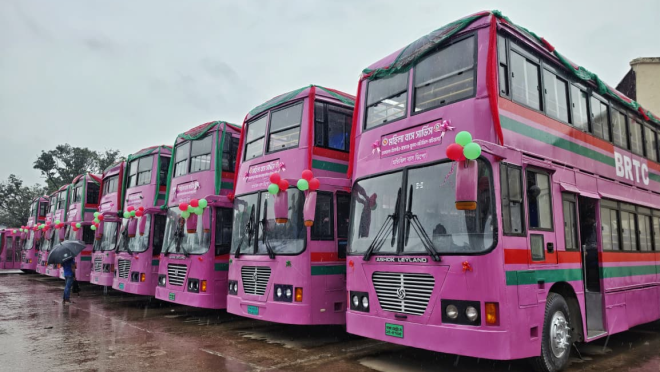
For a city where sexual harassment on buses is so routine that many women have simply stopped using them, that guarantee matters. But it cannot be mistaken for a solution to the deeper problem it is meant to address. It is a patch, not a repair.
Worse, there are now widely shared accounts of the opposite problem taking hold of ordinary buses: refusing to stop for women, or conductors waving women away because “this isn’t a ladies’ route”, as though safety and mobility for women belong only inside a pink-painted vehicle and nowhere else. A bus does not have a gender. It has doors, seats, and a route number. When those doors start deciding who gets to board based on gender, the city has not fixed its harassment problem; it has just relocated it, and in doing so, created a new one: exclusion.
This is the paradox worth sitting with. An initiative built to protect women from discrimination on public transport can, if implemented carelessly, end up normalising a different kind of discrimination, one where general buses feel entitled to turn women away because there’s a pink bus for that. Safety should never become an excuse for segregation. The goal was never to build a parallel transport system for women; it was to make the existing one usable by everyone. If a woman living far from a Pink Bus route is left standing at a stop while regular buses pass her by, the intervention has failed her twice.
None of this is an argument against the Pink Bus itself. Dedicated women’s services have worked as a stopgap measure in cities across South Asia precisely because they offer immediate relief while slower, structural reforms catch up. They matter symbolically too. They are a public admission that harassment on transport is real, common, and unacceptable, not a private inconvenience women should simply learn to manage. That admission is worth something. But a stopgap is not a destination. If Dhaka treats the Pink Bus as the finish line rather than the starting point, it will have solved a visible problem with a visible fix while leaving the invisible, everyday problem exactly where it was.
The deeper issue is that Dhaka’s roads are unsafe for almost everyone, not just women. Road safety in the city is a shared crisis, and treating it as a ‘women’s issue’ alone risks letting everyone else off the hook. A teenage boy standing on the footboard of a moving bus, an elderly commuter unable to find a seat, a child crossing a street with no functioning signal, these are not gender-specific failures; they are systemic ones. If the city’s transport authorities can summon the political will to launch a fleet of pink buses, that same will needs to be redirected towards the harder, less photogenic work: enforcing conduct standards on every bus, training conductors and drivers, installing visible reporting mechanisms for harassment, improving lighting at stops, and holding operators accountable when incidents occur. None of that comes with balloons and ribbon-cutting, but it is where lasting change actually lives.
There is also a quieter cultural task underneath the infrastructural one: breaking the assumption that women’s safety is women’s responsibility to manage by removing themselves from shared spaces. A pink bus can inadvertently reinforce the idea that the solution to harassment is separation rather than the harasser’s accountability. The more durable fix is teaching that catcalling, groping, and intimidation are not minor nuisances to be routed around but violations to be confronted directly, on every route, in every vehicle, by drivers, conductors, and fellow passengers alike.
Genuine progress will look less dramatic than a ribbon-cutting ceremony. It will look like ordinary buses where a woman does not brace herself before boarding. It will look like conductors trained to intervene rather than look away. It will look like enforcement that treats harassment as a punishable offence rather than an unfortunate cost of commuting. And it will look like a transport system where safety is not a special feature reserved for one colour of bus, but the baseline standard for all of them.
The Pink Bus deserves credit for what it is: a visible, immediate response to a problem that has gone ignored for far too long. But its real success should be measured not by how many women it carries, but by how much closer it brings the city to a day when it is no longer needed, when every bus, regardless of its colour, route, or gender, is simply safe. Until then, the pink paint is a bandage. The city still needs to treat the wound.