Your children have certificates, but are they educated?
Your children have certificates, but are they educated?
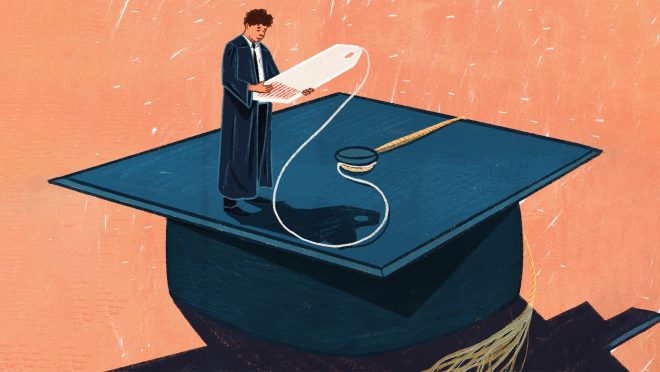
We send our children to school.
Then we send them to coaching centres, private tutors, extra classes. We buy books, uniforms, guidebooks and whatever other educational material is apparently necessary to make sure our children do not fall behind in the race of life, that they become better than us, better educated. Better human.
Raising a child in this economy is, frankly, a massive investment. We do so willingly and go beyond our means just to be able to proudly say that our children are becoming educated.
But are they becoming educated or just literate?
There is a big difference between being educated and being literate. A difference we seem to have collectively ignored because, well, one of them is much easier to measure. Literacy is simple. Can you read? Can you write? Congratulations, you are literate.
Education holds much more depth.
According to recent data, around 79 percent of Bangladesh’s adult population is literate, and that is genuinely good news. But what exactly is that number supposed to tell us? Because you cannot measure education and literacy as a percentage. Shahriar Ullash, an English-medium school teacher, describes, “Being literate is when someone learns how to read, write, speak. In contrast, education is a broad area that consists of how we think, connect the logics, reason; process of applying them in real life and for betterment of the world.”
If a student does not learn the ability to think critically, morality, self-criticism, self-realisation and how to be a human as a part of their education, then what is the point of the whole fiasco?
That, in my opinion, is the problem with how we understand education. Somewhere along the way, we decided that being educated mostly means having enough certificates to prove that you survived the education system. When asked about the education system, Sanjee Rahman, a teacher of British Standard School, reflected, “I think our education system relies solely on books and theories. If practical work can be implemented alongside theoretical learning, I believe the outcome will be more fruitful.” Another teacher, Umme Tazha, quoted, “I don’t think our current education system is successfully producing truly educated individuals. It focuses too much on academic results and memorization rather than creativity and skills.”
I have seen highly qualified people behave in ways that would make a five-year-old look socially advanced, and I have met people with very little formal education who understood kindness, responsibility and respect better than many people who spent twenty years collecting certificates.
So clearly, something is missing.
We are confusing education with academic achievement, literacy with education.
Because we are producing people who can memorise entire books but cannot think independently when the book is taken away. People who can solve complicated mathematical equations but cannot understand why throwing rubbish into a drain might be a bad idea. People who know the definition of morality but somehow become morally confused the moment a domestic worker, waiter, driver or security guard is standing in front of them.
Then there is the great national obsession with marks.
Marks are important, obviously. I am not suggesting we abolish examinations, but we have turned academic success into such a massive part of someone’s identity that everything else has become secondary. We have created a system where education is mostly about remembering what someone else has already said and repeating it during an examination in the most acceptable format possible.
Then we are surprised when people grow up and struggle to think for themselves.
Who do we blame for this?
The schools? The teachers? The parents? The coaching centres that have turned education into an industry? The students who are simply trying to survive a system designed around marks? Probably all of us, which is an extremely inconvenient answer because it means there is nobody we can blame entirely. But we have created a strange situation where knowledge is often valued mainly for what it can earn us.
Somewhere in between all that, the actual purpose of education is quietly disappearing.