A writer, a fatwa, and a Knife: Understanding Salman Rushdie
As writers go, Salman Rushdie is a living dichotomy, being both a celebrated and controversial figure.
A writer, a fatwa, and a Knife: Understanding Salman Rushdie
As writers go, Salman Rushdie is a living dichotomy, being both a celebrated and controversial figure.
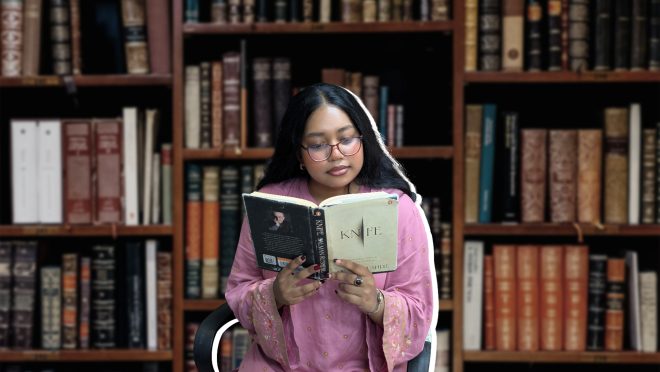
When I, as a kid, learned of his name, it did not leave a good impression on me. Knowing him only from the controversies of The Satanic Verses meant that he was, to me, what any modern-day rage baiter is, just another person who found fame vilifying religious sentiments, too common a trait among certain creative individuals.
However, when my boss asked if I would review his latest book, Knife, I saw an opportunity to really study him further and get to know him a bit more.
As a reader, I am a bit impatient, and I seem to quickly want to get to the good parts. So, after a quick surf through the first few pages of all the chapters, I knew I should not be so dismissive.
As a writer, and a Muslim (by identity, not belief), Salman deserved my attention, especially when I myself saw certain radicals in my country in favour of his fatwa.
“When I started writing that book, it never occurred to me that I wasn’t allowed to do it. I had these stories I wanted to tell and I was trying to work out how to tell them. That was all I was doing.”
A quote which is given on page 98 of Knife, where Salman was talking about The Satanic Verses.
Knife is a book entailing all the details before and especially after the devastating attack on Salman on 12 August 2022.
And as I got into the book, at first Salman’s immaculate writing style was evident (I know, shocker).
It was no surprise to me why he is, or was, a talented and successful novelist. Being a novice reader who prefers non-fiction myself, his autobiographical accounts leading to the date of 12 August 2022 captured every bit of interest I thought I did not have within me.
However, the chunk where the attack and the gruesome details of the knife wounds are described are not meant for the faint of heart, and I am included in that list.
The knife itself is an object of fascination for Salman and, throughout the book, he used the knife to sew the complex fabric of his life.
The first empathetic emotion I felt was when I read and understood the extent of his trauma and the chaotic life after the fatwa had been imposed. However, Salman was overcoming it, and I vividly remember a Curb Your Enthusiasm episode where he appeared as a guest, making fun of the fatwa and the similar fate Larry was going through.
Then came the most difficult phase of the book, going through his days in the hospital. Each and every day was accounted for and written to the point where you could actually imagine the hospital ward, and it felt as though you were sitting beside him, reliving each and every word. It seemed the trauma and the physical toll did not hinder a good novelist’s ability to take you back in time.
Getting to the end of the book, I wish I could have spoken to Salman while reading it. Maybe I could have asked him how he felt seeing the very man who ruined his life being blown into smithereens whilst a resilient writer, now with only one eye, the one-eyed proverbial Blackbeard, still going through life planning his adventure.
Such is the nature of cruelty, it cannot outrun imminent disaster. Love, on the other hand, always finds its way through.
Salman’s Knife, although gloomy, personifies this message to the fullest extent.
I would not recommend it as your first read, obviously. Because a young man wanting to know Salman should start with his novels, not with a road bump in a life full of creative output.
“I don’t know if I can write again,” I told him (Andrew Wylie, Salman’s agent).
“You shouldn’t think about doing anything for a year,” he said, “except getting better.”
“That’s good advice,” I said.
“But eventually you’ll write about this, of course.”
“I don’t know,” I replied. “I’m not sure that I want to.”
“You’ll write about it,” he said.
Precisely the conversation one would expect from a writer, and certainly not a conventional one, that is for sure, but a writer whose will to express his views honestly and without any hesitation is what I came to appreciate about Rushdie.
And that might be the lesson of the book. The only way to “win” in life is not to compromise, not to lower yourself to the behest of others. Rather, you owe it to your life to give it everything the heart wants to give.