Book Review : Beyond Good and Evil
Book Review : Beyond Good and Evil
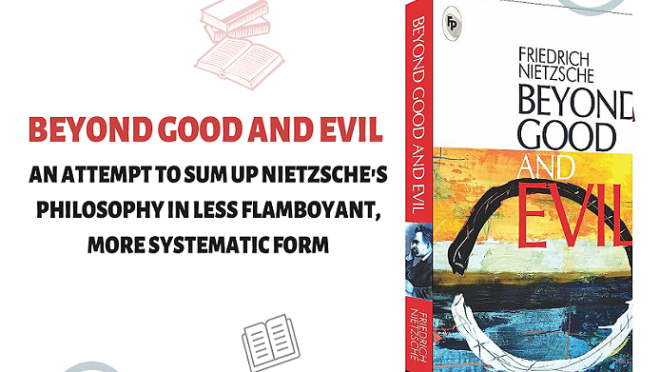
Why do we think what we think? What shapes our views of life? And what is the purpose of following the conventional path of studying, finding a job, settling down and finally meeting the end? These are the questions Friedrich Nietzsche grapples with in one of his most significant creations: Beyond Good and Evil.
The book is full of sarcastic remarks and witty comebacks; it’s like a movie you can watch over and over again, yet find a new detail each time.
It tackles a fundamental question in philosophy, existentialism, which is the philosophical study of finding the purpose of life, and Beyond Good and Evil is a journey that tries to explain humanity’s continuous journey to find and create a purpose in life, to manifest the Will to Power.
The German philosopher highlighted a case study of how Europeans think and what shaped their purpose in life. As a result, he found religion, more specifically Christianity, to be the driving force for people to bring order into their lives.
But according to the author, this cannot be the only medium, so he looks for a more comprehensive explanation to understand the rules of social structures. Why monarchies are worshipped, why revolutions take place and why, in some countries, republicanism is being accepted successfully are some of the questions he asked in the book to figure out the answer.
Nietzsche did not want the population to settle on what religion or conventions have told them about morals, values and truths. He promoted individuality in shaping one’s own direction in life. In all his criticisms of modern society, the most cunning one for me was when he said, “Objection, evasion, joyous distrust, and love of irony are signs of health; everything else absolutely belongs to pathology.”
Nietzsche gave a new characterisation of morality, and he did not see it as a rigid set of rules, but one that needs to be upgraded and evolved, keeping up with the times. He criticised the ruling class who use morality as a face mask to keep the poor uninitiated in the true questions of life.
He gave a critical analysis of religion and the hierarchy of the church in nation-building, and of the philosophers who only pretend to look for answers rather than asking the right questions. This book explores the thoughts that go beyond simply the black-and-white explanation of religion and philosophy. Nietzsche always proves the fact that there are multiple rationales for something to occur, and thus, categorising an act as simply good or evil is irrational.
Friedrich Nietzsche accuses earlier thinkers in Beyond Good and Evil of lacking critical thinking skills and accepting dogmatic premises out of hand when thinking about morality. He charges them specifically with building elaborate metaphysical systems on the notion that the good man is the antithesis of the evil man rather than merely another expression of the same fundamental impulses that manifest more clearly in the evil man. “It has gradually become clear to me what every great philosophy up till now has consisted of, namely, the confession of its originator, and a species of involuntary and unconscious autobiography,” he says.
He reiterates that this behaviour is not sustainable, as society will always fight back against the oppressing class, rejecting its version of morality. “The belly is the reason why man does not so readily take himself for a God,” Nietzsche stated.
This 227-page book, with 296 short and long aphorisms, is Friedrich Nietzsche’s attempt to sum up his own philosophy. You can see his wit as a writer, and he sometimes seems to repeat different synonyms of the same word to drive home the point, though reading the English translation from the early 1900s was a mistake, I must admit. You will be better off reading a contemporary translation that suits modern writing styles.