Contact: A science fiction that makes you rethink life
Carl Sagan, one of the most influential figures in science and perhaps the most popular astronomer, is usually revered for his book ‘Cosmos’. ‘Cosmos’ is a spectacular piece of science writing that makes the reader feel all sorts of things, and you cannot help but wonder about Carl Sagan’s ability to explain things so elegantly. It always made me wonder how he would do as a fiction writer. I did not have to wonder because once I looked him up, I found that he has indeed written science fiction.
Contact: A science fiction that makes you rethink life
Carl Sagan, one of the most influential figures in science and perhaps the most popular astronomer, is usually revered for his book ‘Cosmos’. ‘Cosmos’ is a spectacular piece of science writing that makes the reader feel all sorts of things, and you cannot help but wonder about Carl Sagan’s ability to explain things so elegantly. It always made me wonder how he would do as a fiction writer. I did not have to wonder because once I looked him up, I found that he has indeed written science fiction.
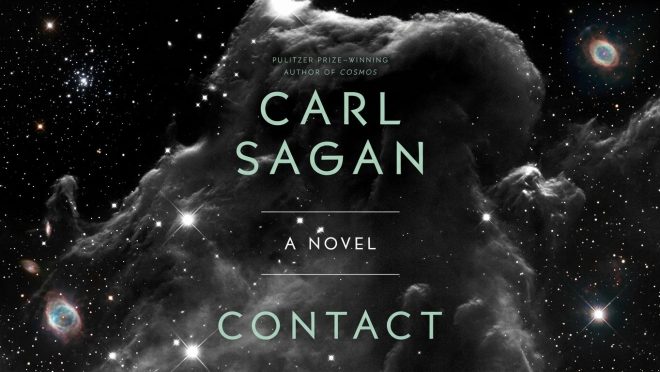
Contact by Carl Sagan is a science fiction novel published in 1985, which basically revolves around the plot that concerns contact between humanity and aliens.
I know what you are thinking. How is a science fiction written in the 80s still relevant? Is it even worth reading anymore? Aliens are old topics for books and as such. I love being the one who bursts your bubble and tells you that this is a book that not only stands the test of time but is still relevant today; perhaps more so than it was in the 80s.
For one thing, when you summarise the book in one line, it essentially boils down to the fact that this is a book about humanity’s encounter with extra-terrestrial life forms. But the book has so much more to tell. What I loved most about the book is the fact that this is not just an alien story but a story of humanity. It’s a narrative of sorts that also reflected Sagan’s view of humanity.
The story starts slow. I admit the first fifty or so pages are slower compared to other science fiction books, but that is just world-building. Once you digest that, we get to the main story. Humanity receives a radio signal from a distant star. As we decrypt the message, we realise there is a hidden message in the signal. We realise that we are not alone in the universe and the ‘others’ are trying to tell us something. Soon the scientists find another layer of hidden message inside the decrypted message; a message that will lead humanity to meet with extra-terrestrial life forms and change humanity. Sounds straightforward, right? Well, the book has to offer some jaw-dropping plot points that will leave you scratching your head and for that you will have to read this amazing book.
In addition, the book tries to picture how humanity will deal with aliens. How knowing that there is someone or something out there will change our lives. How humanity as a whole will react and readjust to the idea that we are not alone in the universe. What effect will it have on society? The economy? Our faiths and beliefs?
How will the politicians react? What about the scientists? Or the religious people? Or the people who are more concerned about personal profits above all else? Will it unite humanity or tear it apart from itself? Can humanity even process this kind of knowledge?
All of these are questions that are not related to the aliens, but they are addressed beautifully in the story. It’s almost like the writer was very human (I’m joking).
There is another element in the story that we notice in almost all writings of Carl Sagan. That is addressing how vast the universe is and how little we are comparatively. It is important to remember that it was Sagan himself that suggested the ‘pale blue dot’ photograph, so it comes as no surprise.
But another Sagan characteristic is present in the book that always inspired me and I think is very important: hope. Sagan had very high hopes for humanity and that is also reflected in this novel.
There are chapters in the book that will make you question everything you know and believe and at the same time raise more philosophical questions. I found that to be a very elegant way of writing in a science fiction book.
It’s not surprising that such a popular book was adapted into a movie. You can try the movie if you wish, but I found the book so compelling that I refuse to believe that a movie can capture its magic. I enjoy it the original way all readers do: in my own imagination.