Maps, empires, and the making of the modern world
Most atlases show you where things were. This one tells you why they matter, connecting ancient borders to today’s headlines. History of the World Map by Map, published by DK, attempts precisely that.
Maps, empires, and the making of the modern world
Most atlases show you where things were. This one tells you why they matter, connecting ancient borders to today’s headlines. History of the World Map by Map, published by DK, attempts precisely that.
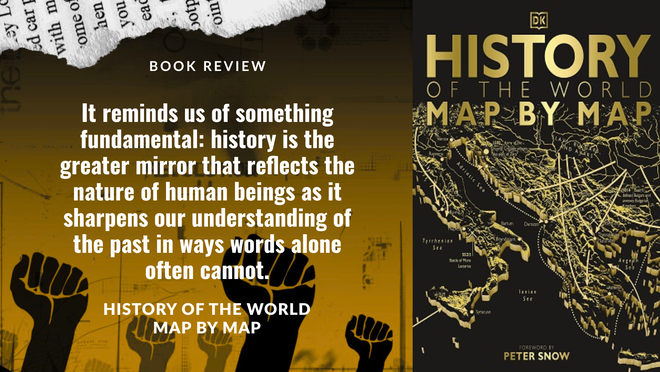
The result is a visually striking and intellectually stimulating book that succeeds brilliantly in some areas, while remaining notably limited in others. I was so captivated that I read the book twice in 3 weeks, and I believe you’ll like it too.
Each historical moment is presented across two pages, dominated by maps and supported by concise explanatory text, timelines, legends, and visual data. It asks the questions that will keep you awake at night pondering upon the things that you haven’t read in it.
The reader must understand that this book is not intended to be a classical history book. It’s for the audience who wants to go deep into territorial expansion, trade routes, and the imperial expansion of a few of the most major events in history. Reading from the scope of a history book will only disappoint the reader as it is a higher intermediary level secondary history reference book.
What the book does exceptionally well
The most impressive part about this book is how it completely erases the unnecessary jargon and sticks to strict understandings only. Reading from a centrist perspective is the best way to understand the complicated parts of history in my opinion.
Upon my understanding of atlases and their relationship with history and politics, it is such a valuable congregation of information in such a simple yet captivating manner that is truly phenomenal.
Its sketch of the Silk Roads and Indian Ocean networks shows China, the Middle East, Africa, and Europe centuries before modern globalisation. Essentially, it demonstrates that maritime trade often detoured imperial borders.
Furthermore, religious expansion is presented as an imperial process formed by routes, states, and geography rather than purely by belief. Christianity’s spread is planned along Roman infrastructure, crusades, and later colonial routes, while Islam’s expansion follows trade corridors across North Africa, the Middle East, and South Asia. Buddhism is seen moving from India through Central Asia into East Asia along caravan routes.
Trade networks are particularly well handled. The Silk Roads, Indian Ocean routes, and Atlantic trade are mapped with the intention that it will be easy to comprehend for the people who want to know the basics of it. The rise of cities, the spread of religion, and even patterns of disease transmission gain a new level of intelligibility when visualised geographically.
On the other hand, in its treatment of European colonialism, the book highlights scale and influence. A student can easily be able to write content and nuanced answers in their BGS exam as it somehow complements their basic understanding of European history.
Maps show how relatively small European states controlled vast overseas territories through naval dominance and strategic ports rather than continuous land occupation, which directly contradicts our traditional understanding of European history.
Another strength lies in the book’s ability to communicate macro-history. Long-term patterns such as the shift of global power from the Mediterranean to the Atlantic, or the persistence of steppe nomad influence over sedentary empires become immediately visible. For readers trying to understand global history as an interconnected process rather than isolated national stories, this is invaluable.
Where it falls short
Now, the issue that I faced is that it has unintentionally insulted the study of theology by not explaining why religions expanded where they did.
What this book teaches exceptionally well is historical comprehension. After reading it, one understands instinctively why geography matters, why proximity shapes conflict, and why certain regions repeatedly become arenas of power struggle.
However, what it does not teach is historical consciousness. It does not engage with contested lands, disputed territories, moral ambiguity, or the politics of historical memory. Readers looking for philosophical depth or critical analysis will be disappointed.
History of the World Map by Map is a book that reminds us of something fundamental: history is the greater mirror that reflects the nature of human beings as it sharpens our understanding of the past in ways words alone often cannot. Yet it also reminds us, maybe unintentionally, that maps do not speak for themselves.