The problem of asking 'are you a feminist?'
If you ask me whether I support feminism or not, I would definitely not answer that question. Because I would rather answer the question of whether I support the modern interpretation of feminism or the traditional one.
The problem of asking 'are you a feminist?'
If you ask me whether I support feminism or not, I would definitely not answer that question. Because I would rather answer the question of whether I support the modern interpretation of feminism or the traditional one.
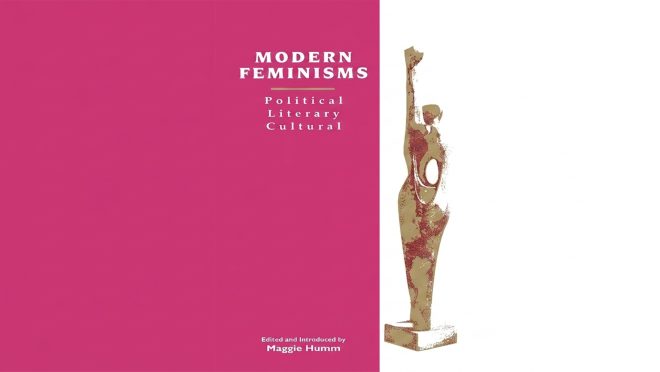
There are certain books that echo such nuances, which do not simply ask us to agree or disagree but to rethink the very assumptions through which we view society.
Modern Feminisms: Political, Literary, Cultural by Maggie Humm belongs to that queue. Unlike many books that attempt to define feminism through a single ideological lens or a bookish definition, this anthology introduces feminism as a conversation which is harmonious, sometimes contradictory, yet always evolving. Reading this collection felt less like the author’s argument and more like entering a room where some of the most influential feminist thinkers of the 20th century are debating power, gender, identity, language, and perhaps culture.
What impressed me most was the editor’s refusal to present feminism as a finished algebraic theory. Instead, Maggie Humm argues that feminism is diverse by the law of nature itself. It changes with multiple factors such as geographical borders, race, class, sexuality, historical experience, and political ideology.
As someone pursuing an undergraduate degree in economics and with a deep interest in public policy, I found this approach particularly refreshing rather than chaotic because it rejects simplistic answers to all the WH questions related to feminism and instead encourages us to appreciate social complexity.
Humm has assembled influential voices whose ideas have shaped modern feminist thought. The collection includes writings by scholars and activists such as Simone de Beauvoir, Betty Friedan, Audre Lorde, Adrienne Rich, Catharine MacKinnon, Gayle Rubin, Julia Kristeva, Laura Mulvey, Elaine Showalter, and many others. Each contributes a unique perspective, demonstrating that feminism is not a monolithic ideology but a broad intellectual tradition encompassing politics, literature, philosophy, psychology, sociology, and cultural studies.
What I appreciate throughout the book is that its disagreements are treated as intellectually productive rather than problematic. The contributors do not always agree with one another. In my view, instead of weakening feminism, these disagreements strengthen it by revealing its openness to self-criticism and revision. Readers are therefore encouraged to think independently rather than simply adopting predetermined conclusions.
At the same time, this diversity can make the anthology demanding. Since it brings together numerous authors writing from different traditions, it may occasionally feature abrupt shifts in style, terminology, and theoretical assumptions.
Those who are unfamiliar with feminist theory may initially feel overwhelmed by concepts drawn from philosophy, psychoanalysis, linguistics, or post-structuralism. Fortunately, Maggie Humm’s editorial introductions and glossary provide valuable guidance, making complex ideas considerably more accessible.
Reading this book also prompted me to reflect on South Asian society, particularly the Indian subcontinent. Although many discussions originate in Western contexts, several underlying questions remain highly relevant and interconnected. Women’s participation in higher education, representation in leadership, workplace discrimination, unpaid caregiving responsibilities, and gender-based violence continue to shape public discourse across Bangladesh.
However, local realities also remind readers that feminist debates cannot simply be imported without considering cultural, religious, and socioeconomic contexts. Genuine progress requires dialogue that respects local experiences while remaining committed to equality and human dignity.
One aspect I especially admired is the refusal to portray women solely as victims. Many contributors emphasise resistance only. They highlight women not merely as subjects of oppression but as producers of knowledge, literature, social movements, and institutional change. This perspective gives the collection an optimistic character despite its critical analysis of inequality.
Nevertheless, some limitations deserve acknowledgment. Since it was first published in the early 1990s, it understandably predates many contemporary discussions surrounding feminism in the digital space, online activism, intersectionality’s later developments, artificial intelligence, and social media cultures. Readers seeking analyses of these 21st-century issues will need supplementary materials. But the book’s foundational arguments remain remarkably influential because many current debates continue building upon the theories presented here.
Ultimately, the book successfully portrays the message it was supposed to deliver because it refuses to reduce feminism to slogans or ideological certainty. Instead, it presents feminism as an ongoing intellectual project, one that constantly questions existing power structures while also questioning itself. Rather than telling us what to think, it equips us with conceptual tools to ask better questions.