Why you should read Kojin Karatani
Kojin Karatani’s work changed the way I view the world and I believe it will do the same for you.
Why you should read Kojin Karatani
Kojin Karatani’s work changed the way I view the world and I believe it will do the same for you.
The words are purely philosophical, it’s better if the reader addresses this from a moderate perspective rather than pushing fully on what I believe in. Considering you, as readers, might have different values and beliefs than I.
Relevance
Although I could relate to The structure of World History, however, as time went by, I don’t relate to it as much nor do I agree.
Kojin Karatani (柄谷 行人), born in 1941 in Amagasaki, Japan, is one of the most distinctive and interdisciplinary thinkers of the late 20th and early 21st centuries.
Karatani’s philosophical work is unified by an ongoing effort to rethink the foundations of social theory and to imagine forms of collective life beyond capitalism, nation-state structures, and hierarchical state power.
Lots of jargons, I know! Basically he writes about life, and the relationship it has with money and power, somewhat like Marx, but of course, a completely different perspective.
Karatani’s The Structure of World History, is, in my opinion, his best creation in his life. Rather than construing social formations primarily in terms of Marx’s famous concept of modes of production, Karatani proposes that world history is best understood through modes of exchange. This is where he disagreed with Marx, his major influence is in economic, political and historical study.
In the book, Karatani distinguishes four major modes of exchange that structure human societies:
Mode A: The nomad; when we actually were interdependent and started sharing resources in hopes of favours, not exclusively for expecting anything in return. Much like a charger you lend to your friend, but that rascal never returns it.
Mode B; Obedience for Protection: Meaning, you pay tax even though you don’t want to. In exchange, the government gives you some perks, for people living in Bangladesh, this might be sound like a far-fetched idea, but in theory, the government should provide value to its citizens, and in exchange, citizens listen to every word it says.
Mode C: Commodity Exchange: The classic capitalist system of market-driven relations. You build a company, employ workers, and sell goods, in return you get a career, a wife and some children to work in the future.
Mode D: Future Possibility: Kojin imagines a world, where the state would not need to exist at all, rather cooperation will be automatically dissolved and people would behave themselves, share resources, stay out of crime, not out of fear, but out of common good.
Central to Karatani’s critique is the identification of a Capital, Nation, State configuration, a triad in which capitalist economy, nationalist ideology, and state power mutually sustain each other.
Meaning, the corrupt government caters to the corrupt businessmen, in return they support the political elite, and round and round the earth moves while the proletarians, meaning you and I suffer with no end in sight,
A mirror image of today’s suffering
We live in a country where bureaucrats fail to do the basic traits, the policies of the government are riddled with corruption, and the system fails to cater to the common man.
In order to understand why we are the way we are, you must read The Structure of World History. Because only by educating yourself can you make sure not to become of ‘them’.
Them meaning, the oppressor class, the corrupt, and the devil that destroys all natural human behaviour.
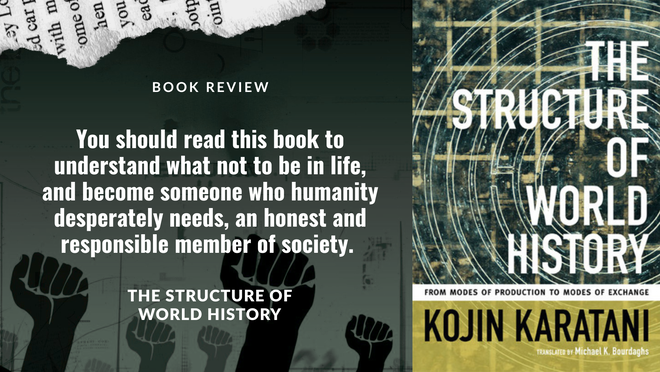
You should read this book to understand what not to be in life, and become someone who humanity desperately needs, an honest and responsible member of society.
Kojin Karatani’s intellectual journey from literary critic to philosopher of world history represents a rare idea of critical theory, historical analysis, and normative vision. His work not only changes the course of debates within Marxism and philosophy but also speaks to contemporary concerns about globalization, inequality, and the possibilities of post-capitalist futures.