No man’s sky: The game that refused to give up
It had one of the gaming’s most catastrophic launches. Then it spent nearly a decade quietly becoming something extraordinary. Here’s why you should be playing it right now.
No man’s sky: The game that refused to give up
It had one of the gaming’s most catastrophic launches. Then it spent nearly a decade quietly becoming something extraordinary. Here’s why you should be playing it right now.
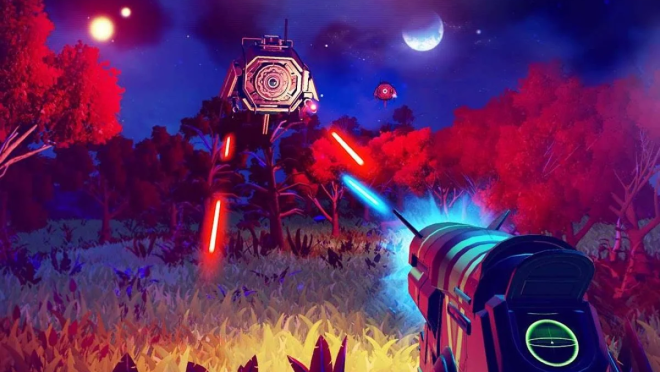
When I first started playing No Man’s Sky, I was kind of shocked. I landed on a planet and just stood there for quite some time. The sky was three different shades of orange, two moons were sitting low on the horizon like they had nowhere better to be, and something that looked vaguely like a giraffe crossed with a crab was grazing maybe fifty metres away, entirely unbothered by my existence.
And I realised, slowly, that nobody had ever seen this exact view before. This planet was generated for this moment, on my playthrough, and the odds of anyone else landing on this exact spot and seeing this exact thing were essentially zero. I looked around the planet for a bit, and, oh well, it really deserves some compliment.
But before we get into what No Man’s Sky is right now in big 2026, we need to talk about what it was, because the story of this game is genuinely one of the strangest redemption arcs in the history of the medium and you cannot fully appreciate where it has ended up without understanding where it started.
When No Man’s Sky launched in August 2016, the hype around it was genuinely worth remembering. The trailers had shown lush alien jungles, enormous dinosaur-like creatures roaming wild landscapes, complex space dogfights, and the tantalising hint of multiplayer, all of it wrapped around the promise of 18 quintillion procedurally generated planets to explore. The number was so absurd it almost became a meme before the game even released. People were losing their minds over it.
And then the game came out, and it had almost none of what was promised. The planets were barren. The creatures were sparse and glitchy. The multiplayer that had been hinted at did not exist. The moment two players finally managed to find each other in the same location, they discovered they were completely invisible to each other. It was one of the most public disasters in gaming history, and the internet, characteristically, made absolutely sure everyone knew about it. The developer, Hello Games, went almost completely silent. Most people wrote them off entirely.
What happened next is the part of the story that still gets me.
Hello Games, a studio of fewer than 30 people, smaller than most university departments, did not give up. They went quiet for months and then started releasing free updates, one after another, year after year, for nearly a decade. They added proper multiplayer; they overhauled base building. They introduced entirely new game modes: a roguelike mode, a survival mode, a creative mode with no resource restrictions. They reworked the graphics twice. They added VR support. They added underwater exploration, giant mechs you can pilot, the ability to adopt and raise alien creatures, and a proper story that runs like a thread through the whole experience if you choose to follow it. Over 30 major free updates. I genuinely do not know of another game studio that has done anything quite like this. And the game they have ended up with is remarkable.
What No Man’s Sky is today is a space exploration survival game with a scope that makes most open-world games look like a car park. You begin with a broken ship on a random planet and the immediate problem of surviving long enough to fix it. That is your tutorial, more or less. From there, the universe opens up and essentially asks: what do you want to do? The answer, genuinely, can be almost anything. You can trade goods between space stations and accumulate wealth. You can raid freighters in asteroid fields and live a pirate’s life. You can build bases, elaborate, multi-planet constructions that other players can visit. You can follow the main story at your own pace, which is surprisingly thoughtful about loneliness and meaning and what it means to be a small thing in a very large universe. Or you can just wander. Hop from system to system, catalogue what you find, upload your discoveries to a shared database, and leave your name on things that no one else has ever seen.
That last option sounds simple, but it is where the game’s strangest magic lives. I have landed on scorched worlds where the rocks glow faintly and the sky burns a deep, angry red. I have found toxic planets so hostile that standing still for ten seconds starts draining my life support. I have stumbled onto worlds so lush and calm that I genuinely forgot I was supposed to be doing something else and spent an hour just walking around listening to the ambient sound. And on every single one of these planets, the creatures are different, assembled by Hello Games’ procedural algorithm into combinations that no human artist consciously designed. Some of them are elegant. Some are bizarre in ways that make you laugh. Some are unsettling in ways you cannot quite explain.
The multiplayer genuinely works now, which still feels like a small miracle given the 2016 launch. Playing with a friend changes the whole texture of the experience. There is something about calling someone over to show them the deeply weird creature you just found, or building a base together across two different playing sessions, or just flying in formation through a ring system around a gas giant. It makes the universe feel shared in a way that solo play, however good, cannot quite replicate.
Let’s be honest, it’s not a perfect game. The sheer number of systems—crafting trees, fleet management, base construction, story missions, limited-time community events—can feel overwhelming when you first arrive, like being handed every instruction manual ever written and told to enjoy yourself. But hey, there’s fun too, such as a storm rolling across a jungle world while I sprint back to my ship, the rain hammering the visor, the whole thing suddenly feeling genuinely cinematic without a single scripted moment.
No Man’s Sky has a quality that is very hard to manufacture: it makes you feel genuinely small in the best possible way, the way you feel standing outside on a clear night and actually looking up. That specific mix of wonder and insignificance that the sky tends to produce, the sense that there is an awful lot out there and most of it you will never see. This game bottles that feeling. It is not always perfect. But when it works, nothing else quite does what it does.