Rip and reinvent: How the modern DOOM trilogy revived a gaming legend
Few video game franchises have shaped the gaming industry quite like DOOM. Since its debut in 1993, the series has influenced generations of first-person shooters, turning a simple premise, one man against the forces of Hell, into a cultural phenomenon.
Rip and reinvent: How the modern DOOM trilogy revived a gaming legend
Few video game franchises have shaped the gaming industry quite like DOOM. Since its debut in 1993, the series has influenced generations of first-person shooters, turning a simple premise, one man against the forces of Hell, into a cultural phenomenon.
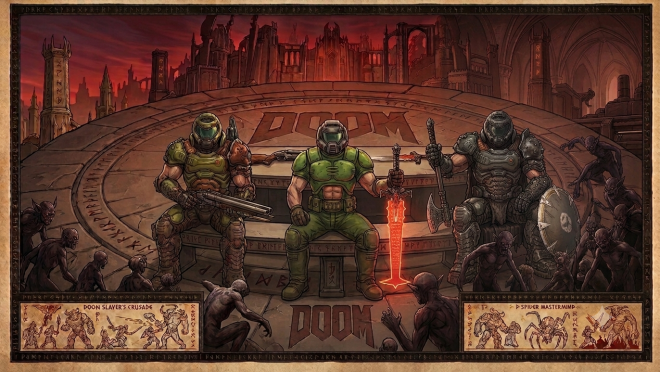
More than three decades later, developer id Software achieved something few studios manage to do successfully: it reinvented a legendary franchise for a new generation without abandoning what made it special in the first place.
The modern DOOM trilogy; DOOM (2016), DOOM Eternal, and DOOM: The Dark Ages, is not merely a sequence of sequels. It is a fascinating evolution of game design, with each entry exploring a different interpretation of power, speed, and violence while expanding the mythology of the Doom Slayer into something far grander than anyone could have imagined.
At its core, however, the trilogy remains remarkably simple:
Demons have invaded, the Doom Slayer is angry, and Hell is about to have a very bad day.
The rebirth of a legend
When DOOM (2016) launched, expectations were mixed. The franchise had been dormant for years, and many feared the reboot would become another generic military shooter chasing industry trends. Instead, id Software delivered a game that felt refreshingly rebellious.
The opening moments perfectly capture its philosophy. The Doom Slayer awakens, listens to a villain explain the situation, and promptly smashes the communication screen without a second thought.
The message was clear: players were not here for lengthy exposition. They were here to fight.
The game stripped away many modern shooter conventions. There was no hiding behind cover, no waiting for health to regenerate and no endless cinematic interruptions. Players were rewarded for aggression, movement and close-quarters combat.
Its “Glory Kill” system transformed combat encounters into a constant cycle of risk and reward. Low-health enemies could be finished with brutal executions, restoring health and encouraging players to charge directly into danger rather than retreat.
Combined with Mick Gordon’s now-iconic soundtrack, industrial sci-fi environments and satisfying arsenal of weapons, DOOM (2016) felt like a return to gaming’s roots.
It was fast, loud and unapologetically fun.
From shooter to combat chess
If DOOM (2016) was a successful reboot, DOOM Eternal was an ambitious reinvention.
Rather than delivering more of the same, id Software completely redesigned how players approached combat.
Every weapon gained a specific purpose, every enemy developed unique weaknesses, and every resource became part of a carefully balanced ecosystem.
Health was earned through Glory Kills, armour came from setting enemies on fire, and ammunition was replenished by dismembering hell-spawns with the chainsaw. The game constantly encouraged players to cycle through weapons and abilities rather than relying on a single favourite gun.
Initially, this design can feel a bit overwhelming. The screen becomes a blur of projectiles, explosions and charging demons. Yet beneath the chaos lies extraordinary precision. Every encounter is meticulously crafted to test movement, decision-making and adaptability.
The result is perhaps the most mechanically sophisticated combat system ever created for a first-person shooter.
Once players understand the flow, combat becomes almost musical. The Doom Slayer darts through arenas, switching weapons mid-air, targeting enemy weak points and managing resources with split-second precision. It is exhausting and exhilarating all at the same time.
And for many fans, it represents the franchise at its absolute peak.
The myth of the Doom Slayer
One of the trilogy’s most surprising achievements is how dramatically it expanded the series’ lore.
Classic DOOM games barely needed a story. The objective was simple: kill demons and survive.
The modern trilogy transforms the Doom Slayer into something approaching mythology.
He is no longer merely a marine trapped in Hell. He becomes a near-supernatural force of nature, feared by demons, worshipped by warriors and spoken of in ancient prophecies.
The games cleverly present this evolution through environmental storytelling, codex entries and character interactions.
Perhaps the most amusing aspect of the lore is how terrified Hell itself appears to be of a single man.
While countless stories focus on humanity fearing demons, the modern DOOM trilogy turns the concept on its head. The demons are often portrayed as fearing the Slayer’s arrival more than anything else.
A different kind of power
Released nearly a decade after the reboot, DOOM: The Dark Ages takes another bold step by travelling into the Slayer’s past.
The futuristic laboratories and orbital stations of previous games give way to castles, battlefields and ancient kingdoms.
The visual shift is dramatic, but so is the gameplay philosophy.
Where DOOM Eternal emphasised speed and aerial mobility, The Dark Ages embraces weight and momentum. The newly introduced Shield Saw becomes the centrepiece of combat, allowing players to block, parry and counterattack with devastating force.
The game often feels less like a traditional shooter and more like a medieval power fantasy fused with science fiction.
Dragon-riding sequences, giant mechs and sprawling battlefield encounters push the franchise into territory that would have sounded absurd a decade ago. Yet somehow, it still works.
While some players miss the breakneck intensity of Eternal, The Dark Ages deserves credit for refusing to repeat old ideas. It demonstrates a willingness to experiment while preserving the franchise’s identity.
The soundtrack of destruction
No discussion of the trilogy would be complete without mentioning its music.
The modern DOOM games possess some of the most recognisable soundtracks in gaming history.
The heavy metal compositions of DOOM (2016) and DOOM Eternal became almost as iconic as the games themselves. Distorted guitars, industrial rhythms and aggressive percussion transform every battle into an adrenaline-fuelled spectacle.
The music does more than provide background noise; it becomes part of the gameplay.
As battles intensify, the soundtrack evolves alongside them, amplifying tension and excitement. Very few franchises have achieved such perfect harmony between action and audio.
More than just violence
To outsiders, DOOM can appear simplistic. The games are often reduced to memes about shotguns, chainsaws and excessive violence. Yet that perception overlooks what makes the trilogy special. Behind the chaos lies exceptional game design. Every weapon feels distinct, every enemy serves a purpose and every encounter teaches players something new.
The games constantly challenge players to improve, rewarding mastery without ever feeling unfair. In an industry increasingly dominated by open-world checklists, live-service models and endless progression systems, the modern DOOM trilogy feels refreshingly focused. It understands exactly what it wants to be.
A benchmark for modern shooters
Together, DOOM (2016), DOOM Eternal and DOOM: The Dark Ages form one of the strongest trilogies in modern gaming.
Each title has its own identity:
DOOM (2016) resurrected a legendary franchise.
DOOM Eternal elevated it into an art form of speed and skill.
DOOM: The Dark Ages proved the formula could evolve once again.
Among them, DOOM Eternal remains the standout achievement; a game that pushes players harder and rewards them more generously than almost any shooter of its generation.
But the trilogy’s true success lies beyond individual rankings.
It demonstrated that even after three decades, DOOM remains what it has always been: a franchise built on momentum, innovation, and the simple thrill of overcoming impossible odds.
Few gaming icons have aged as well. Even fewer continue to reinvent themselves while staying true to their identity. The modern DOOM trilogy does both: one demon at a time.