The virtual museum: How Assassin’s Creed remediates history, culture, and heritage
Video games are no longer just mindless entertainment. Today, they actually help shape how we understand the past.
The virtual museum: How Assassin’s Creed remediates history, culture, and heritage
Video games are no longer just mindless entertainment. Today, they actually help shape how we understand the past.
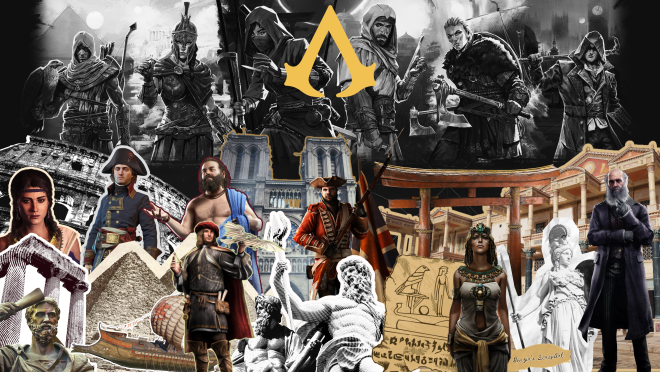
Few series do this quite as well as Ubisoft’s Assassin’s Creed. Since 2007, the franchise has basically worked as a giant, interactive history lesson. Players get to drop into all sorts of different eras, but the series really hits its stride when exploring the ancient worlds of Ptolemaic Egypt in Origins and Classical Greece in Odyssey.
Instead of just using history as window dressing, the games turn it into something you can actually play with.
By dropping a fictional war between the Assassins and Templars right into the middle of real historical events, the developers blur the line between facts, myths, and pure sci-fi.
To make this work, the games rely on a framing device called the Animus. It is a piece of fictional tech that lets modern characters relive their ancestors’ memories.
This is a clever trick because it gives the game a built-in excuse for any historical mistakes or changes. When a city’s layout is shrunk down to make running across rooftops more fun, the game just shrugs and suggests you are playing a simulation, not a perfect replica.
Trying to be completely accurate to history would probably make for a boring game anyway. Instead, the developers aim for authenticity, wanting to capture the vibe and spirit of the era.
They bring in actual historians and experts to build what they call a narrative garden, a place where history becomes an open playground.
Take Assassin’s Creed Origins, released in 2017. It throws you back to 49 BCE just as the Ptolemaic Kingdom is starting to crumble.
The game builds a massive world that ranges from the busy, Greek-influenced streets of Alexandria to the dusty farm towns of the Faiyum oasis. The level of detail is amazing. You can watch farmers harvesting wheat, potters working clay, and everyday people stopping to pray.
You will even see the night sky map out constellations that match Egyptian gods like Osiris and Horus. At the centre of all this political chaos is Cleopatra. The game does a great job of looking past the old clichés about her beauty and instead shows her as a brilliantly ruthless monarch.
She will crush anyone in her way, eventually betraying the main character, Bayek, to team up with Julius Caesar and secure her grip on the throne. This portrayal gives us a much sharper, more calculating version of the famous queen than we usually see in pop culture, showing her using her wit to navigate complex political landscapes.
Then came Assassin’s Creed Odyssey in 2018, dropping players into the Peloponnesian War in 431 BCE. You can visit a brightly painted Parthenon in Athens and even explore the creepy, maze-like Palace of Knossos, which the game mixes with the legend of the Minotaur. Odyssey really shines because it acts like a virtual meeting ground for the greatest minds of antiquity. You get to argue with Socrates, who uses his famous method of questioning to trap you in frustrating logical corners.
No matter what choice you make in a quest, he will question your reasoning and make you think deeply about your morals. You meet Hippocrates, the father of medicine, who constantly bumps heads with religious leaders because he wants to treat sickness with science instead of prayers. Herodotus, the world’s first real historian, tags along as your personal travel guide, constantly chronicling your adventures.
Meanwhile, the intellectual powerhouse Aspasia is secretly running the Cult of Kosmos, pulling the strings of the entire war in a twisted attempt to build a perfect new republic. The game treats Greek mythology as if it were totally real, which makes sense because that is exactly how the ancient Greeks saw their world.
This tradition of weaving real people into the story stretches across the whole franchise. In the Renaissance games, Leonardo da Vinci is not just a famous painter; he is your loyal friend. Rather than painting him as a stiff historical figure, the game shows him as a warm, sparkling conversationalist who is always eager to help. He builds crazy gadgets for you, including an early version of a firearm, just by looking at old sketches. The bond between him and the protagonist, Ezio, gives a deeply human element to the overarching story.
Jump forward to the French Revolution in Unity, and you run into Napoleon Bonaparte. He is portrayed as a cynical, opportunistic mastermind who thinks people secretly want to be controlled. In a chilling speech, he explains that the masses will gladly give up their freedom as long as they are given the illusion of hope. Napoleon uses the chaos of the revolution to hunt down ancient artefacts that will guarantee his absolute power. It is a fascinating look at a young general on the verge of taking over the world, showing his sheer ambition and manipulative nature.
Fast forward again to Victorian London in Syndicate, and you end up helping Charles Darwin. He is a passionate, self-funded scientist fighting tooth and nail to defend his theories. In the game, he helps you bust a shady drug ring run by the Templars while fiercely protecting his life’s work. The game even creates a subtle tension between his real-world theory of evolution and the game’s sci-fi lore about an ancient precursor race. It is a fun twist that lets you interact with a legendary historical figure in a totally unexpected, action-packed way.
One of the best things to come out of all this historical research is the Discovery Tour. Starting with Origins, Ubisoft created a separate mode that strips out all the combat and storylines, turning the game into a massive, peaceful virtual museum. You can take guided tours about everything from ancient farming to religious rituals.
The best part is that the developers are totally honest. The narrators will actually point out where they changed historical facts to make the video game more fun. Studies have shown that when teachers use this in classrooms, students get incredibly engaged because they can actually walk around inside the history they are learning about. It is a massive step forward for educational software, turning textbook chapters into lived experiences.
We also saw just how much these virtual worlds matter when the real Notre Dame Cathedral caught fire in 2019. Ubisoft temporarily gave away Assassin’s Creed Unity for free so people could visit the digital version of the cathedral. A rumour went around saying that the game’s code would be used to physically rebuild the church.
That was not true, as real architects use millimetre-precise laser scans for that, but it didn’t really matter. The game gave millions of grieving people a way to connect with a piece of cultural heritage that had just been severely damaged. It proved that virtual spaces can act as sanctuaries for memory when the real world suffers a tragedy.Assassin’s Creed sits in a really strange, wonderful spot between mainstream entertainment and an educational tool. By recreating the past in such detail, it proves that games can capture the feel of an era better than almost anything else. Whether you are decoding a puzzle with Da Vinci, arguing ethics with Socrates, or just watching a digital sunset over the pyramids, the series reminds us that history is a living, breathing story. And now, we actually get to step inside and play it.