Melania: Behind the curtain, there’s actually nothing
The documentary Melania sets out to do something deceptively simple: show the woman behind one of the most controlled public images in modern American politics.
Melania: Behind the curtain, there’s actually nothing
The documentary Melania sets out to do something deceptively simple: show the woman behind one of the most controlled public images in modern American politics.
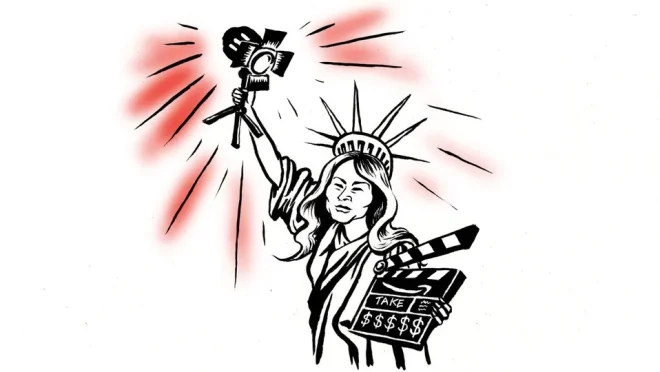
Centred on Melania Trump, the film promises access, intimacy, and insight. What it ultimately delivers, however, is something far more limited and in many ways, far more revealing than it intends to be.
At first glance, Melania looks polished and assured. The visuals are sleek, the pacing deliberate, and the tone consistently calm. The documentary follows Melania Trump during a short but symbolically important period around Donald Trump’s return to the presidency.
Viewers are invited into meetings, transitions, and ceremonial moments that usually remain out of sight. The film wants to feel like a rare backstage pass. Yet, as it continues, it becomes clear that access alone does not make the documentary visually or comprehensively captivating.
One of the documentary’s central characteristics is restraint, how closed the room for spontaneity is. Whenever she talks, her words are measured and careful. There is no dramatic confrontation, no emotional confession, no clear turning point. As if, the documentary reiterated what was already a façade, an aesthetic that mirrors Melania’s long-established public persona. Or that’s what I think.
Many critics have pointed out that the film avoids asking difficult questions. That observation is accurate. Topics that might complicate or challenge Melania’s image—her political influence, her silence during moments of controversy, or her personal stance on key issues—are largely absent. As a result, the documentary was a big disappointment for me, who wanted to know how she is as a person. Not the curated version of her.
This is not necessarily a failure of craft. In fact, Melania is competently made. The cinematography is elegant, the editing smooth, and the production values unmistakably high. But the problem lies in purpose and the content. Documentaries are generally expected to contextualise or reveal. Here, the film seems content to let surfaces speak for themselves.
What becomes increasingly clear is that Melania functions as an extension of image management. The film reinforces what the public already knows or thinks it knows about its subject: how reserved, private, dignified, and separate from the chaos surrounding her husband she is. Whether this separation is genuine or strategic is a question the documentary never entertains.
The most interesting moments are pretty much accidental. The repetition highlights how tightly controlled Melania’s public life is, and how little room there is for spontaneity, like I said before. Ironically, this may be the documentary’s most revealing and key quality.
Statistical data was never something I believed, as it can very easily be manipulated. For example, some viewers interpret the film as dignified and respectful. Others see it as hollow, even evasive, arguing that it offers nothing but a mask. Both readings are valid, and the documentary seems designed to accommodate them.
From a storytelling perspective, the film struggles with momentum. There is no strong narrative arc, and scenes often blur into one another. Viewers looking for transformation or revelation may find themselves waiting for something that does not exist. Instead, the film settles into a rhythm of observation that feels deliberate but emotionally distant.
In the end, Melania is less a portrait than a mirror. As a documentary, it falls short of offering a fuller understanding of its subject. A documentary can never and should never be an example of someone’s dream to be anonymous and silent when someone is the most powerful woman in the free world.
However, no matter how irritated I was with the storytelling, the director and the screenplay were very commendable.
Maybe the audience who might give this documentary a shot after reading my review can watch the documentary through a lens of love for the craft and not for the content. Definitely not something i’ll never recommend to someone though.