‘The Odyssey’ review: The long way home has never looked more majestic
Christopher Nolan has spent the better part of twenty-five years exploring the architecture of the human mind. Memory in Memento, obsession in The Prestige, dreams in Inception, survival in Dunkirk, guilt in Oppenheimer; his films have consistently used spectacle not as an end, but as a vehicle for examining human frailty.
‘The Odyssey’ review: The long way home has never looked more majestic
Christopher Nolan has spent the better part of twenty-five years exploring the architecture of the human mind. Memory in Memento, obsession in The Prestige, dreams in Inception, survival in Dunkirk, guilt in Oppenheimer; his films have consistently used spectacle not as an end, but as a vehicle for examining human frailty.
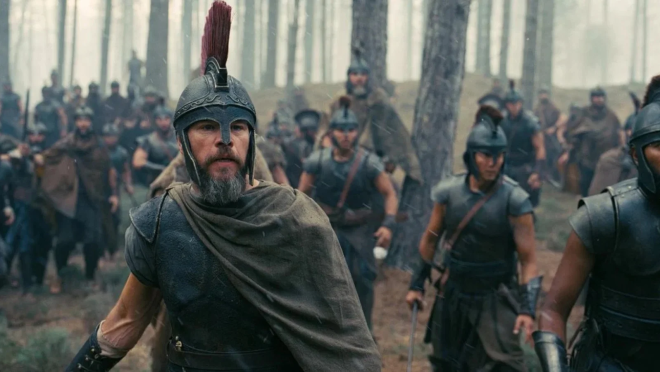
With The Odyssey, Nolan turns to perhaps the oldest surviving story in Western literature and discovers something surprisingly intimate. Rather than delivering a straightforward mythological blockbuster, he crafts a staggering meditation on war, trauma, sacrifice, and the impossibility of returning home as the same person.
The film adapts Homer’s 3,000-year-old poem with remarkable confidence. The film follows Odysseus as he embarks on his arduous voyage back to Ithaca after the fall of Troy. Along the way, he encounters divine wrath, monstrous creatures, impossible temptations, and countless trials that transform what should have been a brief journey into an odyssey spanning years.
Yet to reduce Nolan’s film to a tale of monsters and adventure would be to misunderstand its ambitions. The islands, the battles, and the mythical encounters are merely the surface. Beneath them lies the story of a man attempting to reconcile who he once was with who war has forced him to become.
Nolan has never been particularly interested in heroes. He is fascinated by damaged men navigating systems that no longer function for them. Odysseus fits seamlessly into that lineage.
This is not simply a fearless warrior outwitting monsters; it is a man repeatedly placed in environments where his greatest strengths become useless. In many ways, the perfect follow-up to Oppenheimer: centred on a damaged leader whose actions bring suffering upon many. Structurally, it feels very similar too. It’s considerably more restrained than I had imagined, spending a lot of time with Odysseus simply reflecting on the consequences; a grapple with guilt, which makes it more intimate.
Cinema at its most spectacular
Visually, The Odyssey may well be the most breathtaking film Nolan has ever directed.
His filmography has already taken audiences into dreams, black holes, collapsing cities, and the frozen beaches of Dunkirk. When I say this is the movie of the year, I mean it with complete sincerity.
In a time when filmmakers are increasingly relying on CGI to create scale and artificial props to recreate sets and elements, Christopher Nolan remains a rare filmmaker who still goes the extra mile to make the impossible feel real. He is obsessed with making sure that almost every moving element you see in the frame has been shot in a real location with real people.
The film was shot across Morocco, Greece, Italy, Iceland, and Scotland, and the sheer scale of the production is unbelievable. If you get the chance, watch the 22-minute behind-the-scenes documentary released on Disney+ Hotstar. It gives you a glimpse into the enormous challenges the team faced while bringing this ancient world to life.
From the towering palaces and the ships battling through treacherous waters to the mythical creatures Odysseus encounters, every detail feels carefully crafted. It is a sight to behold.
Cinematographer Hoyte van Hoytema, who has shot every Nolan film since Interstellar, goes all guns blazing again, alongside production designer Ruth De Jong.
The image of the Trojan Horse rising from the sea, the army storming Troy, and the chaos of the unforgiving ocean are moments that are jaw- dropping on the big screen. It honestly hurts that audiences in Bangladesh cannot experience this film in the full format and IMAX aspect ratio Nolan intended.
The night scenes are equally stunning. The flickering flames create an almost dreamlike realism. Faces appear and disappear through shifting shadows, while conversations unfold beneath the uncertain glow of firelight.
Monsters, Horror and Myth – The ‘Nolan’ touch
Every set-piece has an ineffable sense of scale. They feel gigantic, imposing, and absurdly ambitious.
Some of the film’s most striking moments, for me, were the horror-inspired sequences. They are genuinely frightening.
One of my favourite scenes takes place on the island of Aeaea, where Circe, played by Samantha Morton, turns Odysseus’ men into pigs. But she doesn’t present it as a simple spell. She says she is merely revealing them for who they truly are. And when she transforms them back into men, she tells them, “Go back into your disguises.” The implication is chilling. Their true selves are swine; being human is merely the mask.
It reminded me of Batman Begins, where Bruce Wayne is the disguise and Batman is the true identity. It’s a theme Nolan has explored before, but he executes it here with remarkable effectiveness. The practical effects, make-up, camerawork, and Samantha Morton’s mesmerising performance combine to create one of the film’s finest sequences. I genuinely wouldn’t be surprised if she earned an Academy Award nomination for Best Supporting Actress.
The depiction of the Cyclops is equally terrifying and guaranteed to leave your jaw on the floor. Moments like these only made me more excited by Nolan’s long-standing interest in directing a full-fledged horror film someday.
And the final act reminded me why I love going to the cinema in the first place.
Ludwig Göransson’s spellbinding score
Ludwig Göransson, fresh off his Academy Award win for Sinners, once again delivers outstanding work, arguably stepping further outside his musical comfort zone than ever before. Rather than embracing the predictable grandeur of a mythological blockbuster, he crafts a score built around ancient percussion and Bronze Age-inspired instrumentation. The rhythms gather momentum with precision, carrying each scene forward with mounting urgency.
The result is both majestic and deeply unsettling. Beneath the spectacle lies an unmistakable sense of dread, making many moments feel less like heroic adventure and more like ancient folklore whispered around a fire.
A cast worthy of the gods
On paper, the cast sounds almost surreal.
Jason Bourne, Batman, Spider-Man, Catwoman, The Punisher… and Travis Scott?
Matt Damon delivers arguably the finest performance of his career. Funnily enough, there must be a genre of its own of Matt Damon trying to return home after doing a “serious job”; it is officially a genre now. His Odysseus possesses none of the theatrical grandeur one might expect from Greek mythology. Damon plays him with quiet exhaustion. Anne Hathaway plays Penelope, Tom Holland is Telemachus, Robert Pattinson portrays Antinous, Zendaya takes on Athena, and Charlize Theron plays the sorceress Circe. The ensemble is rounded out by Lupita Nyong’o, Jon Bernthal, Benny Safdie, John Leguizamo, Himesh Patel, Will Yun Lee, Mia Goth, Jimmy Gonzales, and Elliot Page.
I have read that in Homer’s poem, Penelope is defined largely through patience. Nolan expands that characterisation considerably. Hathaway portrays a queen carrying the impossible burden of hope. Years of uncertainty have not simply aged her; they have reshaped her. She governs a kingdom slowly falling apart while refusing to surrender faith in a husband everyone else believes dead.
Many of the film’s most emotionally devastating moments belong entirely to Hathaway. Robert Pattinson as Antinous once again proves why he has become one of the most compelling actors working today.
Without revealing the specifics of his role, Pattinson injects an unpredictable energy whenever he appears on screen. There is an unsettling ambiguity to his performance, balancing charm with quiet menace in a way that keeps both Odysseus and the audience perpetually uncertain. Nolan has repeatedly demonstrated an ability to unlock unexpected dimensions within actors, and Pattinson benefits enormously from that collaboration.
The other supporting ensemble performs with similar conviction. Himesh Patel delivers another stellar performance as Eurylochus, Odysseus’ second-in-command, but the star whom I undoubtedly would crown with the film’s best performance is John Leguizamo.
Does the criticism hold up?
Many have said the casting choices and diction are not historically accurate. The controversy surrounding the film’s casting ultimately proves misplaced.
Lupita Nyong’o’s Helen of Troy became a lightning rod for debate, but the performance never disrupts the film’s dramatic integrity. Nolan never repurposes Homer’s epic as a vehicle for contemporary identity politics. The discourse surrounding it feels largely irrelevant upon watching the film itself.
Also, the controversy surrounding the “modernisation” of dialogue might seem unfamiliar at first in a “mythological film”, but the presentation itself doesn’t feel eerie or awkward upon watching the film.
I mean, I absolutely loved The Odyssey. It comfortably ranks among my top four Christopher Nolan films. And without question, it is my favourite film of the year.
One line of dialogue beautifully encapsulates everything Nolan is trying to say:
“The power of sacrifice lies in the person making it.”
Perhaps that is why Homer’s story has endured for three millennia. And perhaps that is why Christopher Nolan was always the filmmaker destined to tell it.
Don’t just watch The Odyssey. Experience it. It’s a 5/5 for me.