You are not reading this in a newspaper and that is exactly the point
The Paper is a show about the death of print. You are watching it on a screen. Greg Daniels knew what he was doing.
You are not reading this in a newspaper and that is exactly the point
The Paper is a show about the death of print. You are watching it on a screen. Greg Daniels knew what he was doing.
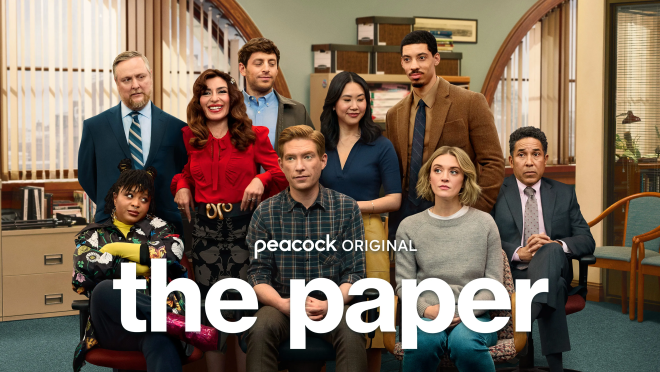
There is a joke buried inside The Paper that the show never explicitly makes, because it does not have to.
The joke is you. The joke is the way you found out about this show, probably a tweet, possibly a reel, almost certainly a notification on your phone at 11 pm while you were pretending to wind down. The joke is that you are now watching a mockumentary about a dying newspaper on a streaming service, likely on the same device you use to not read newspapers, and the show is aware of this, and it is not laughing at you, exactly, but it is noting the irony with the patient expression of someone who has been waiting for you to notice it too.
The Paper, which premiered on Peacock in September 2025, is a follow-up to The Office: same fictional documentary crew, different subject. Twenty years ago, that crew followed the employees of a paper company in Scranton. Now they have found the Toledo Truth Teller, a historic Midwestern newspaper trying to resurrect itself using volunteer reporters. The show was created by Greg Daniels and Michael Koman. It stars Domhnall Gleeson as the publisher trying to save an institution that the world has quietly agreed to let die.
The premise is, on its surface, about institutional decline. It is about a newsroom that cannot afford to pay its reporters in a media landscape that has collectively decided that information wants to be free and then been somewhat surprised by what it got for free. But the premise underneath the premise is about something more uncomfortable: the people who are still trying, sincerely, to do a thing the world has moved on from. The dignity of that, and the absurdity of it, and the way those two things are not as different as they might appear.
The Office sold paper. The Paper is about paper. The audience uses neither.
This is worth sitting with for a moment.
By 2005, when the show began, this was already mildly comedic as a premise. The paperless office had been a cultural expectation for at least a decade. The sadness underneath the comedy came largely from watching people build their entire identities around something that the world was politely phasing out.
The Paper takes this logic one step further and applies it to the thing that paper, at its most culturally significant, was actually for: journalism. The Truth Teller is not just a dying business. It is a dying idea, the idea that a community has something called a local newspaper, that this newspaper employs people whose job is to know things about the place you live, and that this constitutes a public good worth sustaining.
Local journalism has been disappearing for twenty years. The statistics on this, if you were to read them, are genuinely alarming. You would have to read them, though, which means you would have to be somewhere that still has a publication to print them. Fewer places do.
What the mockumentary format does to this story
The Office invented, or at least perfected, a specific grammar of television comedy: the documentary crew as witness, the talking head as confession, and the gap between what characters say to the camera and what they do in front of it as the primary source of both humour and pathos.
It is the kind of structural irony that Daniels does not overexplain. He just builds it into the architecture and trusts that you will feel it.
The specific irony of streaming a show about print
The Truth Teller, in the show, is trying to survive by recruiting volunteer reporters. This is, in the real world, what local newspapers have actually started doing. It is not satire. It is documentation.
The show is funnier than it sounds. Gleeson is doing something genuinely interesting, a man who believes in something unfashionable with the particular quiet desperation of someone who cannot stop believing in it even when every indicator suggests he should. The ensemble is warm.
But the irony does not leave you alone while you watch it. Every time the Truth Teller runs a story that nobody reads, every time a reporter goes door to door to gather quotes for a piece that will be lucky to get two hundred clicks.
The argument is that this still matters.
You are watching it on your phone. You probably are not subscribed to your local newspaper. Neither am I. This is what the show is about, and the show knows that you know it, and it is too polite to say so directly.
It does not need to.